
Arizona Eagle Mining Company (TSXV: asthma) (the “Company” or “Arizona Eagle”) is pleased to announce that it has entered into agreements to acquire 62 acres of patented land hosting three previously producing high-grade silver mines: Arizona National Mine, Lookout Mine and Silver Belt Mine (the “Silver Parcels”). These blocks are located at a damaged site approximately one kilometer northeast of the company’s Maccabi gold and silver mine, where Phase 1 drilling is currently underway.
Kevin Reid, CEO of Arizona Eagle, commented:
“We are pleased to announce the strategic acquisition of three previously producing high-grade silver mines, enhancing the Eagle Silver Project, located just 1 km northeast of the Maccabi Gold and Silver Mine. These high-grade silver mines served as major sources of silver production in Arizona until the 1930s. Mining operations at that time were limited to relatively shallow oxidation depths, with the deepest shaft reaching only 150 metres, providing the opportunity for further discoveries. At depth, these mines were privately owned by multiple parties and were Inactive for nearly 100 years our recent surface sampling at the Eagle Silver property has shown grades up to 344 g/t silver, with samples from the Arizona National Mine tailings pile showing grades up to 861 g/t silver and 15.6 g/t gold.
“By applying the same strategy we use at the Maccabi gold and silver deposits, we see the opportunity to revitalize these mines through the application of modern exploration methods and systematic drilling, and we firmly believe that the Eagle Project offers exceptional discovery potential in one of Arizona’s most prolific historic gold and silver regions. These acquisitions expand the structural mining corridor northeast of Maccabi by 50%, from 3 km to 4.5 km, and will also increase the patented land holding 18%, from 348 to 410 acres Our Phase 1 drilling program, which is focused on the Maccabi mine structure but outside of the historic resource estimate, is currently underway and fully funded and we look forward to achieving results as we move forward on these very promising projects.
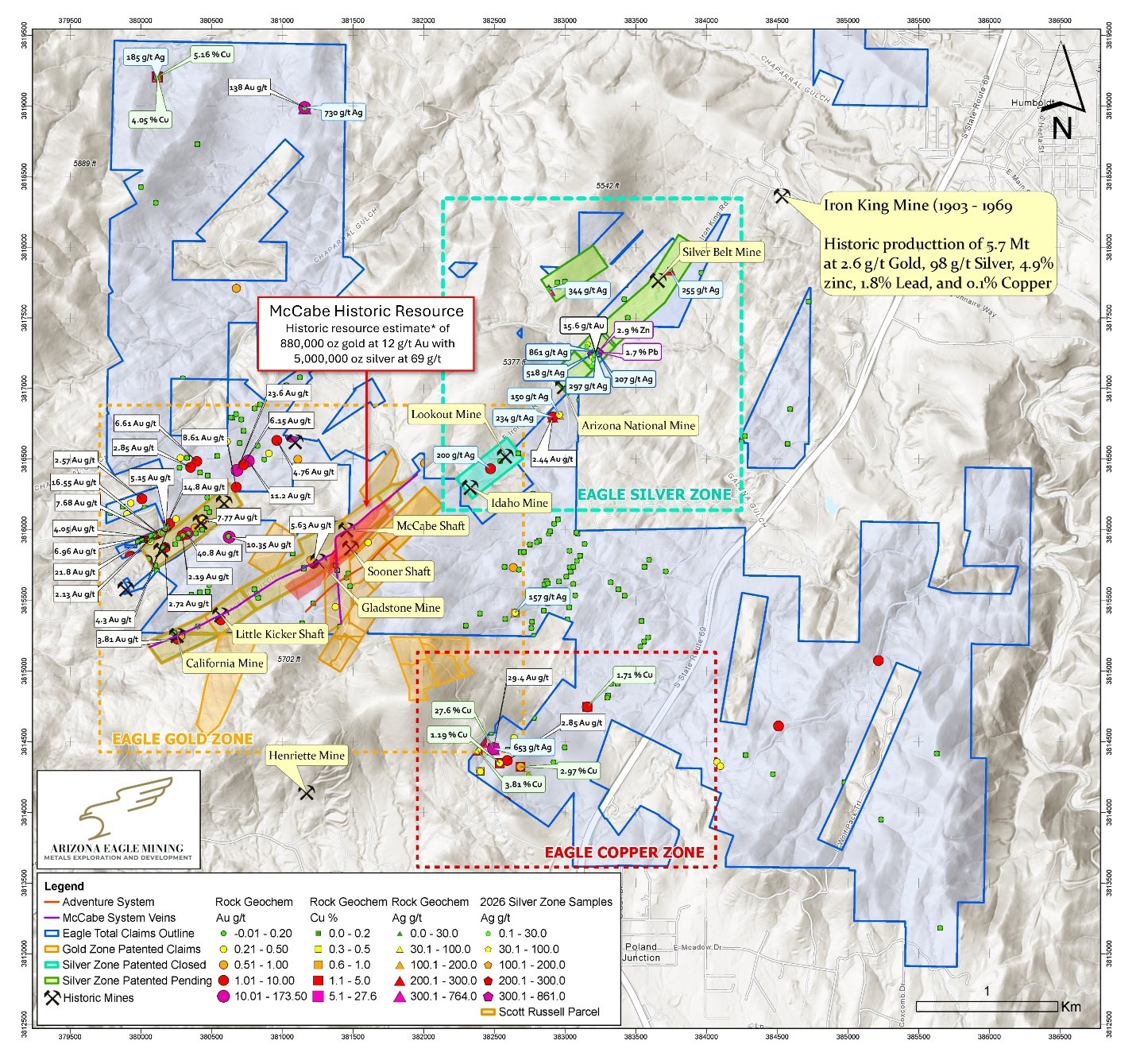
The silver parcel covers a metal structure about 1.5 kilometers long. Surface sampling on these claims by the Arizona Eagle (previously reported on February 19, 2025) returned silver grades including 344 g/t, 255 g/t and 234 g/t, as well as 2.4 g/t gold. Recent testing of tailings dumps in the first quarter of 2026 adjacent to the Arizona National Mine mine included a sample that returned a grade of 861 g/t silver, 2.9% zinc, 1.7% lead, and 0.2 g/t gold. The second sample returned 518 g/t silver with 1.3% zinc. A third sample returned 15.6 g/t gold, 297 g/t silver and 1.5% zinc (see Table 1 below for waste pile samples).
Arizona Eagle has entered into agreements with the owners of the Silver Parcels to acquire five parcels totaling 62 acres of patented land. The acquisitions are expected to close between June 19 and June 30, 2026, subject to completion of due diligence by the company.

Figure 1. Eagle Silver District showing Arizona National Mines, Lookout, and Silver Belt

Figure 2. Outline the results of surface sampling completed by Arizona Eagle at the Silver Eagle Project

Figure 3. Long section showing drilling targets in the Eagle Gold zone (3 km from strike), with the Eagle Silver zone extending to the northeast (1.5 km from strike).
Arizona National Mine
The Arizona National Mine consists of three shafts and seven levels at a depth of 500 feet (150 m). The deposit was excavated intermittently between 1915 and 1931 and shipments of silver lead ore and concentrates were reported (Anderson, 1958).1).

Figure 4. Long section of the Arizona National Mine showing 7 levels to a depth of 500 feet
Recent sampling in February 2026 of the Arizona National Mine tailings pile conducted by the company returned several high-grade silver, gold and zinc samples (see Table 1 below).
Table 1: Arizona National Mine Waste Pile Sample Results

Mine lookout
This observation mine is located on the Silver Belt Road, about 1,000 feet southwest of the Arizona National Mine. The mine was last operated from 1948 to 1949, and production was reported to consist mainly of galena (lead sulphide), sphalerite (zinc sulphide) and gold (Anderson, 1958).1).
Silver Belt Mine
The Silver Belt Mine was discovered in the 1880s and mined until the 1930s. The mine includes four shafts and at least four underground levels. These deposits were mined to a depth of only 250 feet (80 m), with grades up to 20 ounces per ton of silver (600 g/t), with 3% lead, 4% zinc and minor gold (Anderson, 1958).1).

Figure 5. Long section of the Silver Belt Mine, which ceased production in 1949

Figure 6. 1890 photo of the Silver Belt Mine that operated until the 1930s
Eagle Project Overview
Arizona Eagle owns a 100% interest in the Eagle Project, located in Yavapai County, Arizona. The Eagle project is based on the gold and silver producing Maccabi mine, which is located on 348 acres of private land. Stan West Mining has historically invested more than US$35 million (about $110 million CAD in today’s dollars) to drill and develop the mine. In 1984, Stan West Mining published a historical estimate of approximately 878,000 ounces of gold grading 11.7 g/t and 5 million ounces of silver grading 69 g/t.2 It is defined to a maximum depth of about 440 meters and is open in all directions.
Over the past two years, Arizona Eagle has expanded its total acreage to 4,169 acres through acquisitions and acquisitions surrounding the McCabe Mine. During this time, the company completed exploration programs focused on geological mapping, surface sampling, helicopter-borne VTEM surveys, and ground-based induced polarization surveys that identified numerous parallel mineral structures that had not historically been drilled.
First phase drilling programme
In the first quarter of 2026, the company began a fully funded first-stage drilling program with a total length of approximately 4,500 metres. The drilling program is designed in part to explore the lateral and vertical continuity of the McCabe veins in and around the historic resource. The drilling program is expected to conclude in June 2026. Core samples from the initial drill holes have been submitted for laboratory analysis, with analysis results awaited. The Eagle Project’s second core drilling rig is scheduled to be mobilized in July 2026 for further drilling at both the Maccabi Mine and the Eagle Silver Project.
About Arizona Eagle Mining Company
Arizona Eagle is a mineral exploration company focused on the acquisition, exploration and development of mineral properties. Arizona Eagle’s principal asset is the Eagle Project, a 4,169-acre property consisting of patented and unpatented claims located near the town of Prescott Valley in Yavapai County, Arizona. The Eagle Project centers around the once productive Maccabi Mine, a high-grade gold and silver deposit, and includes several parallel structures that host past productive mines that are largely untested by modern drilling. While Arizona Eagle’s primary focus will be on exploration and development of the Eagle Project, it will continue to own the Core Nickel land portfolio in the Thompson Nickel Belt in northern Manitoba.
The scientific and technical information contained in this press release has been reviewed and approved by Clyde Smith, Ph.D., Vice President of the Company’s Exploration Division, a qualified person as defined under National Instrument 43-101 – Disclosure standards for mineral projects.
Cautionary statement regarding forward-looking statements
This press release contains forward-looking statements and forward-looking information (collectively “forward-looking statements”) within the meaning of applicable securities laws. Any statements contained in this press release that are not statements of historical fact may be deemed forward-looking statements. Forward-looking statements are often identified by terms such as “may,” “should,” “expects,” “will,” “estimates,” “believes,” “intends,” “expects” and similar expressions intended to identify forward-looking statements. More specifically and without limitation, this press release contains forward-looking statements, including statements regarding the proposed acquisition of the Silver Parcels and the expected closing thereof, the consolidation of the Eagle Silver Project, the Company’s exploration activities and drilling program at the Eagle Project, the expected timing and receipt of assay results, the mobilization of additional drilling rigs, and the potential expansion of historical estimate. Forward-looking statements are inherently uncertain, and actual performance may be affected by a number of material factors, assumptions and expectations, many of which are beyond the Company’s control, including expectations and assumptions regarding the Company’s ability to complete the silver parcel acquisition on the proposed terms or at all, including the completion of satisfactory due diligence, the timely receipt of all required regulatory approvals, including TSXV approval, the Company’s ability to obtain clear title to the silver parcels, and the Company’s ability to execute the proposed exploration program at the Project. eagle, commodity price fluctuations, availability of financing on acceptable terms, environmental and permissible risks, and risks inherent in mineral exploration and development. Readers are cautioned that the assumptions used in preparing any forward-looking statements may prove to be incorrect. Events or conditions may cause actual results to differ materially from those anticipated as a result of numerous known and unknown risks, uncertainties and other factors, many of which are beyond the Company’s control. Readers are also cautioned not to place undue reliance on any forward-looking statements, as such information, although considered reasonable by management of the Company at the time of preparation, may prove to be incorrect and actual results may differ materially from those anticipated. The forward-looking statements contained in this news release are made as of the date of this news release and are expressly qualified by the foregoing cautionary statement. Except as expressly required by securities law, the Company undertakes no obligation to publicly update or revise any included forward-looking statements, whether as a result of new information, future events or otherwise.
This press release does not constitute an offer to sell or the solicitation of an offer to buy the securities described herein in the United States or in any other jurisdiction, nor shall there be any sale of the securities in any jurisdiction in which such offer, solicitation or sale would be unlawful. The securities have not been and will not be registered under the U.S. Securities Act, or any state securities laws, and therefore may not be offered or sold in the United States except in accordance with the registration requirements of the U.S. Securities Act and applicable state securities laws or pursuant to exemptions therefrom.
Neither the TSX Venture Exchange nor its Regulation Services Provider (as that term is defined in the policies of the TSX Venture Exchange) accepts responsibility for the adequacy or accuracy of this press release. No stock exchange, securities commission or other regulatory authority has approved or disapproved the information contained herein.
1 Anderson, CA and Cressey, SC 1958. Geology and ore deposits of the Jerome District, Yavapai County, Arizona. Arizona Geological Survey Professional Paper 308. United States Department of the Interior
2 The historical estimate of the McCabe deposit is unclassified and pre-dates, and is not consistent with, current NI 43-101 standards; It is based on the 1984 “Total Reserve Estimate” by Stan West Mining Company. The Company’s qualified person has not done significant work to classify the historical estimate as current mineral resources or current mineral reserves. Significant data collection, re-excavation, re-sampling, and data verification by a qualified person may be required before the historic resource can be verified and upgraded to comply with current NI 43-101 standards.



