
Dover, Delaware, April 22, 2026, FinanceWire
Alpha market flow Released Results Highlighting the challenge facing the prop trading industry: Newer companies struggle to compile Trustpilot reviews. Their data suggest that structural shifts in audit verification processes may contribute to this challenge.
Prop trade The industry grew In a $20 billion global market, where more than 2,000 companies compete for traders’ trust. Especially in an industry full of missed payments and untrustworthy support companies, gaining trust is more difficult than ever.
Across many conversations in the prop trading space, the same frustration kept coming up about something less controllable: Trustpilot reviews.
For newer companies, this has become an operational challenge.
In an industry where third-party platforms influence perception more than brand messaging, Trustpilot has become a critical infrastructure. A wave of negative reviews can damage credibility overnight. But a lack of reviews can be just as harmful.
While established companies continue to accumulate thousands of reviews, many newcomers struggle to build even a fraction of that vision.
At first, the explanation seemed obvious. Smaller user base. Less time on the market.
But patterns show that this is not the case anymore.
Are the new companies at an early stage in their journey, or are they entering a radically changed system?
From observation to hypothesis
Alpha market flowa PR agency that specializes in support companies, began looking at this more closely.
Across many new companies, Trustpilot’s review growth has seemed slow and, often, completely stalled.
The initial assumption was that newer companies have fewer customers and thus generate fewer reviews.
But this explanation did not quite correspond to what Alpha market flow Notice.
This led to a more focused hypothesis: Do newer support companies experience friction in compiling Trustpilot reviews beyond time in market?
More specifically, Trustpilot’s sophisticated review verification system, in particular Artificial intelligence-based labeling Processes, do they limit the rate at which reviews stay published?
Alpha Market Flow customers noted that while reviewers could initially provide organic reviews via Trustpilot, those reviews were later removed from the platform. After removal, you’ll receive an email from Trustpilot’s content integrity team asking the reviewer to provide proof of their engagement for the review to be reinstated.
This led to a revised hypothesis.
If users are required to complete verification steps after submitting their review – such as providing proof of purchase – a portion of reviews will not be returned. Over time, this reduces the number of reviews.
To test this, Alpha market flow It analyzed 54 supporting businesses and over 235,000 Trustpilot reviews primarily from April 2025 to April 2026.
Clear pattern, but not the full picture
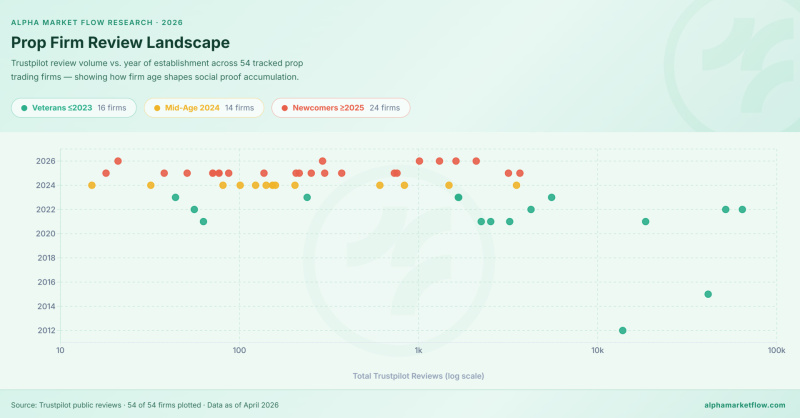
Across the data set, long-established companies consistently conducted thousands of reviews, with an average of over 30,000 reviews. In contrast, most newer companies remained below a few hundred.
For traders comparing companies, the difference between 30,000 reviews and 250 reviews directly shapes perception.
This disparity creates a structural challenge.
If visibility is driven by review volume, and review growth is not evenly distributed, newer companies operate at a disadvantage from the start.
However, when Alpha market flow Looking beyond the total number of reviews and examining cumulative growth patterns, a different dynamic emerged.
Impact of the growth era
One of the most surprising insights from the data is that review growth is strongly influenced by timing.
Companies launched between 2021 and 2023 entered the market during a period of rapid industrial expansion. User demand has increased, engagement has increased, and reviews have become easier to accumulate.
This suggests that audit growth is not just a function of duration in the market, but also when the firm enters the market.
This helps explain part of the gap. But if timing played such a key role in the past, what has changed for companies launching today?
Exceptions that challenge the rule
If timing were the only factor, the conclusion would be simple.
but Alpha market flow The results complicate this narrative.
Within the same group of newer companies, some were growing at a pace that belied the broader trend.
This suggests that rapid review backlog is still possible. But not universally.
Factors such as existing user bases and effective engagement strategies are likely to play a role. It is also possible that platform-level dynamics do not apply uniformly across companies.
The result is a system that is not quite constrained, but not quite flat either.
“Dead track” pattern.
While some companies grow quickly, others start strong, gather early reviews, and show initial momentum. Then growth slows or almost stops.
One plausible explanation lies in the review publishing process itself.
If users are required to complete additional verification steps after submitting the initial review, it is inevitable that a portion of reviews will be dropped.
For newer companies, it can be difficult to recover from a loss of momentum.
 Not all new businesses are created equal
One of the clearest findings is the variation among newer companies.
There are a few companies that collect thousands of reviews within their first year, while most stay below 50.
This gap is too wide to be explained by duration alone.
Instead, review growth appears to depend on a combination of factors, including acquisition strategy, brand positioning, and user engagement.
This suggests that structural friction may exist, but it does not affect all companies equally. It has been overtaken by a select few new companies; While most newer companies struggle.
Final insight
Alpha market flow The data suggest that newer companies are at a disadvantage, but not in an absolute way. Clearly, established companies benefit from scale and momentum.
Whereas today’s newer companies seem to operate in a more complex environment.
Therefore, newer companies may face friction in collecting Trustpilot reviews, especially as verification processes evolve, unless they have robust demand or engagement strategies.
As platform-level systems continue to evolve, understanding these dynamics will become increasingly important for supporting companies.
About Alpha Market Flow
Alpha market flow is a public relations agency that specializes in helping fintech companies measure and improve their public perception. They provide companies with actionable insights into how their stakeholders view them, enabling informed decisions to be made for long-term success.
communication
Sunday Adinkan
Alpha market flow
(email protected)



