
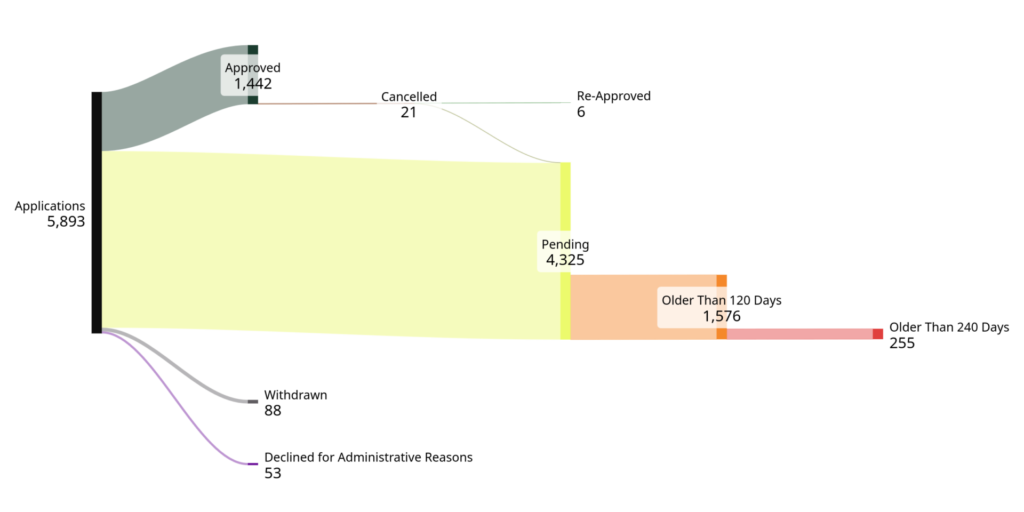
Association of Mineral Exploration (AME) Calls for immediate government action to reform British Columbia’s faltering mineral claims approval system as the first anniversary of the Mineral Claims Consultation Framework approaches. New data shows that the average processing time for mineral claims has risen to 143 days, far exceeding the government’s promised service standard of 90 to 120 days.
When applications were still awaiting approval, only 14.8 percent of applications received decisions within the target timeline of 120 days. The delays have created serious concerns for exploration companies preparing for the 2026 summer field season. Many claims filed between November and January waited three months before being distributed to First Nations for consultation, despite government promises to send out applications monthly.
BC’s mineral claims consultation framework emerged from a 2018 BC Court of Appeal decision that found the province’s previous “free entry” mineral quota system violated its constitutional duty to consult with First Nations before approving mineral claims on their traditional lands. The court ruled in Yahi v. British Columbia That the government must engage with Indigenous communities before granting mineral tenure rights, effectively ending a decades-old system where prospectors can obtain claims first and address First Nations concerns later.
The new framework now requires government consultation with affected First Nations before any mineral claims are approved, creating a bottleneck that has dramatically slowed the approval process from what was previously an instant online system to the current average wait times of 143 days.
This shift has fundamentally changed how mineral exploration operates in British Columbia, forcing companies to reckon with long delays in approval timelines for their projects, and potentially pushing investment into jurisdictions with more predictable regulatory frameworks.
Explorers are concerned about missing a critical summer window
Darcy Viss, president of Tripoint Geological Services, described the real-life impact these delays are having on his business operations. “I have submitted 27 mineral claims since September 2025, and none have been approved yet. “I am concerned that I will not get the claims before the summer, which could impact my ability to access them to complete the work, especially those at high elevations where the summer season is short,” Viss said of the current state of the system.
Research by the Mineral Exploration Society reveals a steadily growing backlog that is outpacing the government’s ability to process applications. Some claims remain in the system after being mortgaged a full year ago, creating uncertainty for exploration companies trying to plan their programs.
Industry leader calls for immediate government action
AME President and CEO Todd Stone stressed that these delays undermine British Columbia’s position in the global minerals sector.
“There are still claims in the system that were placed a full year ago,” Stone said. “British Columbia can only assume its critical mineral leadership role on the global stage if claim servicing standards are met consistently, thus providing the project certainty needed.”
“Prompt consultation with First Nations must be prioritized with government taking a leadership role to assist First Nations with the capabilities necessary to achieve service standards. Government has an obligation to protect the honor of the Crown by consultation, but must also have a concurrent duty to the public interest and mineral explorers to ensure timely decisions are made.”
Budget funding provides the starting point
AME’s advocacy efforts resulted in the inclusion of $2 million annually in BC’s 2026 budget over three years to assist staff and operate the consultation framework system. However, the organization believes that more immediate action is needed to address the current crisis.
“Ultimately, our members deserve a system that operates within a fixed timeline and set of rules,” Stone added. “If we want to capitalize on the current commodities cycle and explore the minerals we need for the future, we need the government to redouble its efforts to solve this problem today.”
The association warns that prolonged delays could drive exploration investment away from British Columbia due to the globally competitive nature of mineral exploration.
Suggested practical treatments
AME has developed several practical solutions to address system problems. The organization proposes removing applicants’ names until claims receive approval and escalating applications to higher levels after certain time thresholds. The association proposes allowing work completed during the application process to count toward claim requirements, which would help companies bridge delays caused by seasonal exploration windows. AME also recommends allowing businesses to voluntarily pause applications while engaging directly with First Nations, protecting their place in line while enabling early consultation.
Additional transparency measures include providing clearer status updates showing the time spent with each reviewing party and improving access to public data through submission dates and decision timelines. The organization also suggests that previously approved claims should not require additional counseling if they are later dropped and resubmitted.
Administrative issues dominate rejection
Existing data show that rejected requests relate primarily to administrative issues rather than consultation concerns. All rejections to date have involved technical issues such as the deletion of overlapping claims under the Mineral Tenure Act, with no applications rejected on consultation grounds. AME plans to release a comprehensive report in the coming weeks that includes detailed research on the performance of the new claims stacking system and additional recommendations for improvement.
The organization continues to emphasize that functional approval timelines are essential for British Columbia to compete in the global minerals market and support Canada’s critical minerals strategy.
More information is available at www.Amebc.ca/mineralsfortomorrow
Source link



