

Anthony Pompliano says that most of the cryptocurrency industry is already dead and that the market has not yet fully recognized it. In a May 6 video posted on
Pompliano said the reaction to his initial post on X was immediate and hostile. He wrote that “most of the cryptocurrency industry is dead and will never come back,” a message he said followed him through the consensus conference in Miami.
“I was called an idiot, told I was wrong, and I must have been asked over 50 times about the tweet while at the Consensus Crypto conference yesterday in Miami,” Pompliano said. “But after spending the day at the conference, I’m more convinced today than I was yesterday. Most of the cryptocurrency industry is dead and will never come back.”
Crypto ghost chains and zombie coins
Pompliano’s primary argument is based on what he sees as a broken business cycle within cryptocurrencies. In traditional industries, failing companies are closed, capital is redeployed, and talent moves toward stronger ideas. In the cryptocurrency space, this clearing mechanism rarely works because the blockchain can continue to operate with minimal involvement and tokens can remain well above zero even after liquidity and importance have evaporated, he said.
Related reading
He described the result as an ecosystem filled with “ghost chains” and “zombie coins.” Ghost chains These are networks that are still technically operational but have little useful activity. Zombie coins are tokens whose communities or markets have collapsed, while their remaining holders are often unable to exit without incurring massive losses.
“There are millions of coins, there are thousands of blockchains,” Pompliano said. “Just those two things alone make my original claim that most of the cryptocurrency industry is very accurate. Because you have to ask yourself: Does anyone actually believe that millions of cryptocurrencies will flourish in the future?”
Pompliano said he asked that question on the consensus platform and “literally no one raised their hands.”
Beyond dead networks and dead tokens, Pompliano argued that cryptocurrencies have lost much of the ideological conviction that once defined their early base. The industry, in his view, has turned from “hardcore evangelists” who It prioritized the success of Bitcoin And the basic technology towards the “mercenaries” chasing any trade offers the greatest financial reward.
This shift is evident in short-lived tokens, scam currencies, market manipulation, higher yield farming incentives, and product launches designed to attract more attention than benefit, he said. Pompliano’s criticism was not only directed at speculation, but at an industry culture that he believes has become disconnected from solving real user problems.
“If you have more mercenaries than evangelists, the broader cryptocurrency industry is now run by people who don’t understand or believe in the original vision of the industry,” he said. “As the saying goes, if you don’t stand for something, you’ll fall for anything. And I think that’s what happens across the industry.”
Wall Street is embracing cryptocurrencies
Pompliano also took issue with what he called “the investor class we hate,” pointing to online criticism of venture capital, big financial institutions, and regulation. He said investment firms funded much of the early infrastructure that allowed users to buy, store and send bitcoin, while large institutions have now become the dominant distribution layer for exposure to cryptocurrencies.
Morgan StanleyThe plan to launch Bitcoin trading through e-commerce was his central example. Noting that e-commerce has 8.6 million customers, Pompliano said Morgan Stanley intends to offer bitcoin trading with lower fees than Coinbase and Charles Schwab, using ZeroHash as the infrastructure. He framed this as a major “narrative breach” of the original crypto companies.
Meanwhile, Pompliano said local crypto businesses are moving in the opposite direction by adding stocks, prediction markets, options, commodities and other non-crypto products. The distinction between cryptocurrency platforms and traditional brokerage firms is becoming less clear.
Related reading
This convergence has also shaped his reading of Michael Saylor’s recent comments that the strategy can sell Bitcoin or Bitcoin derivatives to fund preferred dividends if doing so serves the company’s interests. Such an idea would have been treated as “blasphemy” years ago, but now looks more like a standard capital allocation within the Bitcoin financial business, Pompliano said.
The crypto industry is dying.
This is a good thing.
The resilient and valuable aspects of the industry need to compete on the bigger stage, not remain confined to a small industry with diminishing capital and talent. pic.twitter.com/TlVJAG6zFz
– Anthony Pompliano 🌪 (@APompliano) May 6, 2026
Crypto becomes finance
Pompliano said he continues to see significant value accumulating in four areas: bitcoin, stablecoins, infrastructure, and tokenization. His thesis is not that all cryptocurrencies disappear, but rather that the long tail of speculation disappears while the useful parts are absorbed into mainstream finance.
“We don’t need any more carnivals. We don’t need any more bullshit,” he said, referring to a “crypto carnival” booth he saw in unison. “We’re in competition with legacy financial companies that have a lot of money and very smart people. We need more people focused on building real things for real problems.”
At the time of publication, the total market cap of cryptocurrencies was $2.65 trillion.
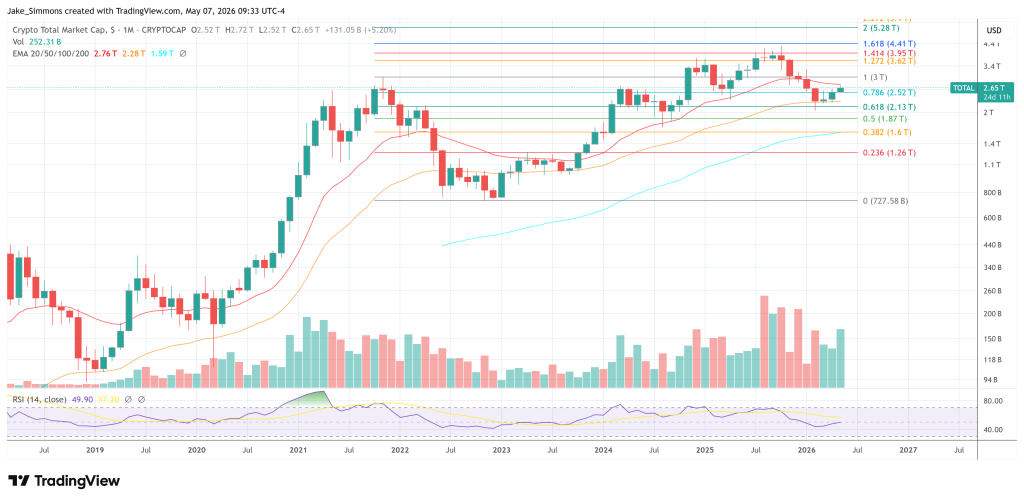
Featured image created with DALL.E, a chart from TradingView.com



