
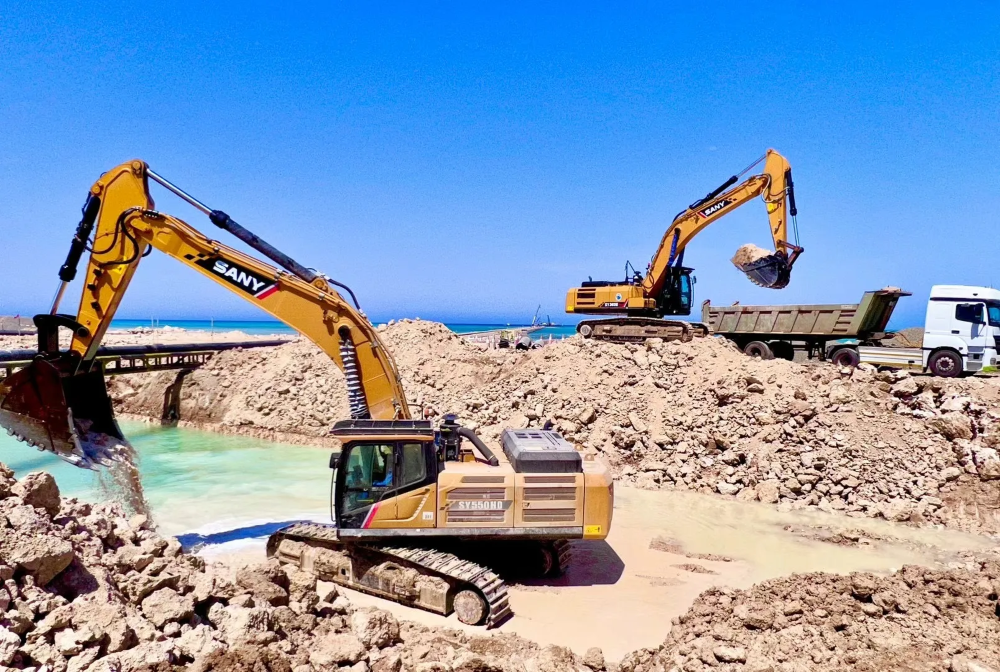
The Chinese manufacturer is advancing unmanned fleet operations while investing more than $800 million annually in robotics research
SANY Group has delivered its 1,000th electric excavator, marking a major milestone in the construction industry’s shift towards electrification and automation. The Chinese equipment manufacturer is now operating 5G remote-controlled excavators in commercial applications, has deployed fleets of unmanned paving rollers, and runs integrated smart solutions across ports and mining operations.
The company invests more than RMB6 billion annually in R&D as it transforms from a traditional manufacturing company into a robotics-focused, AI-enabled enterprise. This strategic shift addresses critical industry challenges while positioning SANY at the forefront of construction technology innovation.
The technology addresses safety and operational challenges
SANY views equipment upgrades as more than simple changes to the power supply. The company seeks comprehensive integration in electricity and intelligence that delivers lower emissions, higher efficiency and lower operating costs. Intelligence capabilities, especially remote control technology, address two fundamental problems in the industry: operator safety and the physical limitations of on-site machinery.
Traditional construction exposes workers to hazardous conditions through heavy reliance on on-site operators. Early remote control solutions created poor user experiences and suffered from unstable connections, which limited real-world scalability. SANY has invested nearly a decade in research and development to address these limitations.
The company has launched the SY550HD, a 5G remote-controlled excavator that combines low latency, high accuracy and intelligent safety features in a commercially viable package. This milestone represents years of engineering work focused on making remote operation practical for challenging construction environments.
Advanced 5G enables global remote operations
SANY has achieved stable latency of 120-140ms through 5G networks and AI algorithms, compared to a typical all-round latency of 120-180ms. This performance enables real-time control from distances up to 8,500 km while minimizing operational and command delay.
The SY550HD operates across public, private or hybrid networks, supporting remote operation across regions regardless of network infrastructure. This flexibility allows contractors to deploy equipment to remote locations while maintaining centralized operational control.
Sany’s 3D motion and depth sensing technologies work with the intelligent loading assistant system to recreate operating conditions on site. These systems provide operators with situational awareness equivalent to live machine operation. 3D spatial awareness allows operators to accurately assess complex environments and perform millimeter-level precision operations suitable for mines, remote field sites and emergency response scenarios.
AI-powered safety systems protect workers and equipment
Multi-dimensional sensors and AI algorithms create a millisecond-responsive digital protection system that includes personnel detection, intelligent collision avoidance and equipment health monitoring. The device autonomously collects point cloud data and live video to support environmental sensing, hazard identification and mission adaptation.
This creates an operating model where machines handle environmental perception, humans maintain operational control, and remote systems coordinate execution. This approach balances the benefits of automation and human oversight while maintaining operational flexibility across diverse construction applications.
SANY plans to increase R&D spending with focus areas including core electric powertrain components, AI-enabled operations, unmanned construction, digital platforms, and integrated mining equipment. The company aims to complement its smart product portfolio and expand commercial deployment on a large scale across multiple construction sectors.
This achievement reflects the industry’s broader momentum toward electrification and automation as construction companies look for solutions to labor shortages, safety concerns and operational efficiency requirements.
Source link



