
-
Circle’s Q1 2026 results were mixed with revenue reaching $694 million and USDC trading reaching $77 billion, but net income fell to $55 million and revenue fell short of expectations.
-
Arc Circle gives a path to monetization of network infrastructure, validator activity, and token ownership, potentially reducing reliance on interest income.
-
The Circle Payments network is also expanding, with annual transaction volume rising to $8.3 billion and other revenue jumping 101% year over year.
Circle Internet Financial has released its first-quarter earnings report for 2026. At first glance, the data suggests that the company is grappling with the gravity of a changing macro environment. However, beneath the surface of major revenue loss lies a strategic pivot that fundamentally rebrands Circle from a simple stablecoin issuer to a global, on-chain financial network.
The report, released on May 11, reveals a “mixed” performance that initially left market analysts scratching their heads. While USDC’s core business remains a source of liquidity, the emerging “Arc” ecosystem has suddenly become the most important variable in Circle’s valuation. As interest rates begin to slowly decline, putting pressure on the traditional “interest on reserves” model for stablecoin issuers, the company is leaning into the future of AI proxies, institutional settlement, and sovereign blockchain infrastructure.
Basic numbers
Department results for the first quarter It was a classic case of “good, but not good enough” for high expectations for 2026. Total revenue for the quarter was $694 million, representing a solid 20% increase year over year. However, this fell short of the market consensus of $720 million, sparking immediate debate about the durability of the current stablecoin revenue model.
The bottom line tells a more accurate story. GAAP net income for the quarter was $55 million, down a sharp 59% from the prior quarter. Adjusted EBITDA also felt the impact, falling to $151 million, down about 10% quarter-over-quarter despite a 24% increase from the same period last year. Interestingly, Circle managed to beat earnings per share (EPS), posting $0.21 versus a consensus of $0.17, although this is still below the more optimistic bull case forecast of $0.25.
The main cause of earnings pressure appears to be the interest rate cycle. As we move into the second quarter of 2026,…“Warsh transition” at the Federal Reserve It has created a more volatile rate environment. Circle’s reserve yield rate fell to 3.5%, down 30 basis points from Q4 2025. This decline reflects the broader decline in the collateralized overnight funding rate, proving that while USDC trading is growing — reaching a record $77 billion this quarter — it is currently a race against time to offset shrinking yields on those reserves.
The $3 billion ecosystem that changed the narrative
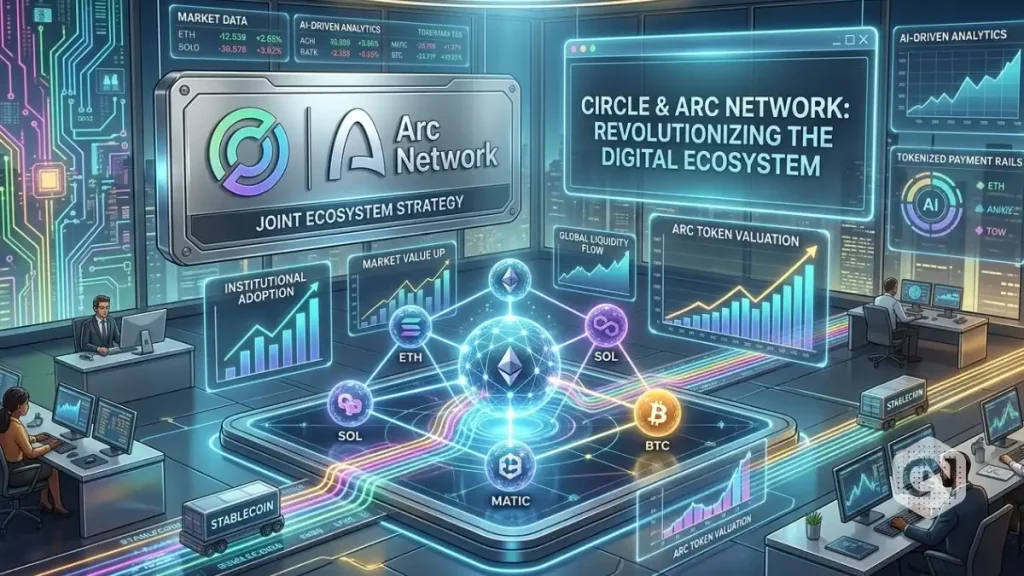
If the earnings report had focused solely on US dollar reserves, the market reaction would have been significantly more bearish. Instead, the focus has shifted entirely to the Arc Ecosystem, a newly unveiled stablecoin financial network. In a move that surprised many, Circle recently completed a $222 million institutional pre-sale of its ARC token, reaching a fully diluted valuation of $3 billion.
The list of investors reads like “personality names” in global finance, including a16z, BlackRock, ARK Invest, Apollo and Intercontinental Exchange (ICE). This high-level institutional support provides Circle with a new “valuation narrative” independent of interest rate fluctuations. Arc is designed to serve as the core plumbing for cross-chain financing, with USDC acting as the original gas and settlement asset.
According to White paper bowThe network features an initial supply of 10 billion tokens. Circle has strategically kept an allocation of 25% of these tokens on its balance sheet at no cost. For investors, this creates unprecedented “earnings elasticity”: As the Arc network gains traction, Circle can convert its token holdings directly into pure profit, effectively decoupling EBITDA from the whims of the Fed to raise or lower interest rates.
Diversification in work
While the Arc ecosystem is a long-term play, Circle’s “other revenue” segment provided a big highlight for the first quarter. This revenue stream, which includes payments and network services, jumped 101% year over year to $41.63 million. Although it still represents only approximately 6% of total revenue, it indicates that Circle is successfully monetizing its infrastructure.
The main driver of this growth is the Circular Payments Network (CPN), which has seen its annual transaction volume rise to $8.3 billion – an increase of 75% since the last report. Furthermore, the newly launched managed payments service allows traditional banks to access stablecoin settlement without the regulatory headache of holding digital assets directly on their books.
The department also leans heavily into the AI narrative. On May 11, the company announced the launch of the Circle Agent Stack, which includes developer tools such as the Circle CLI and “Agent Wallets.” The goal is to make USDC the primary settlement currency for AI agents, which are software entities that require high-frequency, low-friction machine-to-machine payments. By positioning USDC as the “currency of the AI economy,” Circle is building a moat that traditional banking rails cannot replicate.
All eyes on the Clarity Act
Beyond the balance sheet, Circle’s biggest tailwind remains legislative progress in Washington, D.C., and market expectations for the passage of the Clarity Act as soon as this month have become a major catalyst for investor sentiment. Final settlement regarding Section 404 of the Clarity Actwhich prohibits passive interest but protects active on-chain rewards, is seen as a net positive for the stablecoin issuer.
the Passing the Clarity Law It will provide the federal framework the department needs to fully integrate with the U.S. banking system. It would effectively give USDC the “official” status of a payment stablecoin, which could lead to a massive wave of institutional adoption. For Circle, it’s not just about organization; It’s about distribution rights. With clear federal licensing, Circle can legally deliver its products to every corporate locker and retail brokerage in the country, dramatically expanding its addressable market.
Read also: Ethereum price faces big test as BitMine approaches 5% ETH ownership



