
SpaceX’s IPO prospectus does something rare. It strips public investors of the right to fire the CEO. The same file warns that his departure may be existential.
The contradiction is structural, not accidental. The S-1 requires markets to fund a single founder. They are also asked to accept a pay package whose incentives exist only in expectations.
SpaceX’s IPO failed at one point
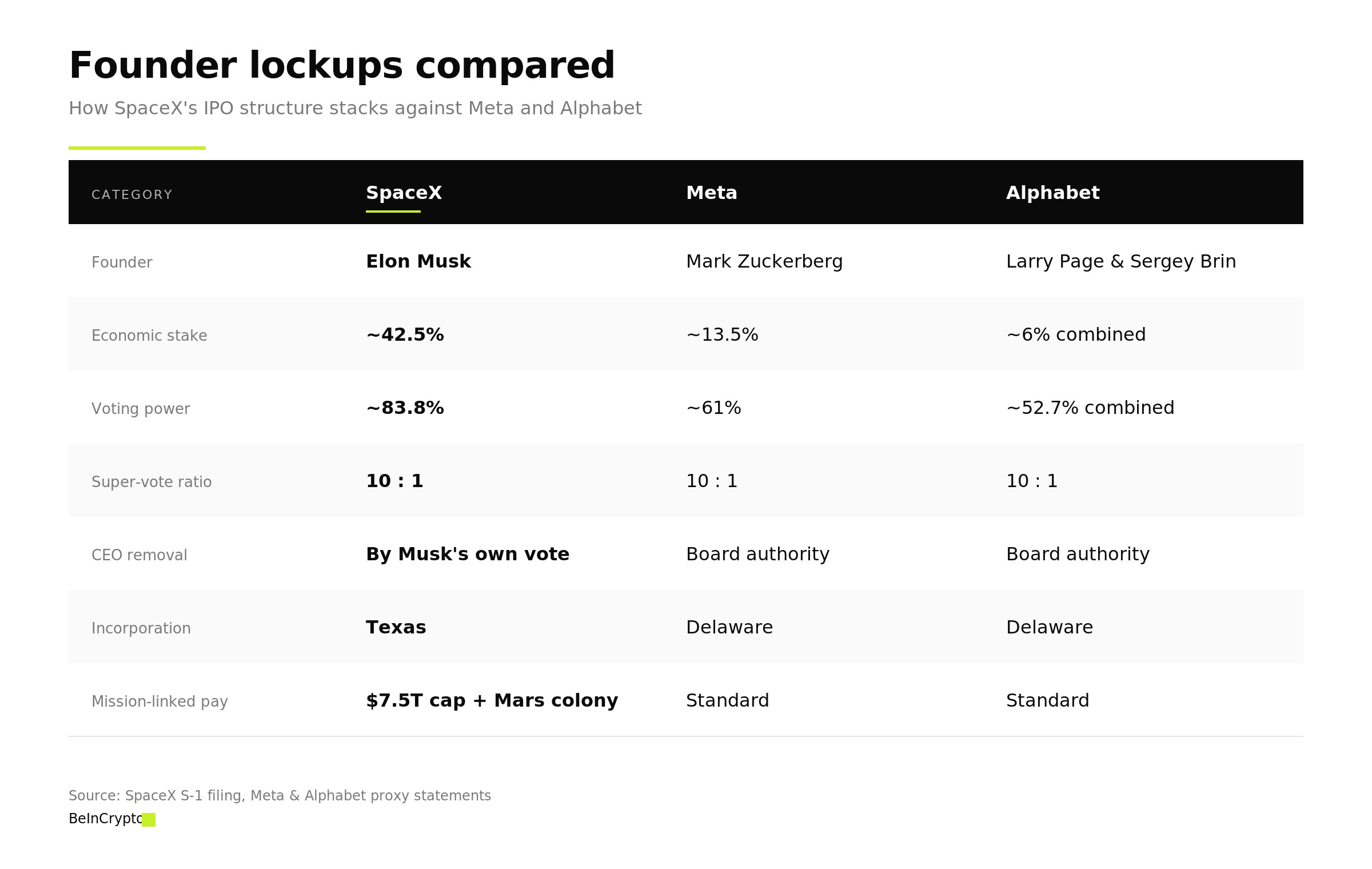
Musk owns about 42.5% of… SpaceX shares But 83.8% of voting power is through super-voting Class B shares. Removing S-1 states from their roles requires a Class B vote. He controls those votes directly.
Harvard Law Professor Lucian Bebchuk described this arrangement as “uncommon.” Councils usually retain formal removal power. The structure consolidates that power into Musk’s voting bloc, leaving autonomous veto power in place.
The filings cite Musk’s loss as a multi-page risk factor. They cite it Overlapping commitments in Tesla, xAI, X, Neuralink, and The Boring Company.
There is no organized framework for succession in place, and no representative is in a position to take over.
Corporate feudalism is returning to public markets
Texas incorporation, mandatory arbitration, and controlled company exemption, along with a 3% or $1 million minimum on shareholder proposals. The filing itself states that the influence of public shareholders will be limited or eliminated.
Pension fund officials have already responded. CalPERS, the New York State Comptroller, and the New York City Comptroller have signed a joint agreement letter.
They describe the Musk-led structure as a departure from accepted public company norms.
SpaceX says the structure protects long-term goals from short-term shareholder pressures.
This defense does not address the mechanisms of removal. Founder detentions at Meta and Alphabet look modest by comparison.

Mars’ $7.5 trillion mark is not a valuation
The main pay tranche gives Musk up to 200 million Class B shares. It will only vest if SpaceX reaches a market cap of $7.5 trillion. The same trigger requires permanent Mars A colony with a population of at least one million.
The threshold of $7.5 trillion exceeds the combined market value of Apple, Microsoft, and Saudi Aramco. The Mars Standard has no precedent, no predictable infrastructure, and no off-world regulatory framework.
Neither criterion is consistent with standard evaluation methods.
The second tranche awards up to 60.4 million shares for orbital data centers with 100 terawatts of computing power. The prize Reflects XAI’s ground-based artificial intelligence race. The S-1 acknowledges that such processes may not be commercially viable.
This is the price of single-point governance combined with speculative wage design. Investors are asked to fund a company they cannot influence and set price parameters that no model can estimate.
The only person who can fail a task is the person who is allowed to set it.
this post SpaceX’s $1.75 Trillion IPO Makes Elon Musk a Corporate Risk by One Point appeared first on BeInCrypto.



