
Bitcoin has remained below $70,000 through most of the first quarter of 2026. Prices appear weak on the surface, and many traders have turned bearish due to the short-term outlook. But a new analysis from XWIN Research, published on CryptoQuant Insights, says the real story lies beneath the price chart.
The Bitcoin market is not collapsing, but rather splitting into two very different camps.
Selling whales, corporate scoop
the Exchange ratio whalewhich tracks flows of large holders into exchanges, rose steadily during the quarter. When this metric rises, it usually indicates that large players are moving coins to sell. In a market with poor liquidity, this type of pressure can limit any attempt to rise above resistance.
However, corporate buyers do just the opposite. XWIN Research estimates that public companies added about 62,000 BTC on a net basis during the first quarter. strategyformerly known as MicroStrategy, led the charge by purchasing over 88,000 BTC alone. The company now owns approximately 762,000 bitcoins, funded through convertible bonds and stock offerings, according to Securities and Exchange Commission filings.
This is not a speculative purchase. The strategy raises capital and converts it into Bitcoin as a long-term treasury strategy. This creates a steady flow of demand that does not depend on whether prices rise or fall.
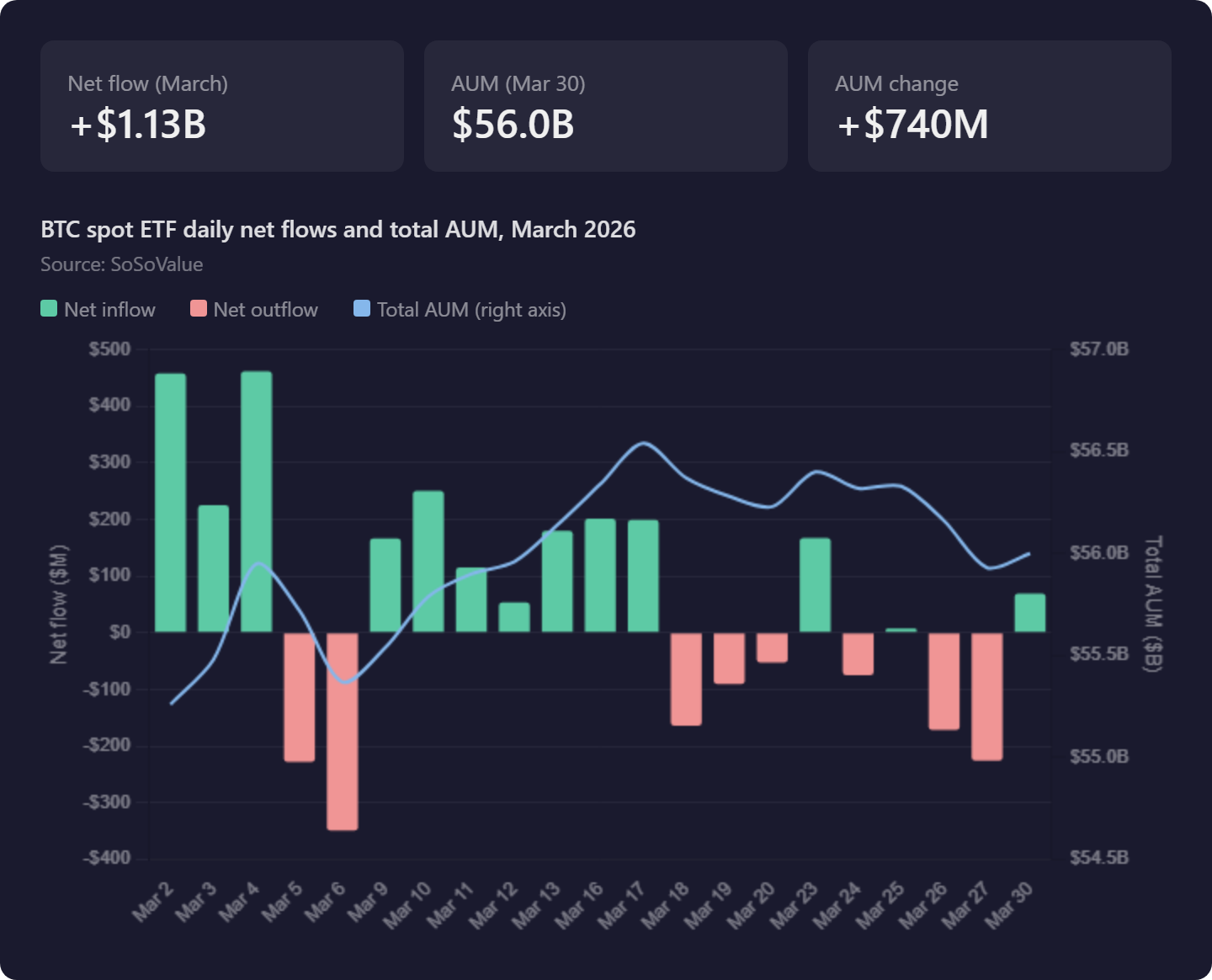
Meanwhile, spot inflows of Bitcoin ETFs tell a more complex story. BlackRock’s fund has attracted inflows, but Grayscale’s GBTC continues to lose assets. SoSoValue data shows that March inflows from ETFs swung wildly, from an increase of $458 million on March 2 to an outflow of $348 million just four days later. Total ETF assets under management barely moved, ending March at $56.00 billion, up from $55.26 billion initially.
This is a rotation between products, not new money flowing into the asset class as a whole.
What does this mean for the second question
XWIN research concluded that Bitcoin is not just weak. The market is in transition, splitting between short-term sellers and long-term accumulators.
Whale selling pressure kept prices below $70,000 for most of the quarter. But the strategy alone took in more than 88,000 Bitcoin during the same period, even as prices dropped. This type of continuous buying reshapes who holds the offer over time.
The ETF picture adds another layer of uncertainty. The shift from Grayscale to BlackRock looks like corporate activity, but it’s not new money. Until net flows return with conviction, ETFs will remain a neutral force rather than a bullish catalyst.
The real question for Q2 is whether corporate accumulation can withstand selling pressure long enough for broader demand to catch up.
In a broader sense, companies may become the new whales. Strategic corporations and other public companies now act as persistent buyers and beneficiaries with access to capital markets. They are replacing the original crypto whales that once dominated the dynamics of the show.
For those early holders, buying companies creates something of an IPO-style exit window. Long believers who accumulated Bitcoin at much lower prices now have firm institutional demand to sell. Supply doesn’t disappear, it moves from early adopters to corporate balance sheets at scale.
this post Bitcoin is not dying, it is changing, the analyst says appeared first on BeInCrypto.



