

Key takeaways
- Global bond yields rise Pressures on stock markets intensified as the 30-year US Treasury yield approached the critical 5.20% level, reinforcing fears that the Federal Reserve may shift toward future rate hikes rather than cuts.
- Markets are very focused on… Nvidia profitsas options markets point to a massive post-results valuation swing that could determine the near-term direction of AI-related stocks and the broader Nasdaq 100 index.
- Asia Pacific markets Markets were mixed on rising yields and currency pressure in today’s Asian opening session.
- Today’s chart: Gold (XAU/USD) A breakout down from the one-month range, with the next intermediate support eyed at $4,415 and $4,319.
Most important macro addresses
- Inflation fears fuel massive sell-off in global bonds: Wall Street fell on Tuesday for the third straight session as growing inflationary panic pushed long-term US bond yields to their highest levels since 2007. The 30-year US Treasury yield is approaching the critical threshold of 5.20%.
- Increasing pressure to raise interest rates on the Fed: The massive collapse in bonds reflects a structural shift in monetary policy expectations. US futures now point to a greater than 50% probability of a rate hike by the Federal Reserve later this year, effectively eliminating earlier hopes for a rate cut.
- Besant clarifies the hardline stance towards Iran: US Treasury Secretary Scott Besent called on global allies to forcefully disrupt Iranian financing networks. He announced a comprehensive review of the US sanctions list to make it easier for financial institutions to root out complex terrorist financing schemes. At the same time, oil markets saw a brief respite after J.D. Vance signaled progress in peace talks between the US and Iran, prompting President Trump to postpone the scheduled attack.
- Japan issues warnings about interference in the currency market: With the Japanese yen falling 159 yen to the US dollar towards the critical level of 160 yen, Finance Minister Satsuki Katayama issued a stern warning at the G7 meeting in Paris, indicating that Tokyo was fully prepared to intervene to defend the currency.
- NVIDIA Earnings Loom Amid Options-Based Volatility: Markets are gearing up for NVIDIA’s highly anticipated quarterly earnings report on Wednesday. Options data suggests the chipmaker is poised for a staggering $350 billion market cap price swing after the issue.
Key macro topics
- Sovereign Yields Storm vs. Technical Ratings: Higher bond yields lead to higher discount rates, which directly threatens the present value of future earnings of high-growth technology companies. This yield breakthrough comes at an incredibly vulnerable moment, with large scalers taking on record debt to fund an estimated $700 billion in AI capex this year.
- “Battle and anvil” scenarios for the central bank: Multi-year macro shocks push central banks into intense policy swaps. For example, tough UK employment data, which showed a 100,000 drop in payrolls for April, is in direct conflict with the impending hot inflation data due on Wednesday, leaving the Bank of England to choose between supporting growth and containing prices.
- Diminishing returns on foreign exchange intervention: Sources indicate that Japan has already allocated nearly 10 trillion yen since late April to defend its currency. The yen’s rapid reversal to 159 per US dollar confirms that massive interventionist capital is failing to buy central banks sustainable breathing room against the widening US yield advantage.
Global market impact
Stock: Wall Street fell, with the S&P 500 and Dow Jones down 0.7% and the Nasdaq down 0.8%. Shares of communications services and consumer discretionary goods topped the list of losers, down 1.3% to 2.3%.
Fixed income: Sovereign debt markets faced violent selling. The long end of the curve collapsed under the weight of inflation fears, pushing the US 30-year yield close to 5.20%, its highest level since 2007.
foreign currency: The US dollar index remained dominant. The Japanese yen fell beyond 159 against the US dollar to hit an intraday high of 159.25 on Tuesday, May 19, entering the risk zone of severe intervention. The Indian rupee fell further, hitting a record closing low for the sixth straight session to hit a record low of 96.52 per US dollar in the Asian opening session today.
Goods: WTI and Brent crude oil remained flat over the past 24 hours, posting gains of 1% on Tuesday, May 19. Non-yielding precious metals fell due to yield pressures, with spot gold down 1.8% and silver down 5%.
Asia-Pacific influence
- Regional stock bloodbath excluding Singapore: Stock markets in the Asia-Pacific region absorbed the severe shocks. South Korea’s Kospi suffered a harsh 3.3% sell-off on Tuesday, May 19, leading to regional losses as the tech-heavy index reacted to rising risk-free prices and structural weaknesses in the hardware supply chain. Meanwhile, the Straits Times Index in Singapore bucked the trend, rising 1.5% to a new record high, supported by defensive dividend stocks. However, rising bond yields led to profit taking today, with the STI down 0.7% on open and sharp losses seen by the Nikkei 225, down 1.2%, the ASX 200, down 0.8%, and the Hang Seng, down 0.6%. Meanwhile, the Kospi traded almost unchanged, and the China A50 rose 0.2%.
- Currency decline and intervention tensions: The broad rise in the US currency and global yields has put intense pressure on regional currencies. The Indian rupee’s multi-day record fall and the yen’s collapse to over 159 against the US dollar have raised the risk of cross-border capital flight.
The top 3 events to watch today
- UK CPI and PPI (April) – 2.00 pm GMT Impact: GBP/USD, GBP pairs, FTSE 100, UK bonds
- Minutes of the Federal Open Market Committee meeting – 2.00 am Impact: All asset classes
- NVIDIA Q1 earnings release – After the conclusion of the American session Impact: NVIDIA stocks, Nasdaq 100, S&P 500, semiconductor stocks, and AI-related stocks
Today’s Chart: Bearish breakdown of gold from a 1-month support level
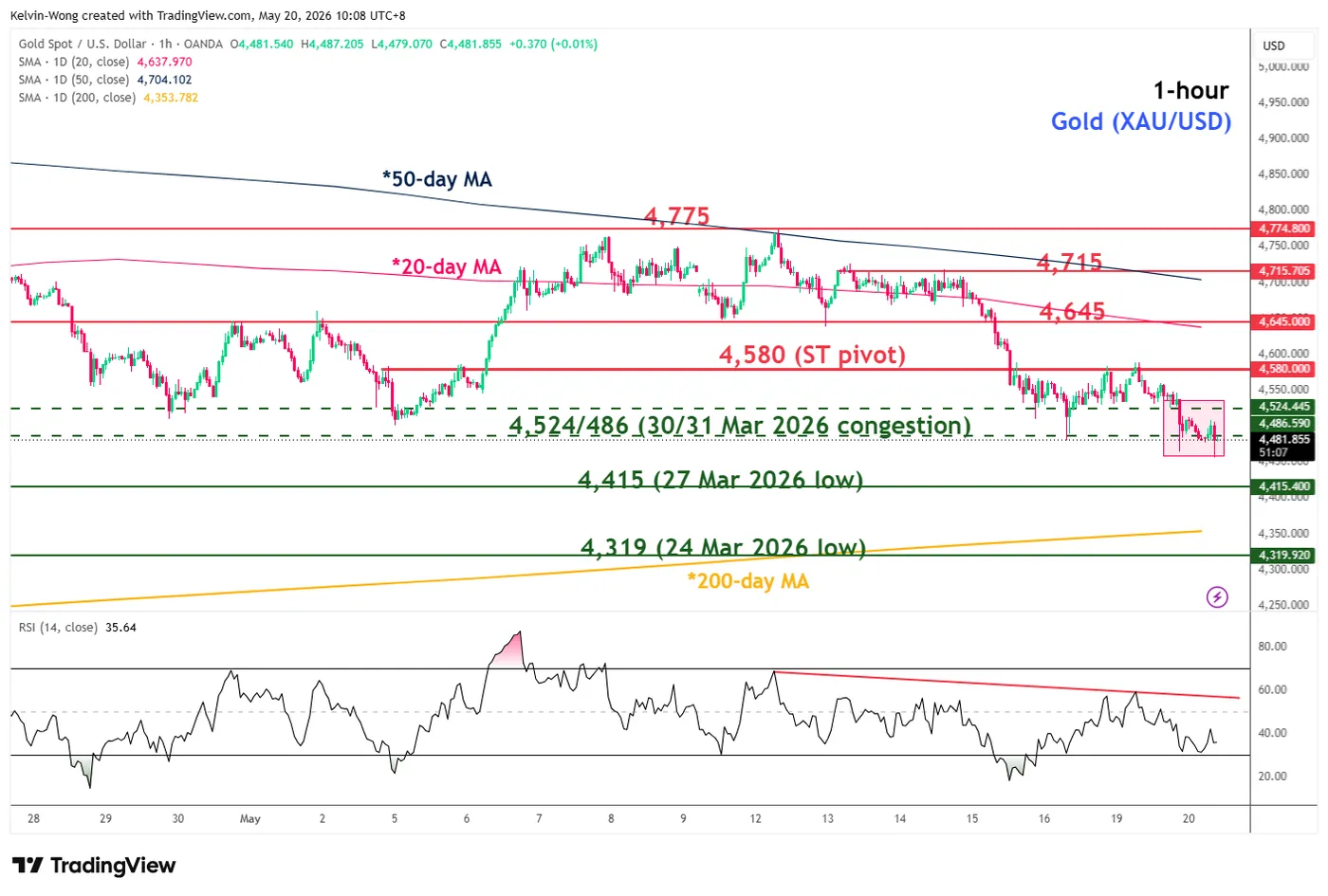
Figure 1: Secondary trend for gold (XAU/USD) as of May 20, 2026. Source: TradingView.
Gold (XAU/USD) saw a downside breakdown from its previous one-month range support at $4,486. In addition, the hourly RSI momentum indicator continued to show bearish momentum conditions below the 50 level.
a witness The major short-term pivot resistance level is at $4,580 To maintain the slight downtrend until the next intermediate support comes $4,415 and $4,319Also near the key 200-day moving average.
However, hourly clearance and close above $4,580 negates the bearish tone of a potential corrective rebound to retest the next intermediate resistance at $4,645 and $4,715As well as the 20-day and 50-day moving averages.



