
Key takeaways
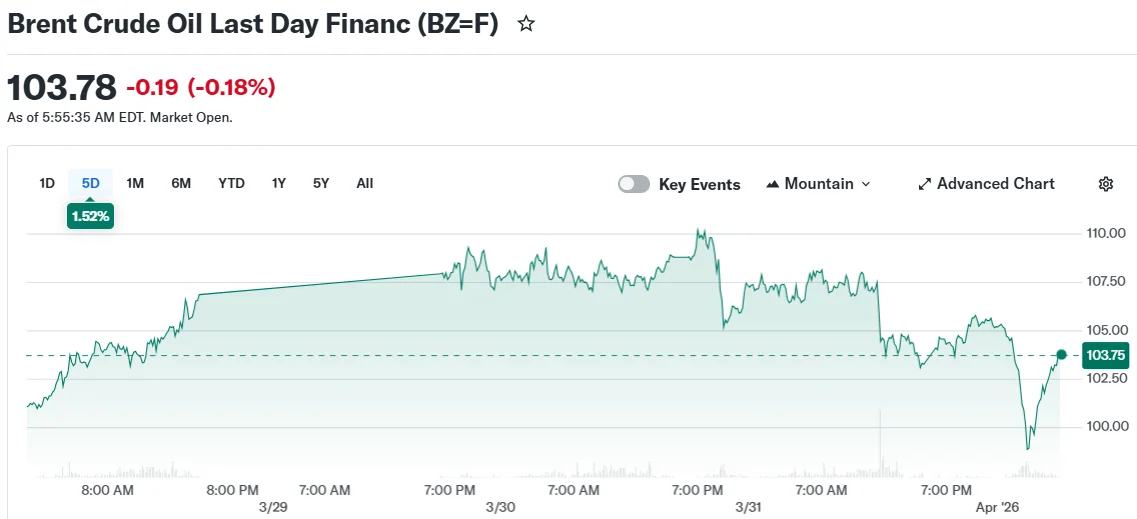
- Brent crude traded temporarily below $100 a barrel, down more than 5% before beginning a partial recovery.
- President Trump indicated that the United States may withdraw from Iran within two to three weeks
- Despite this decline, crude oil prices remain about 40% above pre-conflict levels since late February
- The Strait of Hormuz, responsible for transporting about a fifth of the world’s oil supplies, continues to face major disruptions
- US crude inventories rose by 10.26 million barrels in the previous week, significantly exceeding analysts’ expectations
Energy markets saw major turmoil on Wednesday after President Donald Trump signaled that the United States may end its involvement in the Iranian conflict within weeks, causing Brent crude to temporarily fall below the $100 per barrel threshold for the first time since the start of hostilities.
Brent crude oil witnessed a decline of more than 5% during its lowest levels during the session before recovering some losses. The index recently traded near $102.25 per barrel. Before the conflict erupted in late February, the price of Brent crude was hovering around $70 per barrel.
US West Texas Intermediate crude similarly fell, falling 2.4% to $98.92 per barrel.
Speaking to the press at the White House, Trump stated that America could leave Iran within “two to three weeks.” He also noted that Iran would not necessarily need to finalize a formal agreement to cease hostilities.
Iran’s presidential leadership indicated that the country possesses the “necessary will” to end the war on the condition that it receives guarantees against future attacks. Iranian Foreign Minister Abbas Araqchi admitted that contacts were taking place with the United States, although he stressed that there were no formal negotiations underway.
The president was scheduled to address the nation on Wednesday evening at 9 p.m. ET, with the White House calling it an “important update on Iran.”
Despite diplomatic discussions regarding de-escalation, military actions continued on Wednesday. An oil tanker was damaged near Qatar, causing a fire that was later extinguished. Officials did not report any environmental damage.
Factors that keep crude oil prices high
Oil prices Continuing to trade approximately 40% above pre-March levels. The Strait of Hormuz, a critical sea lane that facilitates nearly a fifth of global oil transport, has seen tanker traffic nearly halted due to fears of an Iranian attack.
The International Energy Agency described this disruption as the most severe supply shock in recorded history. Some markets witnessed fuel prices rising to exceed $200 per barrel. US gasoline prices topped $4 per gallon this week, the first such occurrence since August 2022.
Market analysts have warned that even partial restoration of Strait operations may take a long time. Trump stressed that US allies will need to contribute to securing the waterway. According to reports from the Wall Street Journal, the United Arab Emirates has called on Western and Asian countries to form an alliance aimed at reopening the corridor by force.
China and Pakistan issued a joint statement on Tuesday demanding the immediate cessation of hostilities and the restoration of safe maritime shipping.
Inventory data indicates weak consumption
Recent figures issued by the American Petroleum Institute revealed that US crude inventories expanded by 10.26 million barrels during the past week. This figure significantly exceeded expectations, with a decrease of 1.3 million barrels.
American Petroleum Institute President Mike Sommers stressed that reopening the Strait of Hormuz represents a “critical part” of stabilizing global markets, warning that prices will continue to rise without the restoration of shipping flows.
A third US aircraft carrier group is currently heading to the Middle East, keeping the possibility of further escalation alive.




