

short
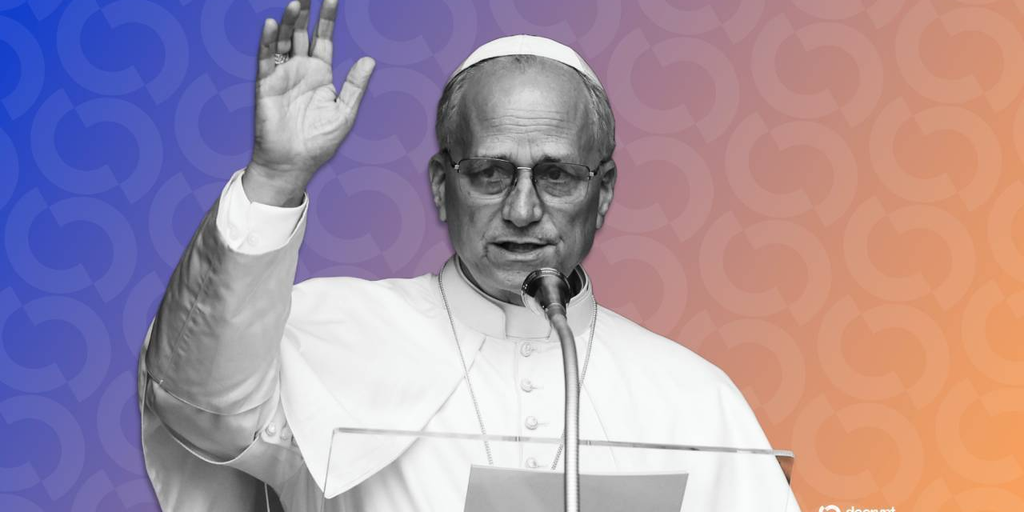
- Pope Leo XIV released “Magnifica Humanitas” on May 25, the first papal encyclical devoted entirely to artificial intelligence.
- The publication classifies algorithms, data and digital platforms as common goods that cannot remain under the control of a private monopoly.
- Christopher Olah, co-founder of Anthropologie, spoke at the Vatican launch and warned that large-scale AI-driven labor displacement would become a “moral imperative of historic proportions” that must be addressed.
Pope Leo
document, Wonderful humanity (“Splendid Humanity”), released in the Vatican Synod Hall on May 25. It was signed by Pope Leo 10 days ago, on May 15, on the 135th anniversary of Rerum Novarum — Pope Leo XIII’s 1891 encyclical on workers’ rights that became the foundation of modern Catholic social teaching.
Pope Leo has consistently portrayed artificial intelligence as the defining moral challenge of his papacy, comparing the coming social upheavals to the upheavals of the Industrial Revolution.
The thesis covers a lot of topics: artificial intelligence in war, dehumanization, technocracy, data colonization, children’s online safety, mass unemployment, disinformation, autonomous weapons, and even transhumanism. But the argument tying these things together is simple. Every algorithm reflects the priorities of the people who designed, funded, and deployed it. Building systems that pretend otherwise does not eliminate this bias, it only masks it.
Data belongs to everyone. Including yours.
Catholic social teaching has long maintained that the Earth’s natural resources are intended for all of humanity, not for private owners. Liu extends this principle directly to the digital economy. The encyclical argues that algorithms, platforms and data should be governed as common goods, not locked behind commercial walls by a few companies.
“Data is the product of many contributors and should not be treated as something that can be sold or entrusted to a select few,” the pope wrote.
The text also applies the principle of subsidiarity – the principle that decisions must be made at the most local level – to technology platforms specifically. The encyclical calls not only for top-down regulation; Advocate instead for transparent algorithms, independent community audits, and real legal power for people to challenge automated systems that affect their credit scores, job applications, or criminal risk assessments. Without this distributed oversight, Liu argues, AI governance becomes a form of digital tyranny that silences the populations it claims to serve.
The encyclical also takes aim at transhumanism – the idea that human limitations and weaknesses are flaws that need to be engineered away. Leo’s counter is that limitation is not a mistake. This is what makes empathy, moral judgment, and genuine care for others possible. Systems designed to improve do not produce better humans. They produce something that evaluates and excludes the vulnerable more efficiently.
The Pope is careful not to anthropomorphize this technology. AI systems, he writes in the Encyclical, “have no body, nor feel joy or pain.” The overall message suggests that AI systems lack the lived experience that produces true understanding. They can emulate empathy and produce persuasive language, but they do not understand what they are outputting.
This distinction is practically important. When an algorithm makes hiring decisions, determines credit terms, or determines the degree of risk in a courtroom, its apparent objectivity obscures the choices made by its designers. The encyclical warns in particular against delegating sensitive decisions to automated systems that “do not know mercy, compassion or forgiveness” and against treating an outcome as neutral simply because a machine produced it.
Anthropy was there
The person who shared the stage with Liu on Monday attracted as much attention as the doc itself. Christopher Olah — co-founder of Anthropic and head of the Interpretability Research Team — spoke at the presentation in the Synod Hall alongside two Vatican cardinals and a pair of theologians.
like Decryption I mentioned When Leo was elected, the pope framed artificial intelligence as the central moral issue of his papacy from his first address to the cardinals. The encyclical issued on Monday is the official doctrinal version of this commitment.
Olah used the occasion to say bluntly what most AI executives avoid: that every major laboratory “operates within a set of incentives and constraints that can sometimes interfere with doing the right thing,” and that external scrutiny — from governments, religious institutions, and civil society — is not optional. He also pointed to labor displacement due to artificial intelligence as a near-term risk that, if achieved on a large scale, would create a “moral imperative of historic proportions.”
Leo had already written the harder version of that argument. “More ethical AI is not enough,” the encyclical says, if the ethics behind it are determined exclusively by those who control data and computing. Leo Made the same thing The case will be brought directly to Silicon Valley executives at the Vatican in November 2025. And the Vatican, too consent A new internal AI committee was formed on May 16, bringing together seven departments to coordinate AI governance work across the Holy See going forward.
Daily debriefing Newsletter
Start each day with the latest news, plus original features, podcasts, videos and more.



