
The Fed left its benchmark interest rate unchanged at 3.50-3.75% as widely expected, but the updated forecast delivered a distinctly hawkish message. In a significantly shorter statement after the meeting, policymakers acknowledged that economic activity continues to expand at a strong pace despite heightened uncertainty caused in part by the conflict in the Middle East. The Fed highlighted strong growth in productivity and capital investment, while noting that labor market conditions remain stable with job gains keeping pace with labor force growth.
The statement also emphasized the Fed’s continued concern about inflation. Officials acknowledged that supply shocks, especially in energy-related sectors, continued to fuel price pressures, and reiterated their commitment to restoring price stability. The noticeably simplified statement was also consistent with new Fed Chairman Kevin Warsh’s preference for more concise communication, signaling a shift toward saying less while letting policy expectations carry more of the message.
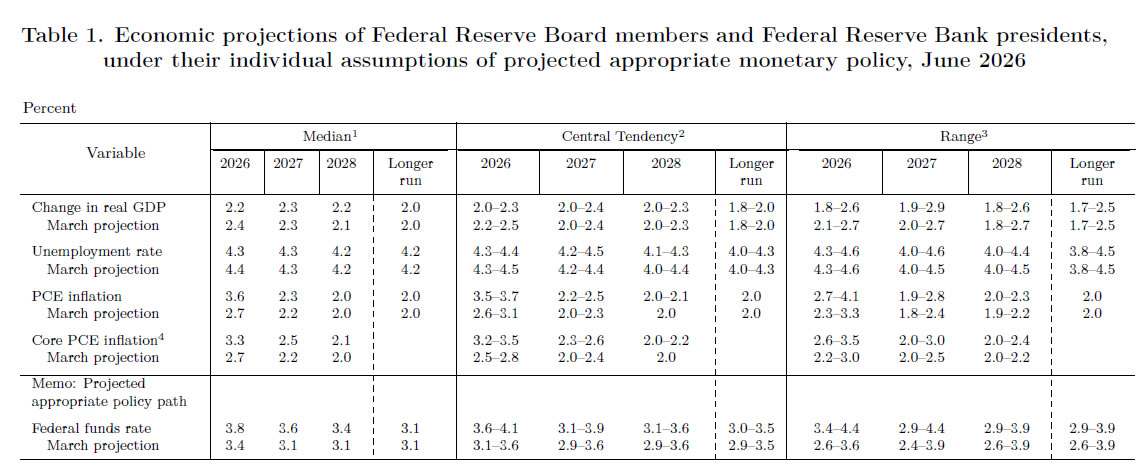
This message has been reinforced by the updated Economic Outlook Summary. The average forecast for the federal funds rate has been revised upward, with policymakers now expecting interest rates to end in 2026 at 3.8%, compared to 3.4% previously. The expected path of interest rates for 2027 and 2028 has also been raised, indicating an eventual slowing of the pace of policy normalization.
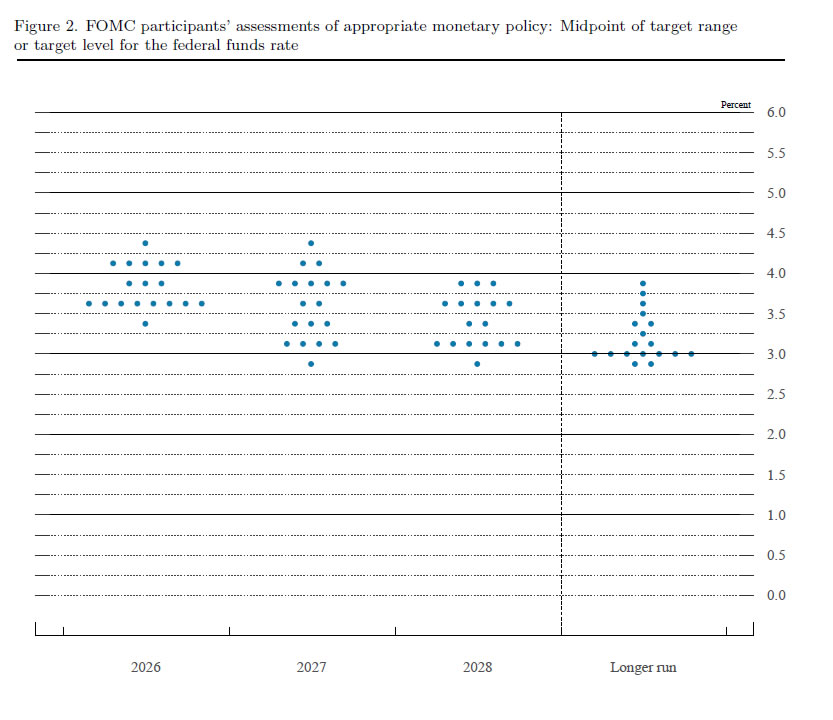
The accompanying point plot revealed a committee leaning strongly toward additional tightening, with Nine officials expect to raise interest rates at least once this yearEight expect interest rates to remain unchanged, and only one expects the interest rate to be reduced.
While the Fed modestly lowered its 2026 GDP growth forecast to 2.2% from 2.4%, officials simultaneously revised core inflation expectations much higher. Core PCE inflation is now expected to be 3.3% in 2026 and 2.5% in 2027, both significantly higher than previous forecasts. Although PCE inflation expectations are down slightly for 2026, continued underlying price pressures appear to outweigh growth concerns.
Taken together, the updated forecasts suggest that the Fed is willing to tolerate somewhat slower growth in exchange for ensuring that inflation pressures do not worsen, boosting expectations that interest rates could be raised.



