By the time the Bank of Canada announces its policy decision today, the Canadian dollar will have already built a strong foundation for further gains. The USD/CAD pair fell to its lowest level in nearly a month, supported by not one catalyst but three consolidating forces: a broad-based decline in the US dollar after weak inflation data, rising oil prices boosting Canadian export expectations, and growing expectations that the Bank of Canada may look more hawkish than markets expected just a week ago.
The first two movers have already reshaped the currency outlook. A weaker-than-expected US CPI for June prompted investors to downgrade the Federal Reserve’s hawkish outlook, weighing on the dollar across major currency pairs. Meanwhile, Brent crude rose above $86, as renewed hostilities between the US and Iran threaten energy supplies through the Strait of Hormuz. For Canada, higher oil prices are more than just a global inflation story – they improve the country’s terms of trade and usually provide direct support to the Canadian dollar, which helps explain why the Canadian dollar has outperformed most of its peers following inflation data.
The Bank of Canada now has the opportunity to either build on or challenge this momentum. Economists overwhelmingly expect rates to be held for the sixth consecutive time at 2.25%, making the decision itself unlikely to come as a surprise. The more important question is whether Governor Tiff Macklem will adjust his message in response to the renewed rise in oil prices. His previous description of policy as a balance between weaker growth and energy-driven inflation was shaped before Brent crude’s recent rise, meaning the monetary policy report may actually understate current inflation risks. Therefore, markets will pay more attention to Macklem’s live assessment rather than the published forecast.
This leaves the accompanying statement and Macklem’s press conference as the main market events. Investors will focus on whether the governor continues to describe policy as a balancing dilemma or acknowledges that the renewable energy shock has raised inflation risks. Any discussion of the ongoing trade review of CUSMA will also be closely watched, as it remains an important downside risk to Canada’s growth outlook. Even without signaling an impending interest rate hike, a modestly more hawkish tone could encourage markets to increase expectations of tightening in early 2027, as rates are already increasingly balanced.
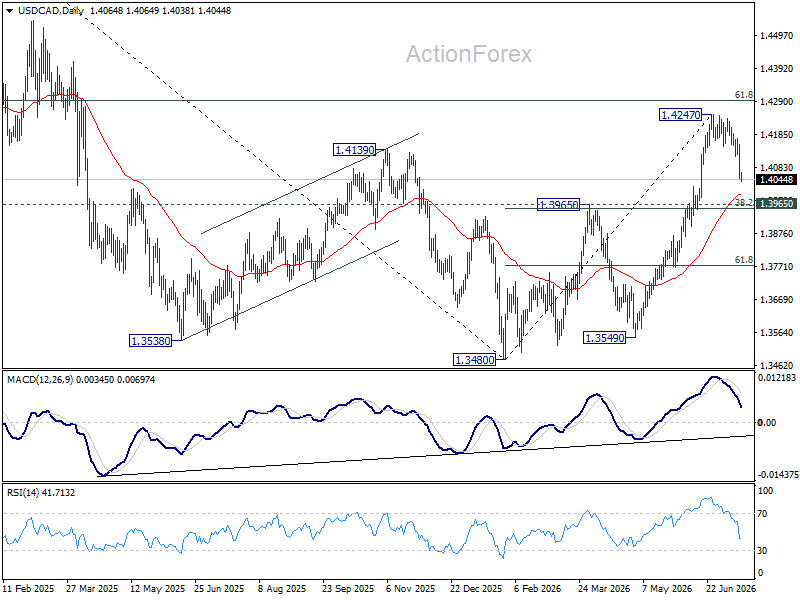
Technically, the USD/CAD pair is approaching an important inflection point. While the decline has accelerated from 1.4247, it is still seen as a correction within the broader uptrend from 1.3480. Strong support is expected between previous resistance at 1.3965 and the 38.2% retracement from 1.3480 to 1.4247 at 1.3954. Breaking the secondary resistance 1.4159 will indicate the correction is complete.
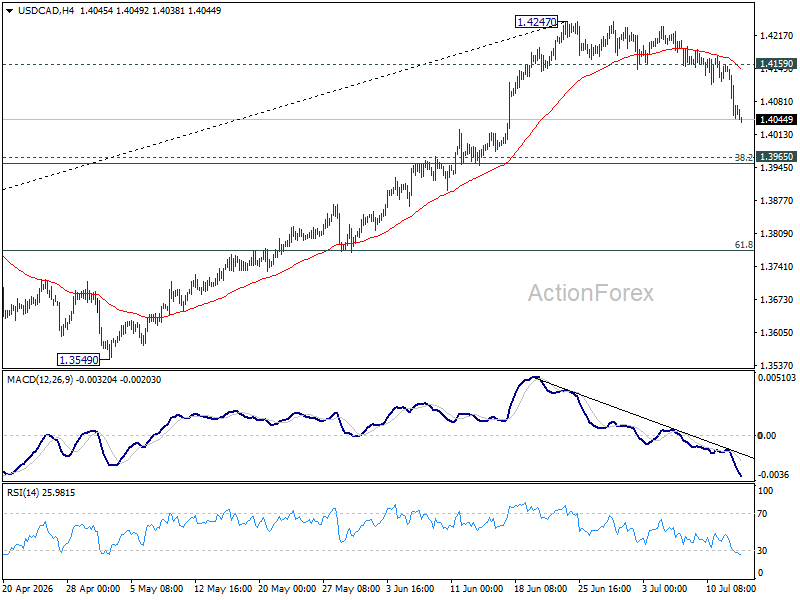
However, a decisive break below 1.3954/65 would indicate that the advance from 1.3480 has been completed as a three-wave corrective bounce after failing near the 61.8% retracement from 1.4791 to 1.3480 at 1.4290. Such a development would shift the near-term technical outlook decisively in favor of further Canadian dollar strength.