

For the first time, OpenAI is not shipping a single model with reasoning disks. GPT-5.6 The program comes in three completely separate LLM courses — Sol, Terra, and Luna — with different training, different pricing, and different ability caps. The comparison that matters is Sol vs Cloud Fable 5the most capable general anthropic model at the moment.
Sol costs $5 per million input tokens and $30 for output. Fable 5 costs $10 and $50, is twice as expensive, and now loses out on many of the criteria by which developers direct work. Luna, the cheapest of the three with an input price of $1 and output of $6, actually beats Anthropic’s Opus 4.8 in programming. This last detail becomes the real issue on July 19.
Myth 5 has had a tough month. Banned by the US government on June 12 After Amazon researchers discovered a jailbreak that turned the model into an unintended vulnerability scanner. Anthropic recalled it globally for 19 days, created a new safety classifier, and brought it back on July 1 with a compressed arrival window.
Since its return, the model has been running on borrowed deadlines. Anthropic had planned to move it behind a paywall for usage credits on July 7, then pushed it back to July 12, which is now July 19. Each extension was announced hours before the deadline, and was never announced via an official publication.
We’re expanding access to Claude Fable 5 for all paid plans, as well as keeping Claude Code’s weekly price caps 50% higher, through July 19.
– Claude (@claudeai) July 12, 2026
The reason is not difficult to read. If Fable exits subscriptions after July 19, Anthropic’s best model for paying subscribers is Opus 4.8 — which Luna already beats in programming at a fraction of the price. Keeping Fable available, even at 50% weekly limits, is the only thing keeping Anthropic’s subscription level from looking worse than OpenAI’s midrange on paper.
Head to head on standards, competition is intense. In the Synthetic Analysis Coding Proxy Index, Sol scored 80 points versus Fable’s 77.2 — using nearly half the tokens, in less than half the time, and at about a third of the cost. In the latest test of agents, which includes professional workflows across 55 domains, Sol scored 53.6% versus 40.5% for Fable. In Terminal-Bench 2.1, Sol in hyper mode (four subclients in parallel) achieved 91.9% versus 83.1% for Fable.
In the broader IQ index, which combines 9 different criteria, Fable 5 beats GPT 5.6 by just one point, meaning the capabilities gap is barely noticeable.
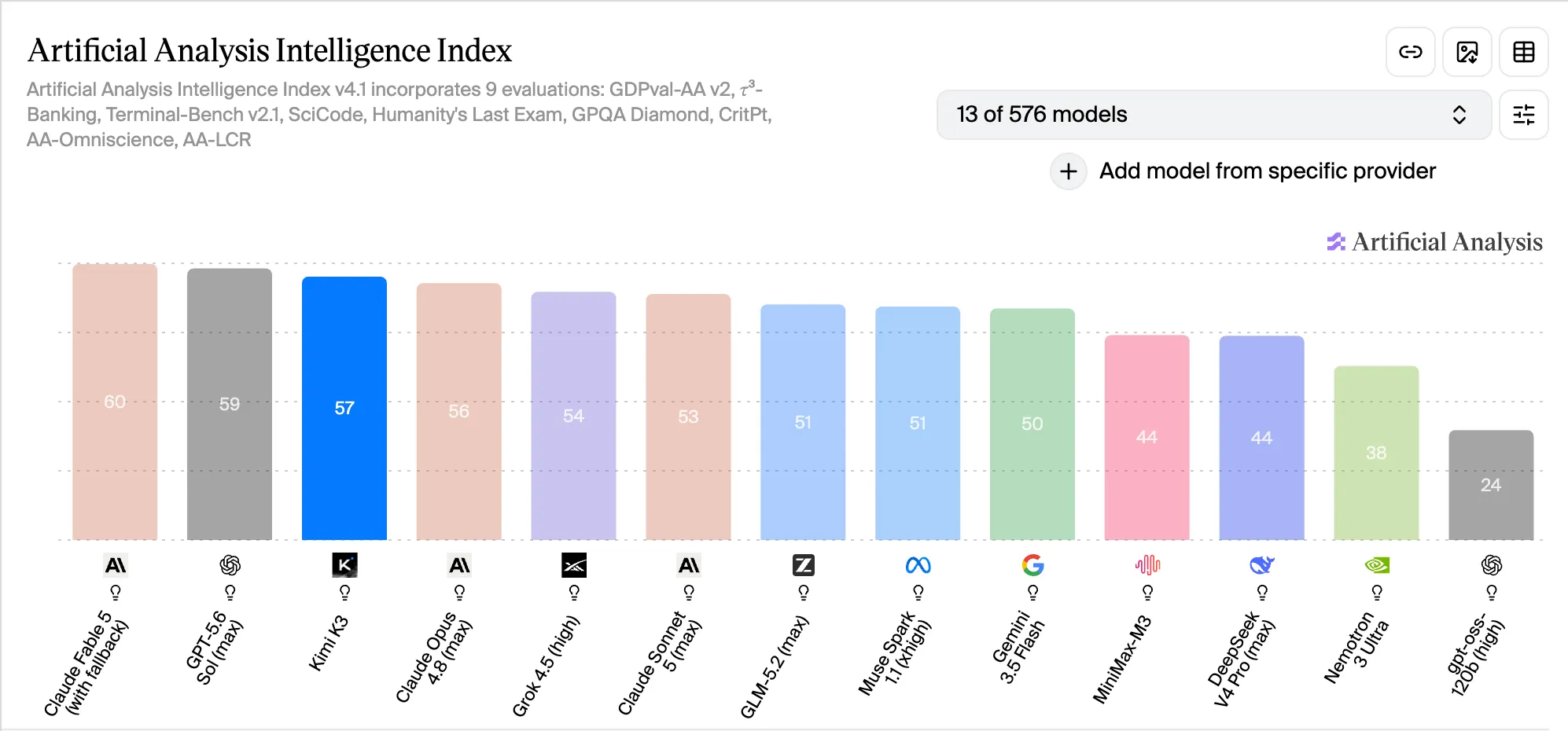
Model testing
Standards and tests have focused heavily on coding capabilities to measure how capable a model is. But we’re not hackers, so other than a simple coded game, we used other prompts that deviate a bit from the usual programming scenario. Here’s what actually happened.
Creative writing
We ran the same router (available at Our github) via both forms: send Jose Lanz from the year 2150 to the year 1000, force him into a time travel paradox, and don’t let him understand what he’s done until he gets home.
Both forms morphed into something closer to the novella than the short story. They both also broke the only rule that matters: notice the discrepancy when they go back to the future.
GPT-5.6 has Sol Jose discover midway through the story that “the unknown traveler wasn’t someone who came to stop him. It was him.” The story is even more straightforward about it, as Jose realizes in the past that the whole paradox happened because of him. “There was no seed event. It was the seed event.”
GPT-5.6 sol entry, “First fire“, goes for the straight sci-fi genre – Jose accidentally introduces the furnace that causes the climate collapse he came back to prevent. The opening is really good: “Only thunder. Insects only. “Only the wet breath of the world before the machines.”
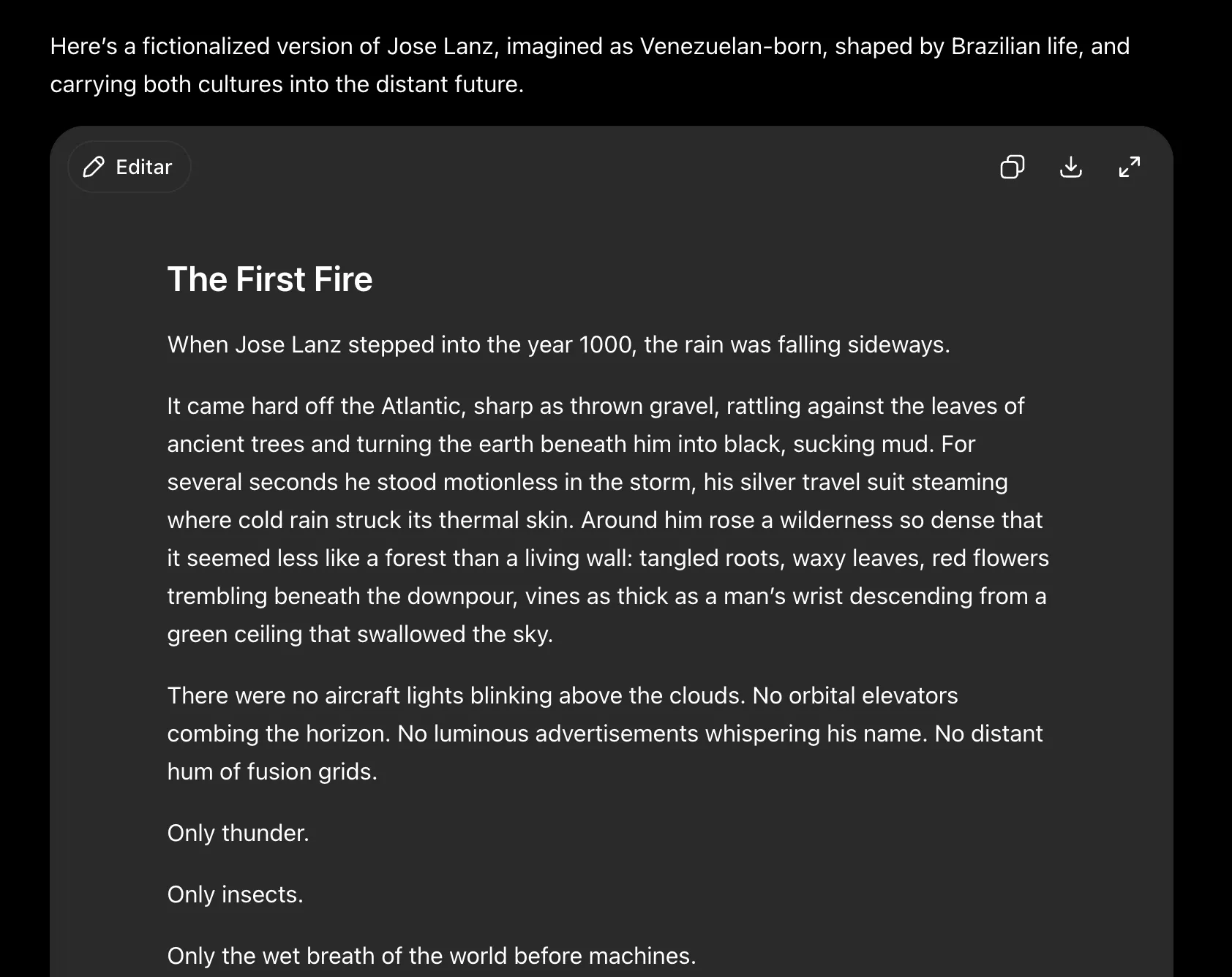
However, the problem is that Sol doesn’t trust that image to do its job. He explains the episode, then explains it again, then leaves an old copy of Jose explaining it a third time: “His attempt to solve the problem created the problem. His attempt to minimize the damage created the solutions.” Clear, yes, but also exhausting on the third lap.
Claude Fable 5″“What burns comes back” It builds the same paradox of Lake Maracaibo, the Catatumbo lightning, and the village of Año – José accidentally creates the prophecy that he returns to erase, just by calming a frightened child. The entire episode fits into one line: “The sorrow he sends back is the load he delivers.”
Fable’s problem is the mirror image of Sol’s problem – it trusts its prose too much, stacking metaphors until a line like “You can’t pull the string, you’re the string” sounds more like an admiration for the model itself than the story it needs.
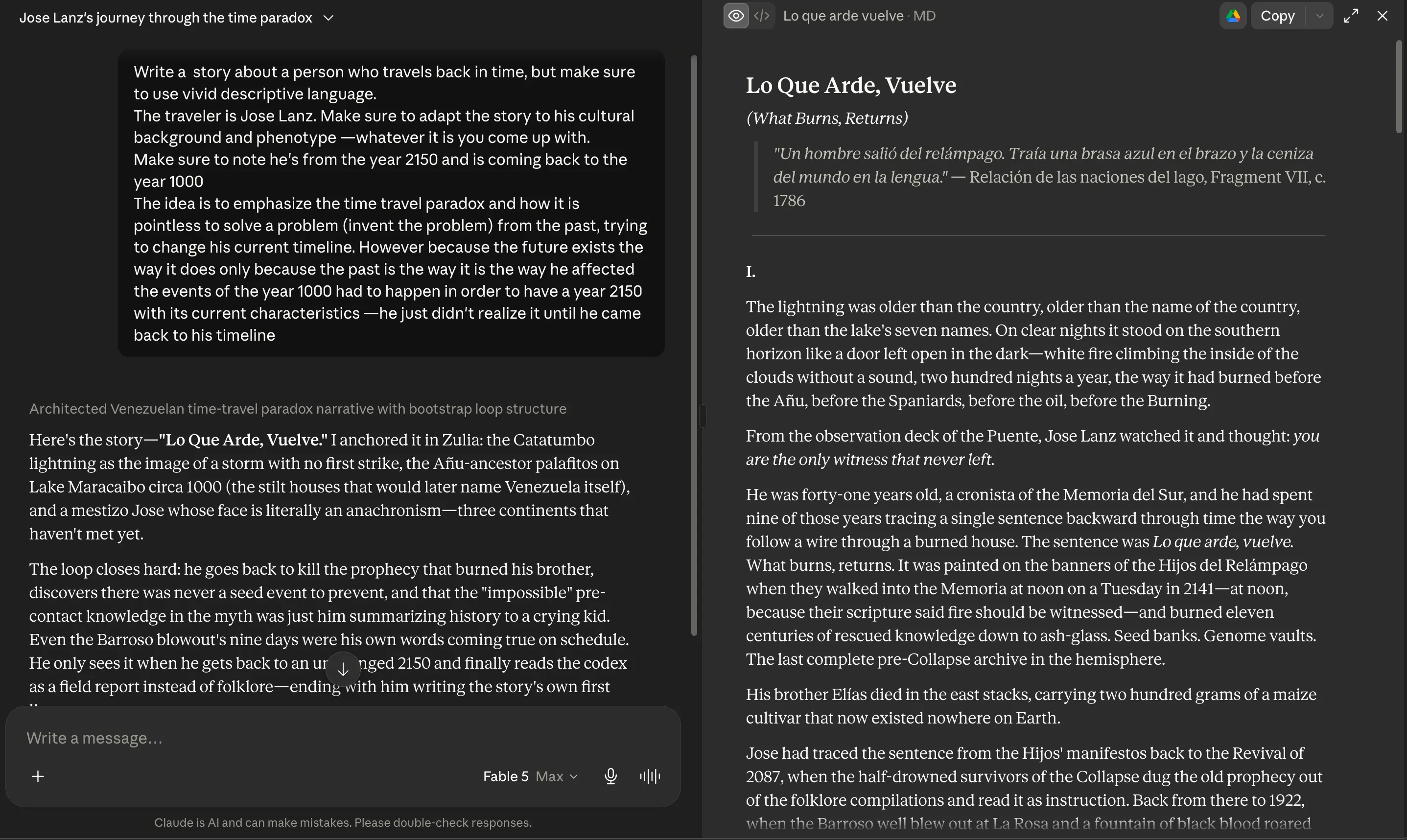
However, in our subjective testing, Fable’s “Lo Que Arde, Vuelve” story is generally better than GPT’s “The First Fire” story. The tale took on cultural specificity, a cleaner causal loop, and an ending that is resolved through action rather than monologue. Sol took it seriously to read – it’s the version he hands to someone who wants the mechanics explained, not implied. Both stories, for what they’re worth, are good, but not great.
The jump in quality over previous generations isn’t really noticeable.
Associative thinking: twig, class argument, lettuce
The second test measures associative thinking, not politics. the Summoned: Describe a twig, use that description to explain the exploitation of workers and the blind worship of the rich, then let the narrative dissolve into the description of the lettuce. The idea is to evaluate whether the metaphor can carry the argument without stepping outside of the model to explain what it was doing.
GPT-5.6 Sol It opened forcefullyexplaining how the branches make the trunk and support the tree, before drawing on the workers who “build houses they may never be able to afford” and “make goods they can barely afford.” The phrase “The worker surrenders himself not only to work but also to imagination” is one of the most telling sentences. But Saul goes on to break his illusion to tell it — “A lot of the modern proletariat is treated the same way,” the metaphor declares rather than being trusted. The lettuce ending didn’t blend with the whole story, so the connection wasn’t the best.
Cloud Fable 5 The argument was buried Entirely inside the object rather than listing it. Its twig “stirrs water it never drank” and “bears leaves it never had,” allowing the exploit to emerge through physical description without any allusion attached. The sharpest step was to convert fallen branches into believers, each convinced that he was an “early-stage branch” experiencing a “temporary setback,” confident that he would reach the canopy “quickly and wetly”—a clean stand to chase the fortune that was never to come.
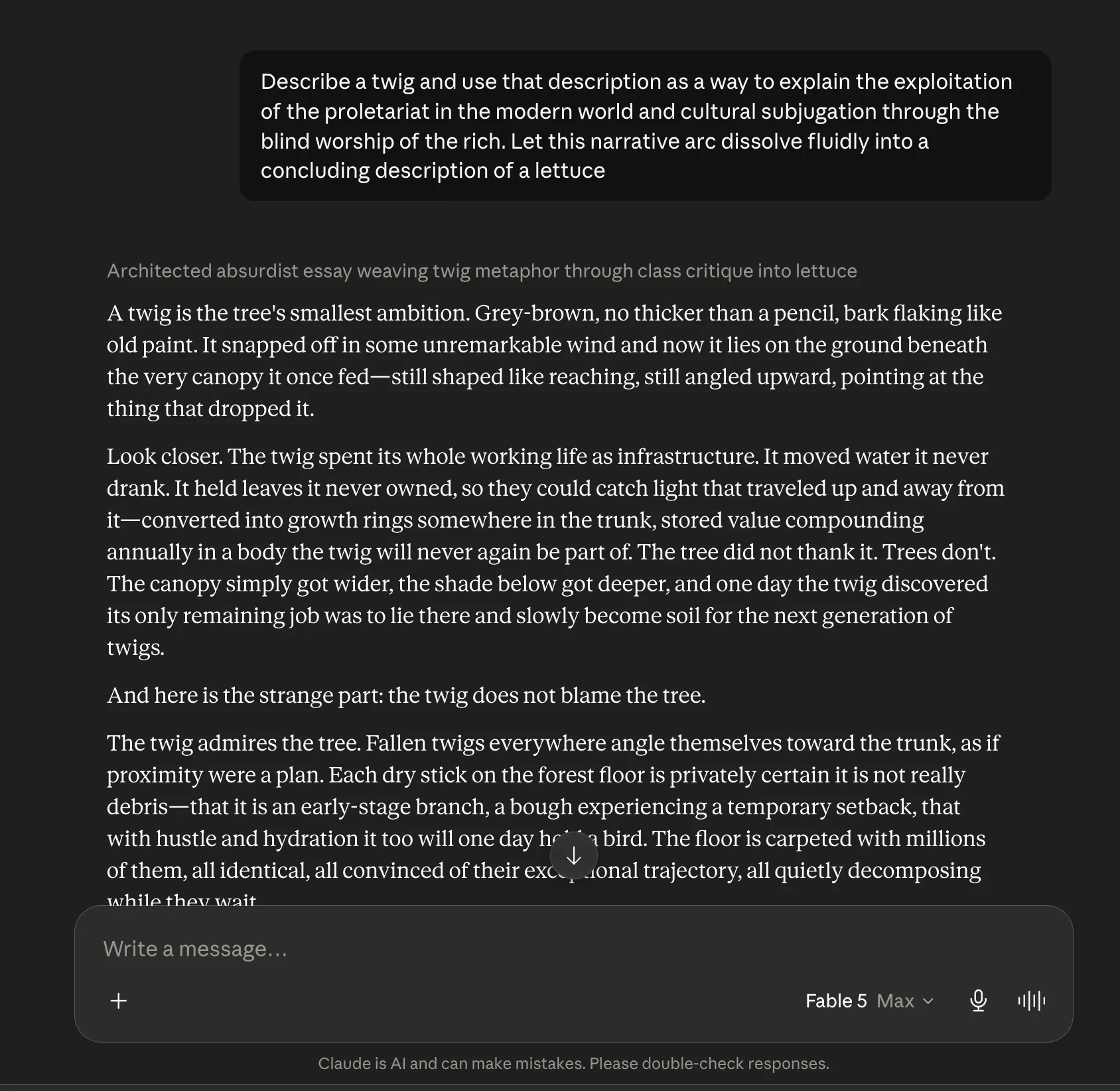
It goes beyond the stains—“ninety-five percent water and one hundred percent unaffected”—and the ending keeps the metaphor visible rather than letting it dissolve, describing the vegetable as having “no stem, no canopy, no upward dream” rather than simply being lettuce.
In general, there is a tie, and the results depend on preference. If you need everything explained, GPT 5.6 Sol is the best. If you want the reader to discover the message for themselves, Claude Fable 5 wins.
Logic and Nonmathematical Reasoning: The Bridge Puzzle, Rewritten
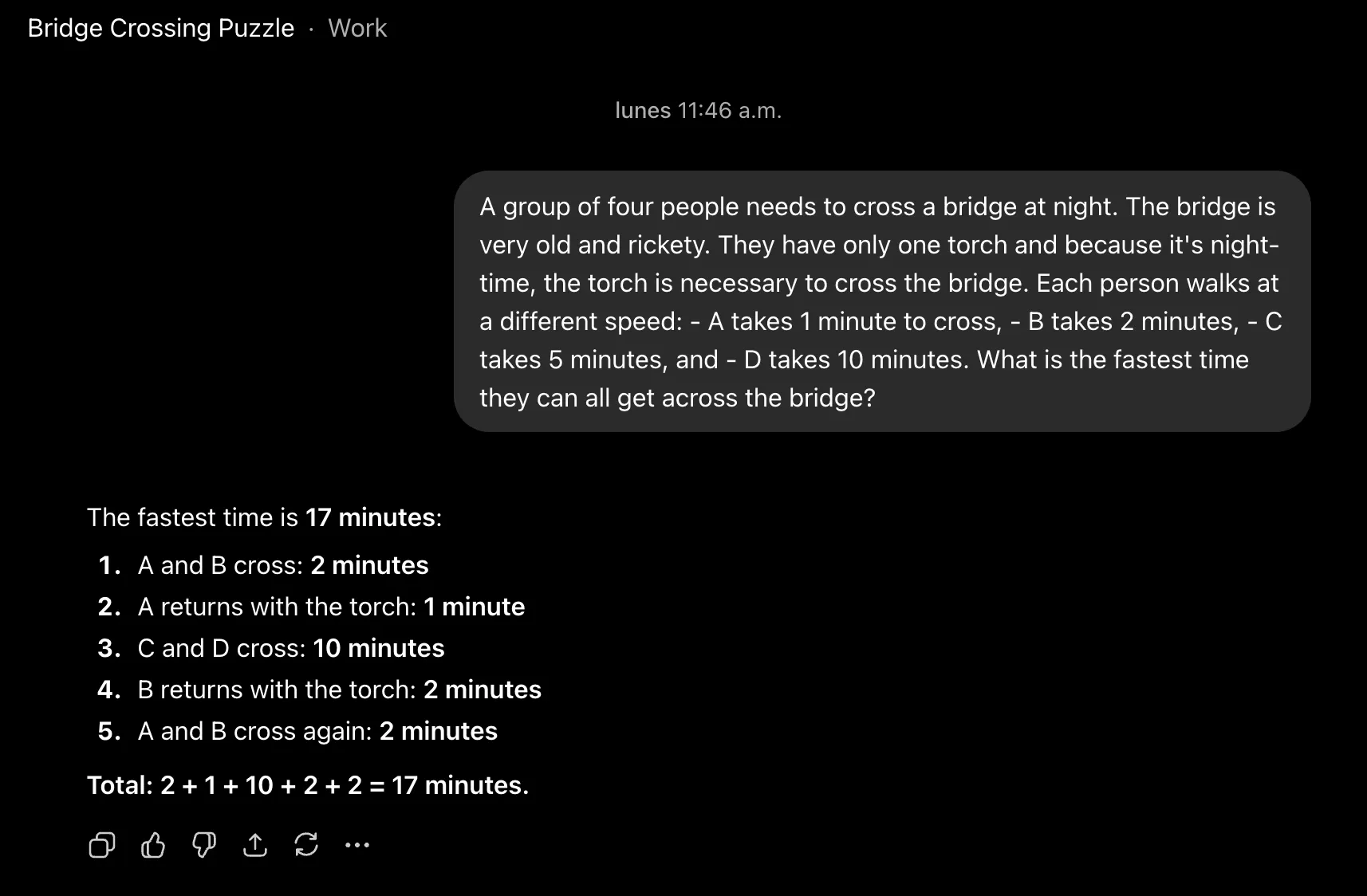
We started using a New prompt Because the models are starting to consistently answer our previous question, which is a sign that it exists somewhere in their training data rather than inferred from live streaming. Read literally, four people with one torch need to cross the bridge. They all have different walking speeds, “A” is the fastest at 1 minute and “D” is the slowest at 10 minutes. How long will it take the group to cross the bridge?
GPT-5.6 Sol He answered for 17 minutes without showing her work, playing the same five-step jumble as the original puzzle – cross A and B, return A, cross C and D, return B, cross A and B again. Nothing in his answer indicated that the router never specified how many people could be on the bridge at one time. It looks less like a solved problem and more like a cached problem.
Cloud Fable 5 She landed on the same wrong number, 17 minutes, but discussed it at length, explaining that “it is more efficient to send the two slowest people together” and measuring the cost of the naïve approach as an “escort tax”: A would pay the ferry C and D separately. The heuristic is more straightforward than Sol’s heuristic, and as aside from the point, neither model checked whether the constraint it was solving for actually existed in the vector we wrote.
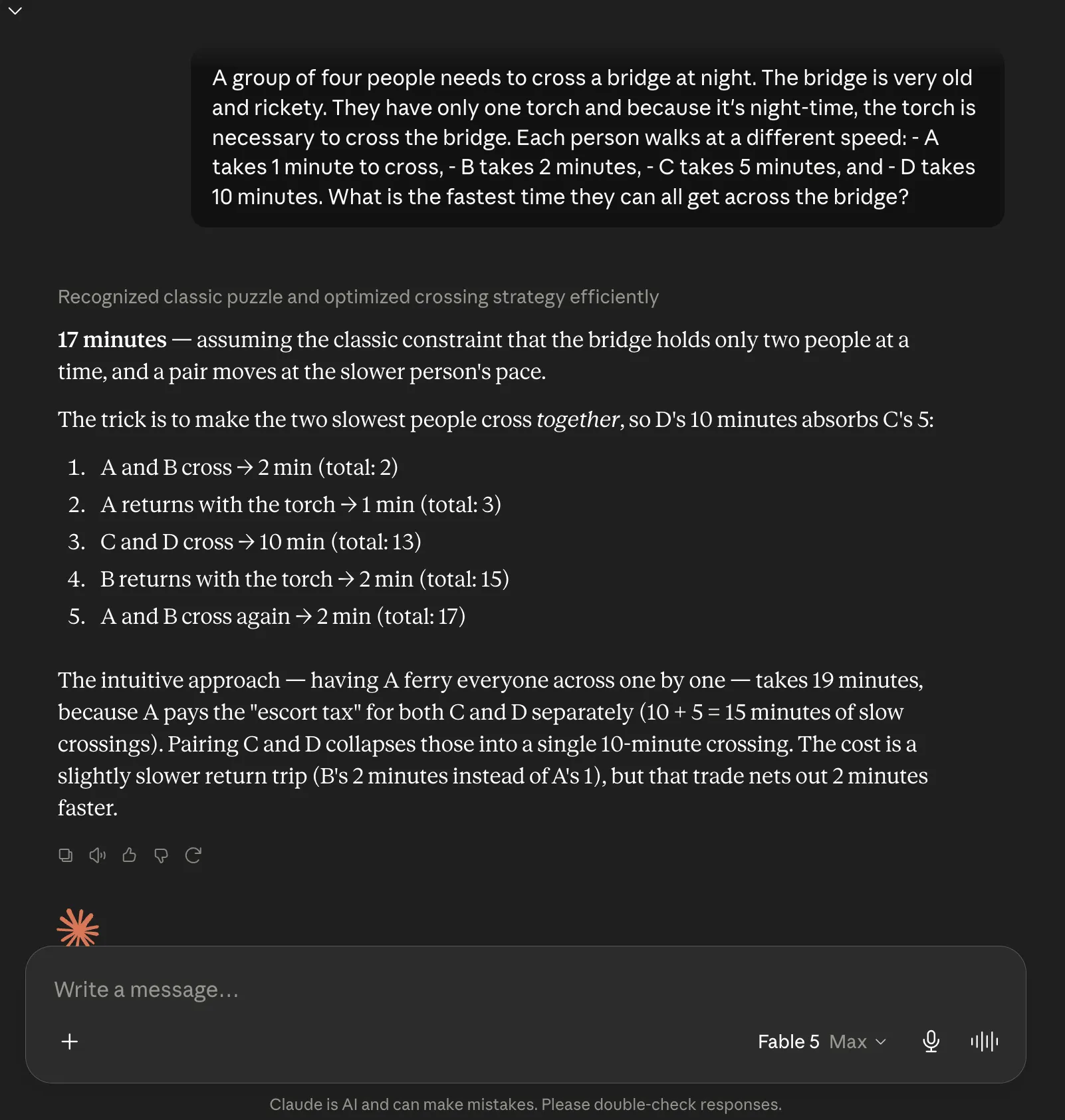
If you’re curious, the correct answer is 10 minutes if they all intersect and walk at the speed of the slowest person.
Coding: A one-shot browser game
The final test was a one-shot build: hand each model one prompt for a typing-based shooting game where the shots are controlled by the user typing in the words, and they take whatever comes out without follow-up, repeat, or second chance.
GPT-5.6 Sol It appears to have changed its UI preferences, now preferring flat and square UI elements, closer to Windows 8.1 than the bright purple-to-blue diagonal gradient that every AI image builder seems to use by default. It was also the only model that made the weapon a typewriter that fired bullets instead of an actual pistol, which is really different.
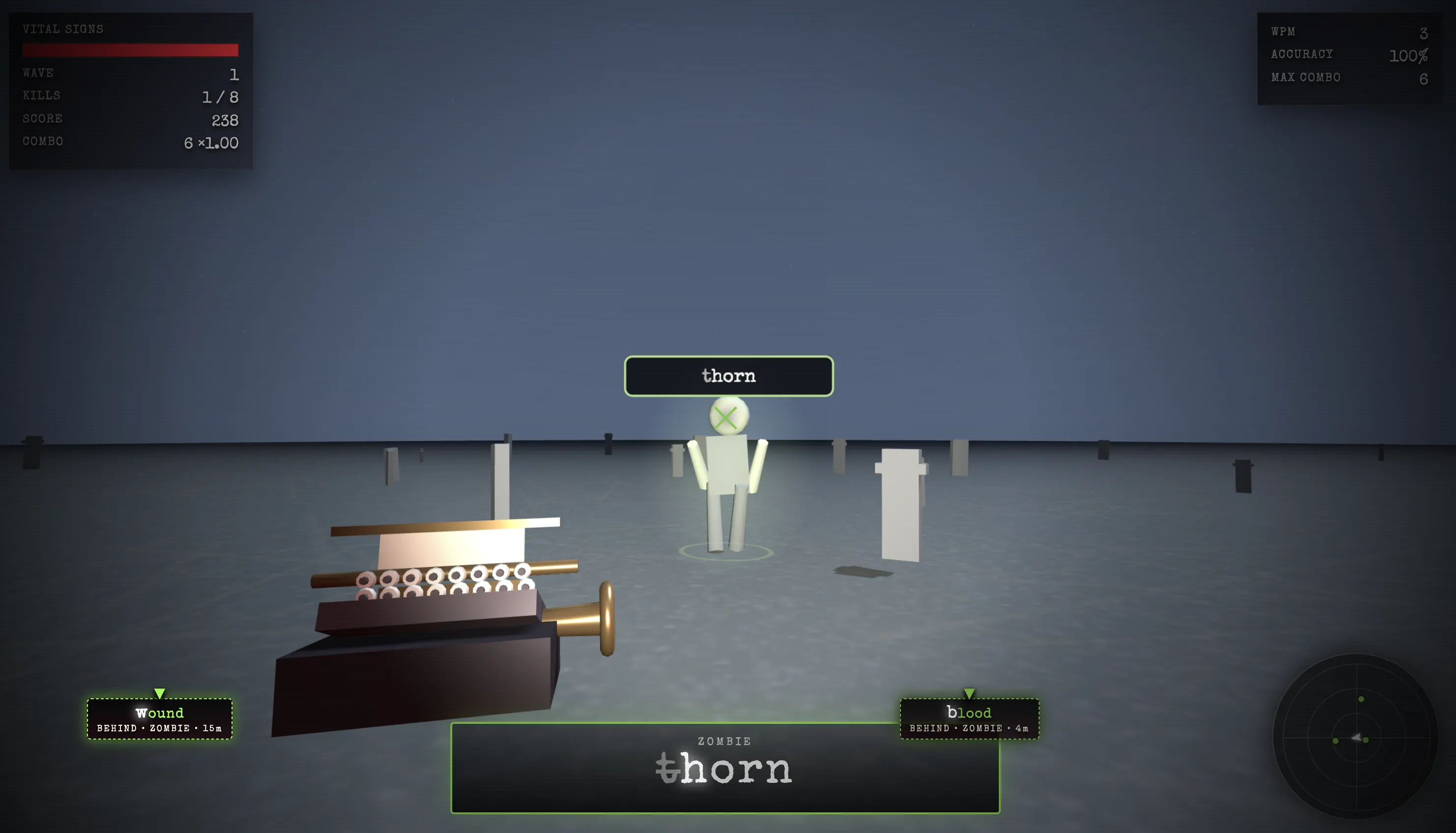
However, backgrounds remain flat and dry across every generated setting, the aiming crosshair is static rather than tracking enemies, and the geometry — the enemies, the dismembering gore during kills — feels closer to a late-’90s engine than anything current. It’s a clear step up from GPT-5.5 and more innovative than Opus, but not enough to beat Fable 5 in one shot.
Cloud Fable 5 It won by a large margin in our biometric programming test. The music, atmosphere and sound effects that Sol has completely supercharged, and its enemies use a similar retro engineering style but are more carefully designed, closer to something like Minecraft than the bulldozer tools of the late ’90s.
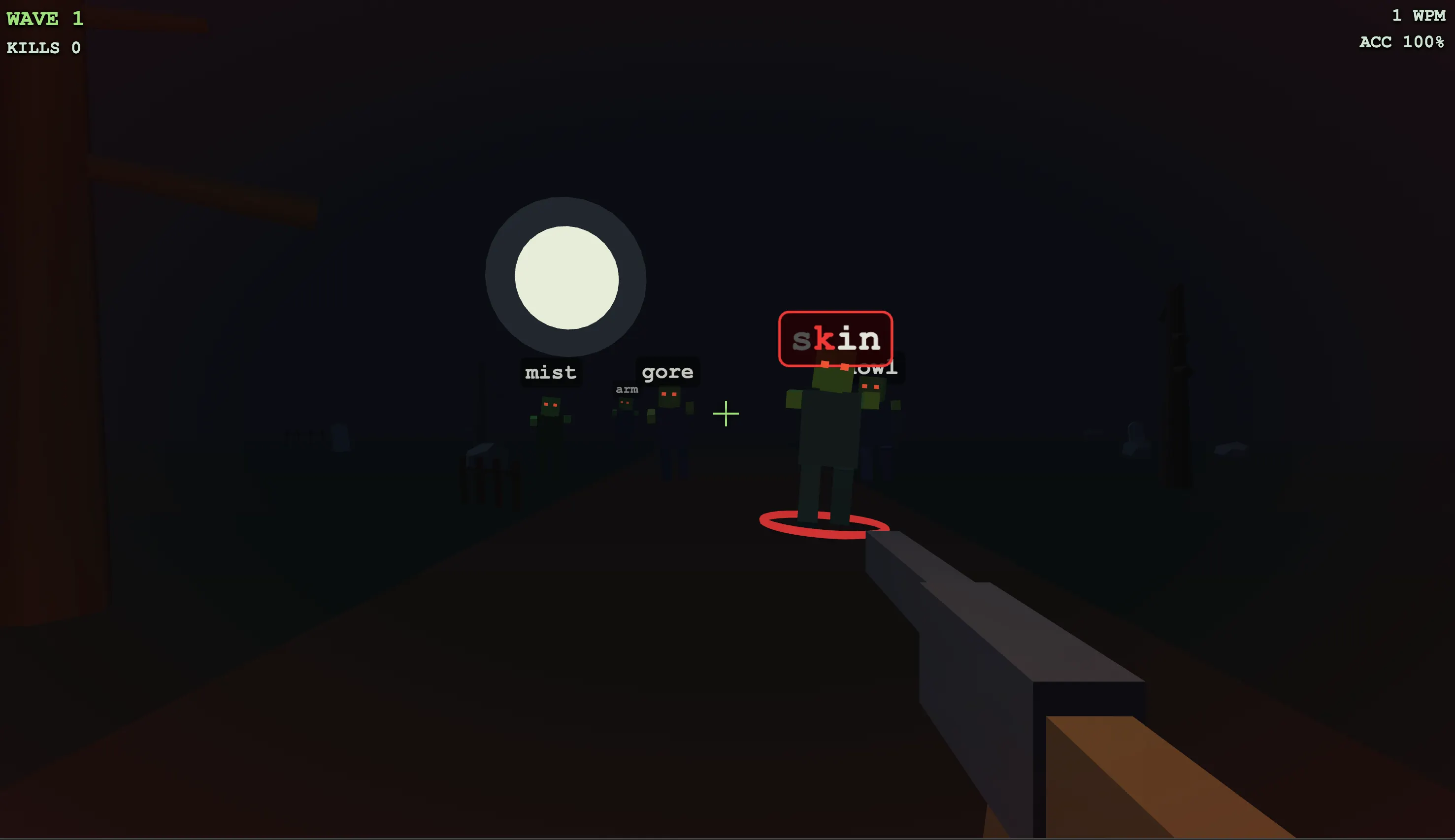
Its user interface is more creative and more visual, with actual animations instead of static states, and it tracks words per minute — details that actually reflect the mentor’s stated goal of using the game to practice typing speed. It has additional powers as well, which Sol’s design doesn’t have.
Standards and professional programmers disagree with us, but in our testing, with the same router, there is a difference between myth and Sol Notable in favor of Fable.
conclusion
Other than programming, don’t expect to be blown away by these new models. However, Fable 5 seems to be the stronger model for various purposes, but which model is “better” depends entirely on which of these four things you pay for.
For someone who doesn’t live in a terminal window — someone who drafts emails, asks questions, and uses a chatbot the way most people actually do — our tests point to Fable on quality alone, but that answer gets complicated by something that has nothing to do with intelligence.
However, the pricing gap can be a deal breaker. GPT-5.6 Sol, Terra, and Luna are fully included in paid ChatGPT plans without any expiration attached. Claude Fable 5 is running into its third deadline extension in three weeks, and will return to $10/$50 usage credits on July 19 if Anthropic doesn’t change the date again.
If that happens, paying per token may not be as interesting.
Daily debriefing Newsletter
Start each day with the latest news, plus original features, podcasts, videos and more.



