

Canada’s only cobalt refinery has become an unexpected victim of US sanctions on Cuba, exposing a serious vulnerability in Western mineral supply chains that extends far beyond geology.
the Shutdown of Sherritt International Refinery at Fort Saskatchewan, Alberta, shows how political and regulatory risks can disrupt strategic mineral processing even when facilities are located in allied nations, Patricio Foundes of GEM Mining Consulting wrote in a recent research note.
The refinery relies on mixed sulphide deposits produced at the Moa nickel-cobalt operation in eastern Cuba. Follow a US executive order issued in May With the expansion of sanctions affecting Cuba’s metals and mining sectors, the refinery has lost access to raw materials and will remain idle until production in Moa resumes.
The episode highlights how sanctions can span across banking, insurance, auditing and commercial relationships without directly targeting industrial assets.
“This case sends a warning signal to the West: mineral security depends not only on the presence of factories, technology, or political allies, but also on the existence of traceable, bankable, and legally viable supply chains,” Foundes wrote. “The constraints do not just come from the East. They can also arise from within the Western organizational structure itself.”
The broader lesson extends beyond a single refinery, the analyst said. Governments across North America and Europe have invested heavily in processing capacity to reduce reliance on China for critical minerals, yet refineries remain vulnerable if they cannot secure legally compliant sources of raw materials.
The case of Fort Saskatchewan, according to Fundys, suggests that building refineries alone is insufficient unless governments also ensure a stable, diversified and politically secure supply of raw materials.
Rich in nickel and cobalt
Although Cuba attracts little attention in global mining, it has one of the most important nickel and cobalt regions in the world. The deposits around Moa, Nicaro, Maiari and Holguin account for almost all of the country’s strategic mineral importance. Unlike many untapped deposits, MOA combines mining with high-pressure acid leaching and produces mixed sulphide deposits for refining in Canada, allowing Cuba to derive greater value from exporting raw ore alone. A smaller zinc-lead-barite project at Castellanos shows some additional mineral potential, but nickel and cobalt remain the country’s premium assets.
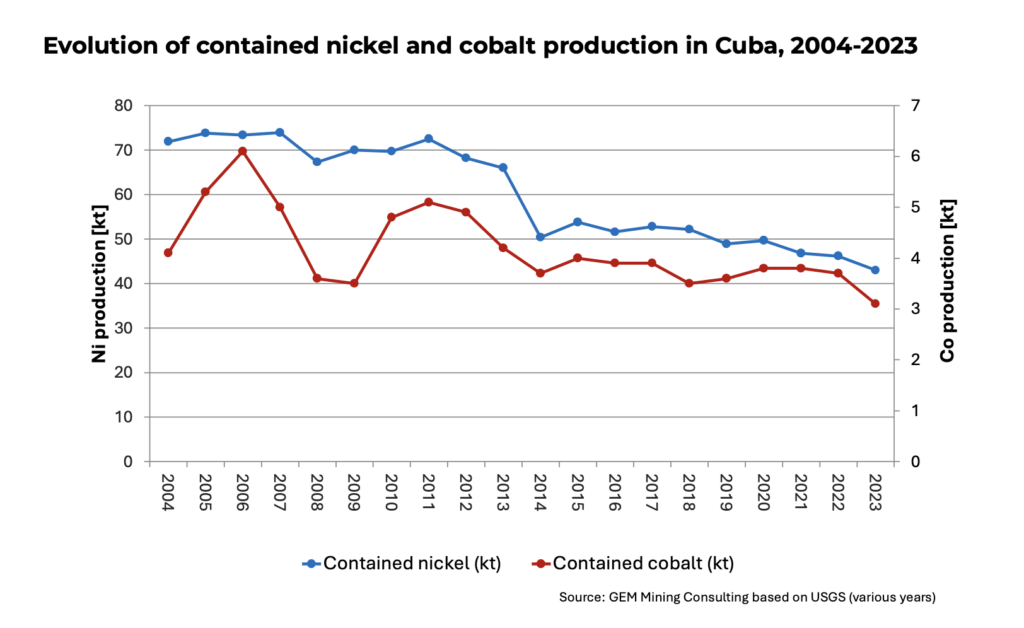
Cuba’s geological wealth has not translated into increased production. Nickel production remained relatively flat between 2004 and 2013 before entering a long-term decline, falling to about 43,000 tons by 2023. Cobalt production followed a similar path, falling from peaks near 6,000 tons in the mid-2000s to about half that level.
The long-term outlook for nickel could make these resources increasingly valuable. BMO Capital Markets analyst George Heppell says the recent weakness in nickel prices was likely overdone, with values falling significantly further down the global cost curve. Structural supply constraints and Indonesia’s increasing incentive to support prices are expected to lift nickel to a more sustainable medium-term range of US$18,000 to US$20,000 per tonne, higher than recent levels. Demand for battery materials.
The report finds that cobalt presents a two-level challenge to the supply chain. Mining remains heavily concentrated in the Democratic Republic of the Congo and Indonesia, which together account for nearly 90% of global mine production in 2025. However, refining is more concentrated. China produced nearly 79% of the world’s refined cobalt last year, while Canada produced only about 3%.
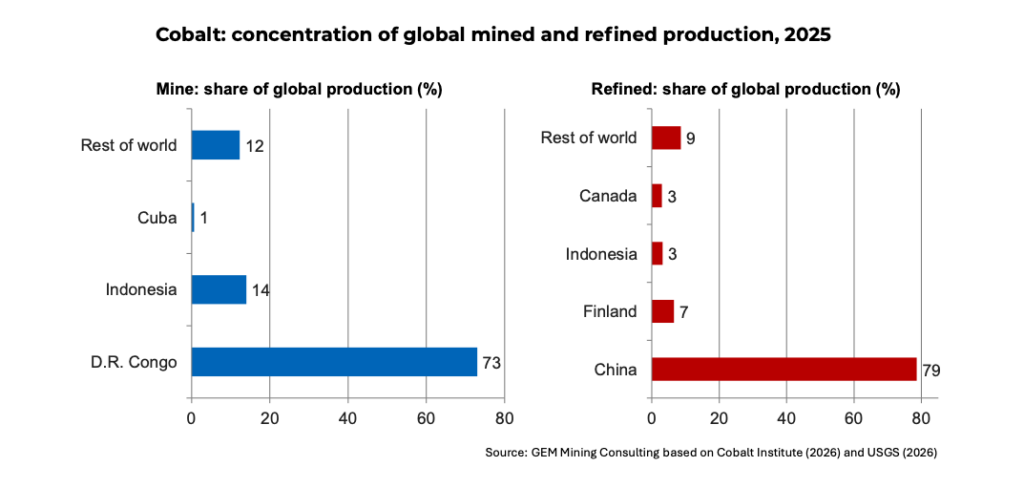
This imbalance leaves Western governments with limited room for maneuver. The United States, Canada and Australia combined contribute only a small share of global cobalt mine supplies, while refining capacity in North America remains modest. The temporary closure of Fort Saskatchewan therefore represents more than just a local industry setback. It highlights how easy it is to disrupt one of the West’s few refining facilities when upstream supplies become politically or legally constrained.
Western awakening
The report also challenges the widespread assumption that critical risks to mineral supplies arise primarily from China or other geopolitical competitors. China has imposed export controls on several strategic minerals in recent years, while Indonesia continues to restrict its exports of unprocessed nickel ore, and the Democratic Republic of Congo has moved to manage cobalt exports through temporary bans and quotas. The case of Cuba illustrates that Western sanctions can create similar disruptions by making financing, insurance, and business transactions more difficult for companies associated with sanctioned jurisdictions.
For Cuba, the country’s nickel and cobalt deposits remain a strategic asset, but realizing their value will require more than just favorable geology. Sanctions, weak economic conditions, and limited infrastructure continue to hinder development. The report estimates that if Cuba increased production to better reflect its estimated share of global reserves, the country’s economy could receive a significant boost.
For Western policymakers, the lesson is broader. Building new refineries and processing plants will not, in and of itself, secure supply chains for critical minerals. Governments must also ensure access to diverse, legally secure sources of raw materials that can withstand geopolitical shocks and regulatory changes.
If nickel prices recover as some analysts expect, the economic cost of leaving those resources stranded could become more significant.
Source link



