

Our summary of recent economic events and what to expect in the coming weeks.
Notable Canadians
- The Bank of Canada left interest rates unchanged at 2.25% but adopted a more positive tone on the near-term economic outlook, anticipating a sharp rebound in second-quarter growth.
- Inflation remains the main source of uncertainty, although the removal of references to possible “cascade” increases in interest rates suggests that policymakers are becoming more comfortable that energy-led price pressures are not widespread.
- This week’s data broadly supported the bank’s expectations, with strength in manufacturing, wholesale trade and home sales pointing to an economy gradually regaining momentum.
Highlights in the United States
- Tensions in the Middle East continued to escalate this week, pushing WTI prices above $80 per barrel.
- Inflationary pressures slowed more than expected in June. Although the recent shift in oil prices raises concerns about the persistence of deflationary dynamics.
- Retail sales remained nicely strong in June, suggesting that consumer spending regained some momentum in the second quarter after stalling in the first quarter.
Canada – The bounce is gaining credibility
The Bank of Canada’s interest rate decision was the main story of the week, but the decision itself was not the main story. In fact, the bank left the overnight interest rate unchanged at 2.25% for the sixth meeting in a row, which was globally expected by the markets. The most notable development came in the bank’s updated economic outlook, which highlighted a somewhat more positive tone on the economy and suggested that the soft correction weighing on growth may be starting to ease.
After successive periods of non-growth, the bank now expects GDP to rebound at an annual pace of 2.5% in the second quarter, supported by stronger exports, resilient consumer spending, and initial signs of stabilization in housing markets (Chart 1). It is certain that surplus supply still exists and labor market conditions are still described as weak. Although overall growth expectations remain unchanged, the latest data has increased policymakers’ confidence that the economy is moving away from the bottom rather than sliding into further weakness.
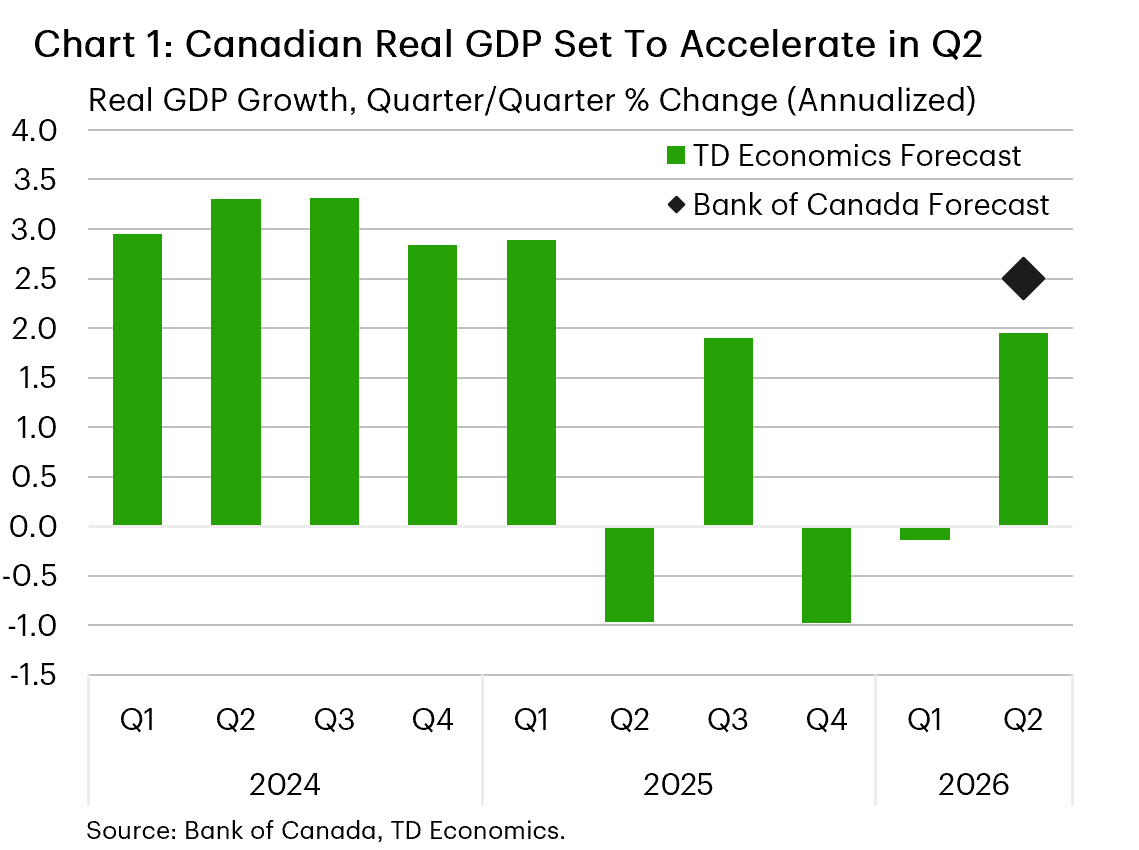
The economy may be showing more signs of life, but the bank’s policy stance remains firmly in wait-and-see mode. Inflation remains the main source of uncertainty, with the headline CPI still above 3% due largely to rising energy costs caused by the conflict in the Middle East. The bank continues to expect inflation to moderate over the coming quarters, although the rise in crude oil prices since the expected cutoff date adds modest upside risks. With the Consumer Price Index released next week, we will be watching closely for any signs that inflation has peaked and that energy-related price pressures are beginning to ease.
Finally, policymakers appear to be becoming somewhat more comfortable with the inflation backdrop. In its latest statement, the bank dropped its previous reference to the possibility of “successive” rate hikes if inflation pressures widen, reflecting confidence that higher energy costs are not yet meaningfully reflected in core inflation. Financial markets took this as confirmation that the bank was still holding its ground. Bond yields were little changed, the Canadian dollar rose 1 cent against the US dollar, and market pricing continues to imply low odds of policy action by the end of the year. Let us remember that at the beginning of the conflict between the United States and Iran, markets were expecting interest rates to rise by three-quarters of a percentage point by December.
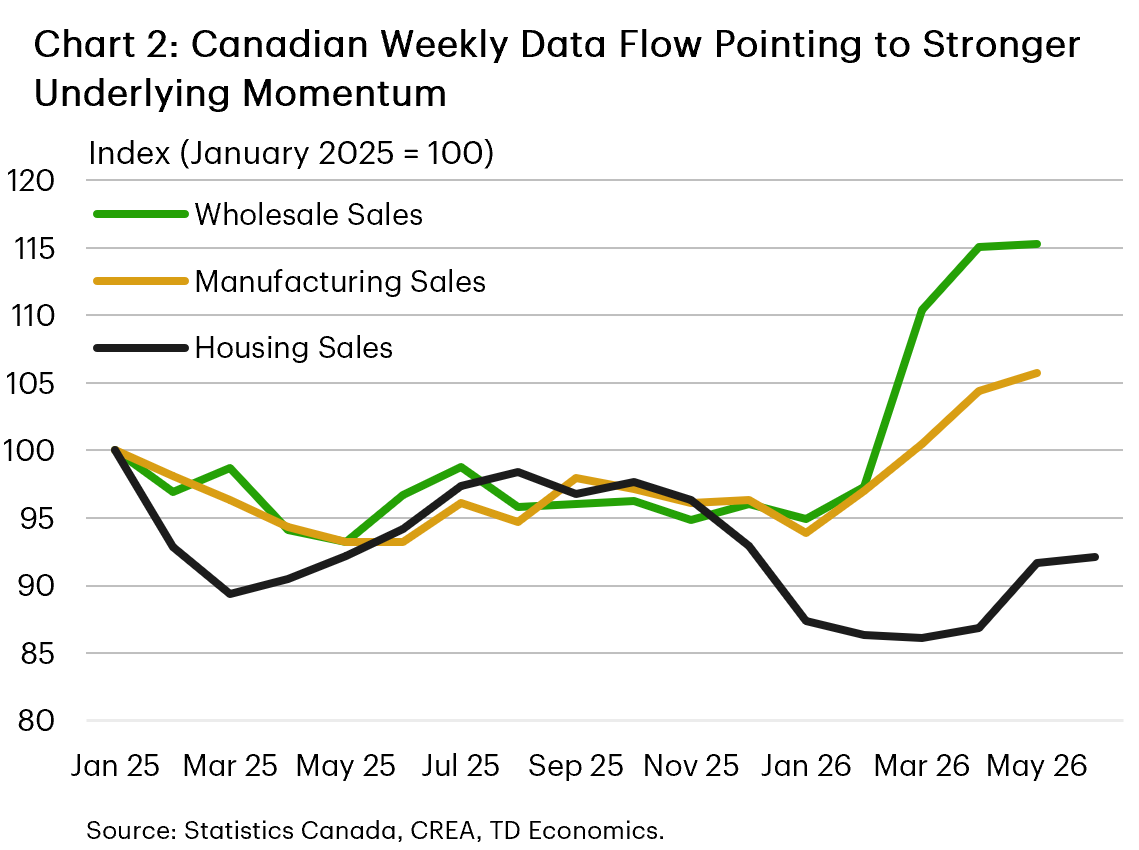
This week’s economic data broadly supported the bank’s assessment. Manufacturing sales rose for the fourth straight month by 1.3% month-over-month in May, reaching a record high and wholesale activity remained elevated after several months of gains (Chart 2). Home sales rose for a third straight month in June, although housing starts were somewhat weaker, suggesting the recovery remains uneven across sectors. However, the broader signal from this week’s releases is an indication that the economy is gradually regaining momentum after a difficult start to the year.
Mark Ercolau, economist
United States – Cooling inflation rates call for interest rate hikes in July
Despite a relatively busy week on the economic data calendar, market attention remained focused on renewed tensions in the Middle East. Earlier in the week, Iranian forces attacked several oil ships crossing the Strait of Hormuz, prompting the United States to resume strikes on various military targets across Iran and reimpose its naval blockade. Tanker traffic through the vital corridor was halted again, pushing WTI prices above $80 per barrel.
Renewed upward pressure on oil prices helped moderate the market’s response to the very encouraging inflation report. The headline CPI fell 0.4% month-on-month in June — its first decline since June 2024 and the largest since April 2020 — pushing the 12-month change to 3.5%. The sharp decline in gasoline prices was largely responsible for last month’s decline, although even after removing these effects, there were plenty of positive developments. Core inflation was flat during the month, with goods and services little changed (Chart 1). Importantly, many categories where tariffs have been adding to price pressures over the past year, including appliances, medical goods and apparel, were all lower during the month – suggesting that the worst of the tariff crossing is now in the rearview mirror. Also encouraging is the fact that there is little evidence that higher energy prices will lead to core inflation.
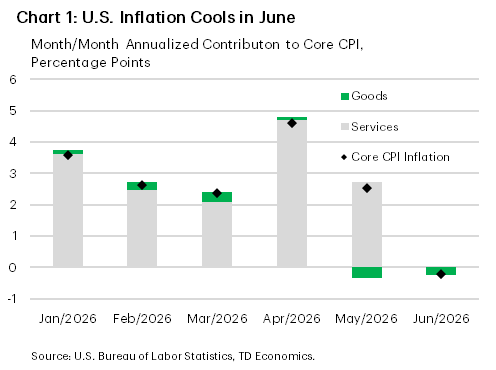
Deflationary dynamics were further reinforced by a weak PPI reading, which helped dampen speculation of a Federal Reserve rate hike later this month. However, Fed futures are still priced in at little more than a rate hike by the end of the year, as the shift in oil prices is already raising concerns about the robustness of anti-inflation dynamics.
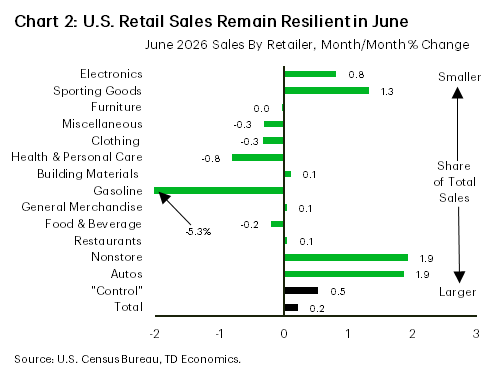
June retail sales provided further confirmation that households continue to ignore the effects of rising energy prices (Chart 2). Although the headline figure recorded only modest gains, this was partly related to the sharp decline in nominal sales at petrol stations – due to price effects. Focusing on the control group, which deletes volatile categories, it showed healthier gains in spending while the previous month’s revisions were slightly higher. This reinforces the view that consumer spending regained some momentum in the second quarter, after faltering in the first quarter. However, spending dynamics remain K-shaped, with low- and middle-income consumers becoming increasingly price sensitive and reluctant to spend on discretionary items – something highlighted in the Fed’s Beige Book released this week.
Everyone who was hoping that Fed Chairman Warsh would relent and offer some guidance during his first congressional testimony this week were sorely disappointed. Instead, Warsh reiterated the committee’s steadfast commitment to restoring price stability, but offered no hints about the Fed’s next step. Several other policymakers spoke this week, and perhaps their most important takeaway was that while last month’s weak inflation numbers encouraged them all, a single data point does not constitute a trend. It will take several more months of easing inflation to convince officials that price pressures are moving in the right direction. If that happens, expectations of a rate hike should fade, putting some downward pressure on yields.



