

short
- Claude Opus 5, released on July 24, costs $5 per million input tokens — which is on par with its predecessor Opus 4.8 and exactly half the price of Fable 5 — while beating Fable 5 in most key benchmarks.
- Opus 5 scored 43.3% in Frontier-Bench v0.1, an evaluation of proxy encryption, versus 33.7% for Fable 5 and 34.4% for OpenAI’s GPT-5.6 Sol; And in ARC-AGI-3, a new problem-solving standard, it scored 30.2% versus 7.8% for GPT-5.6 Sol, a gap that’s not even close.
- The new model is the default in Claude Max and the most powerful in Claude Pro, effectively replacing Fable 5 as the preferred choice for most subscribers.
Cloud Opus 5 is Out today. The companies are cheaper to run than Anthropic’s flagship model, the Claude Fable 5, which the company has positioned as an everyday frontier product for paying users. What’s more, the Opus 5 also outperforms it in important parameters.
To understand where Opus 5 fits in: Anthropic’s lineup consists of four tiers. Haiku is fast and cheap. Mid-range sonnet. Opus is a heavy backbone. Above that is the Mythos class—an Anthropic class introduced this spring—which includes Cloud Fable 5 for the public, and Claude Mythos 5, a lower-restriction version reserved by Project Glasswing for vetted cybersecurity researchers and critical infrastructure operators.
Fable 5 has gone through a rough patch as a subscriber flagship. It was launched on June 9, Cannes It was withdrawn globally three days later After the US government issued an emergency export control order due to a jailbreak vulnerability, and Returned June 30th—Only to immediately switch to a credits-only model, which is no longer included in the standard plans. Opus 5 now fills the slot that Fable 5 couldn’t hold.
Lovable, a developer platform with millions of users, ran Opus 5 in its internal evaluations and noted that the gains extend far beyond the initial results: “Not only is it better on our toughest proxy coding tasks, up 22% over Opus 4.7, it’s much more stable, with much less variance in playback,” Fabian Hedin said in a statement shared by Anthropic.
Standards
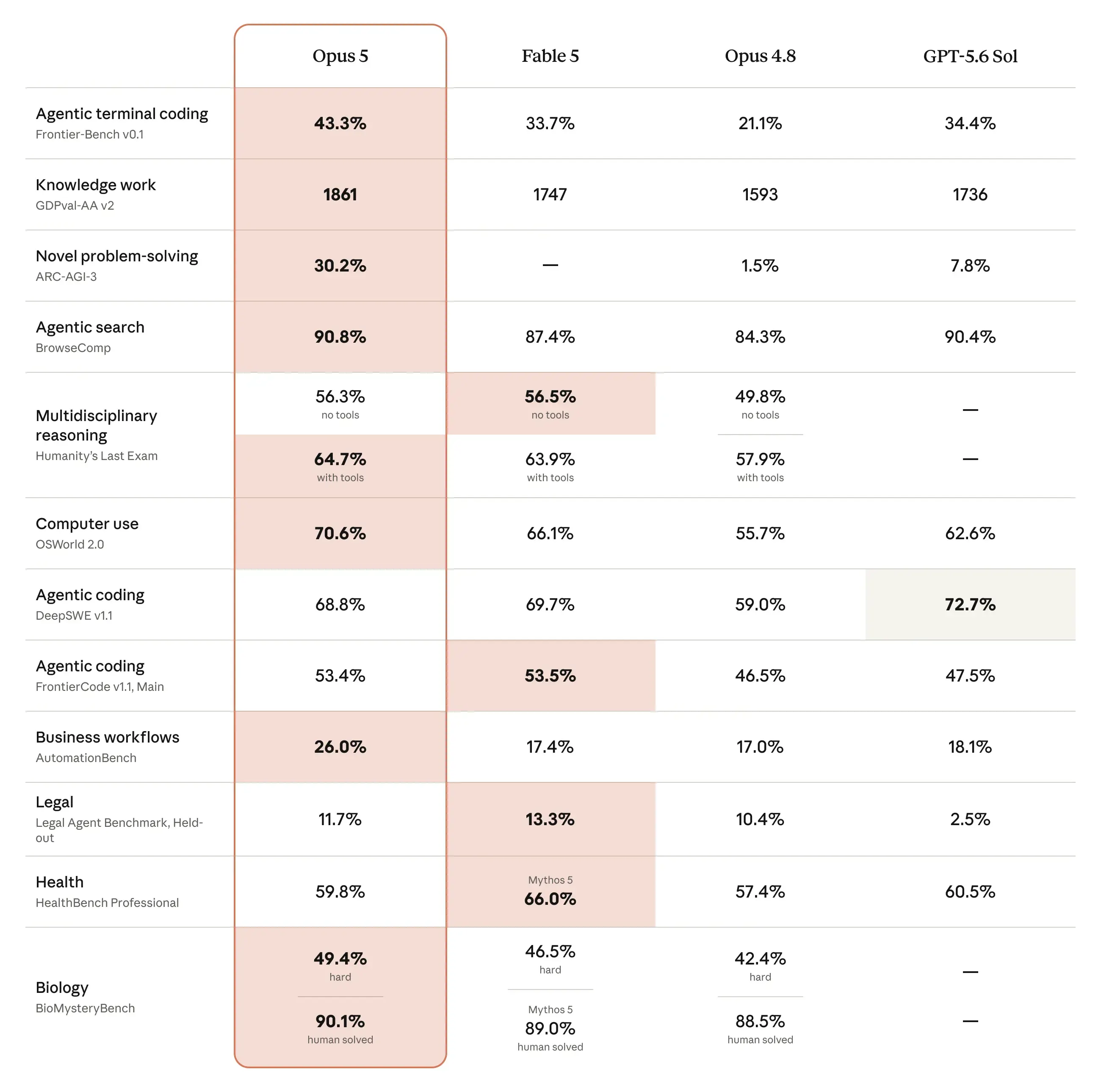
It may seem strange, but Opus beats Fable in almost every way that matters to the everyday user while not being classified as Mythos like Fable.
In Frontier-Bench v0.1 — a benchmark that tests whether AI coding agents can fully complete real software engineering tasks, and is scored as a percentage of tasks passed — Opus 5 achieved a score of 43.3%. Myth 5 came at 33.7%. GPT-5.6 Sol from OpenAI, Anthropic’s main commercial competitor, scored 34.4%.
The largest margin is found in the ARC-AGI-3, a test of real problem solving built on new puzzles that the model cannot save from the training data, and is scored as a percentage of puzzles solved. The percentage of authorship 5 reached 30.2%; GPT-5.6 Sol scored 7.8%; Fable 5 has not been tested at all. In GDPR (GDVval-AA v2) — a benchmark of cognitive work scored via Elo ratings, a chess-style rating system used to measure relative performance on real professional tasks — Opus 5 reached 1,861 versus 1,747 for Fable 5 and 1,736 for GPT-5.6 Sol.
Zapier tested Opus 5 on AutomationBench, an evaluation that scores whether a model can execute a complete business workflow from start to finish without human assistance. Their verdict: The model “took an initial account health classifier and ran the entire churn prevention sequence from start to finish: flagging accounts at risk, alerting the appropriate owner, and summarizing retentions. Previous models didn’t work; Opus 5 hit 100%.”
Anthropic is also promoting Opus 5 as a research upgrade. Ultima Genomics, a DNA sequencing company, said the model “behaves more like an accurate scientist than any model we’ve run. It hits the right statistical tests to rule out confounders, verifies its results with independent methods, and stays on track through long, multi-step analyses.”
However, these two areas – legal and health – are the only areas in which Fable 5 excels by any margin.
The release comes a week after Moonshot AI, a Beijing-based startup backed by Alibaba, unveiled Kimi K3 — a 2.8 trillion-parameter open weight model (meaning anyone can download the underlying code to run it independently) that Moonshot describes as the world’s largest open AI system. Independent benchmarks consistently place Kimi K3 in third place overall, behind both Fable 5 and GPT-5.6 Sol, beating out those two in select areas.
Opus 5 is now available via API at $5 per million input tokens and $25 per million output tokens. (Symbols are the basic unit of information that an AI model can process into both input and output.) There’s also a fast mode that runs at about 2.5 times the default speed, and at twice the base price — $10 per million input codes and $50 per million output codes.
This release may end the worry about Fable 5 not being available to the public. Opus is also available via subscription to everyone.
Daily debriefing Newsletter
Start each day with the latest news, plus original features, podcasts, videos and more.



