

TL;DR: The weak CPI reading in Australia prompted all four major banks to agree that the Reserve Bank of Australia’s tightening cycle is over for now, prompting… Australian Dollar/US Dollar Below its rising channel with the 0.6750 area emerging as the next major support group.
Why would the printing of the CPI change this story?
Australia’s weaker inflation report is more than just another surprise for the Consumer Price Index (CPI) – it marks the point at which markets have concluded that the Reserve Bank of Australia’s tightening cycle has effectively run its course. This shift in policy expectations led to a sharp decline in… Australian Dollar/US DollarBut its effects extend beyond Wednesday’s trading session. With expectations of further RBA tightening quickly fading, the Australian dollar is losing one of its few remaining domestic pillars of support.
What the data actually showed
The inflation data itself provided little justification for another increase in interest rates in the near term. The headline CPI slowed from 4.0% to 3.8% on an annual basis In June, while average inflation remained unchanged at 3.6%. The quarterly figures echoed the same trend, with headline inflation falling from 4.1% to 3.8%, and average inflation rising only modestly from 3.5% to 3.6%.
But the more important detail was how these numbers compared to the Reserve Bank of Australia’s forecasts. Both monthly and quarterly metrics came trimmed less The Central Bank’s forecast for May is 3.8%. This result effectively validated the ruler Michelle Bullock Comments on Tuesday that core inflation had developed broadly as expected since May – while also hinting that the process of disinflation may be progressing a little faster than policymakers themselves had expected.
Westpac reversal seals rare consensus among banks
The biggest surprise came from Westpac. As of Wednesday, it was the only one of Australia’s big four banks still expecting to raise interest rates again in August. Following the CPI release, Westpac abandoned that call, and now expects the RBA to remain on hold for the rest of 2026 – leaving the door open only for a conditional risk of a rate hike in November if inflation returns to accelerate sharply during the third quarter.
This amendment carries an importance that exceeds the expectations of any economist. For the first time in this intensive course, All four major Australian banks We are united in expecting the RBA to leave policy unchanged until the end of the year based on current information. This consensus reinforces the perception that Australia’s monetary tightening phase may be over – unless a new inflationary shock occurs, such as another sustained rise in oil prices.
Where the risk turns now: The Fed and Asian stocks
Attention is thus shifting away from Australia and towards global developments. Domestically, the policy story is largely settled for now. As for externally, Australian Dollar/US Dollar It still faces several potential downside catalysts.
- The first is Federal Reservewith the Federal Open Market Committee’s interest rate decision scheduled today. Cleveland Fed President Beth Hammack and Dallas Fed President Lori Logan are widely expected to vote in favor of another interest rate increase. If additional members of the Federal Open Market Committee also dissent, markets will likely interpret the result as a more hawkish signal than currently expected — supporting higher Treasury yields and extending recent dollar strength.
- The second is Regional risk sentiment Asian stock markets remain fragile despite Wednesday’s brief rebound. Renewed selling in technology stocks has already propelled the market Cosby It’s down nearly 17% this week, while pressure continues to build across the broader AI sector. Given the Australian dollar’s strong correlation to Asian equity performance and global growth outlook, a deeper regional correction could reinforce downward momentum.
ActionForex’s technical view on AUD/USD
The artistic image has already begun to reflect this deteriorating background. The AUD/USD pair has decisively broken below its short-term upward channel after again failing to overcome the bearish 55 D EMA near… 0.7004. Price action strongly suggests that the bounce from 0.6864 ended at 0.7026 as merely a corrective rebound within the broader decline from 0.7277.
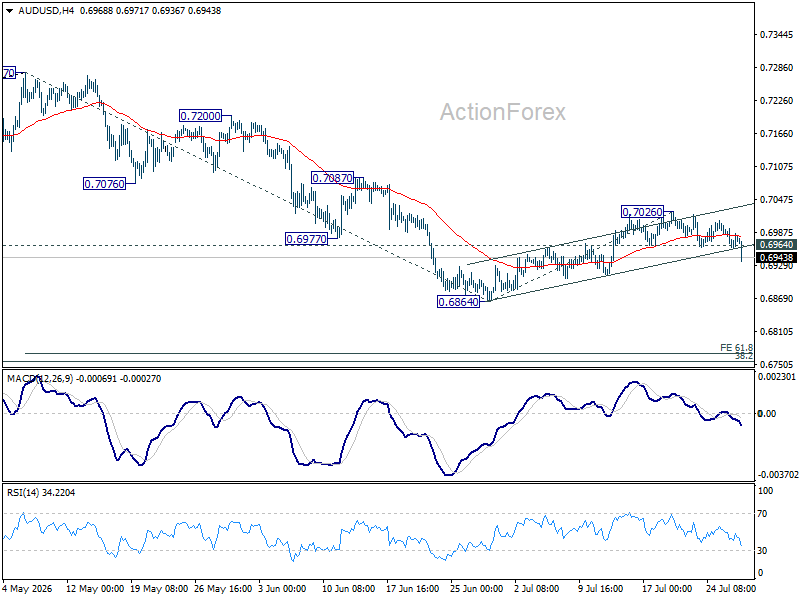
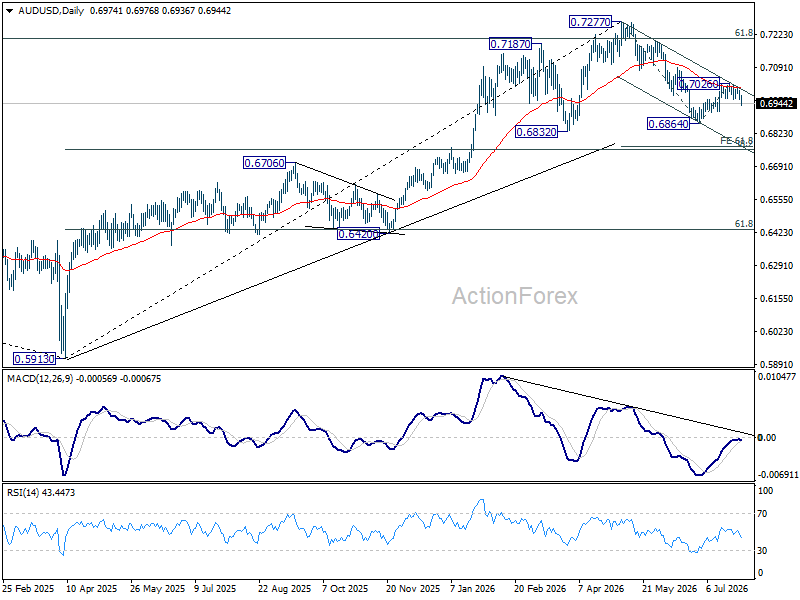
As long as highs remain limited below the 55-hour moving average for four hours 0.6981The path of least resistance remains. Retest 0.6864 We should see next, with a sustained breakout opening the way to a 61.8% forecast from 0.7277 to 0.6864 from 0.7026, at 0.6771. This level is located just above key medium-term Fibonacci support – the 38.2% retracement from 0.5913 to 0.7277, at 0.6756 – Create a critical support group around her 0.6750.
Whether buyers are willing to defend that area should decide whether the broader uptrend from 0.5913 remains intact or gives way to a much deeper decline in the medium term.
Key takeaways
- Australian Q2 data trimmed the average CPI which came in below the Reserve Bank of Australia’s forecast of 3.8% in May, validating Bullock’s “develop as expected” framework.
- Westpac abandoned its only call for a rate hike in August, leaving all four major Australian banks aligned with the RBA until the end of the year.
- Today’s FOMC decision and continued weakness in Asian stocks (KOSPI is down ~17% this week) are now the dominant risks for AUD/USD, not domestic politics.
- The AUD/USD pair broke its short-term rising channel after failing at the 55 EMA (0.7004), with the bounce at 0.6864-0.7026 now considered corrective.
- The 0.6750 area is the key support area to watch, and a break above it opens the door to a deeper decline in the medium term; Holding it keeps the broader uptrend from 0.5913 intact.



