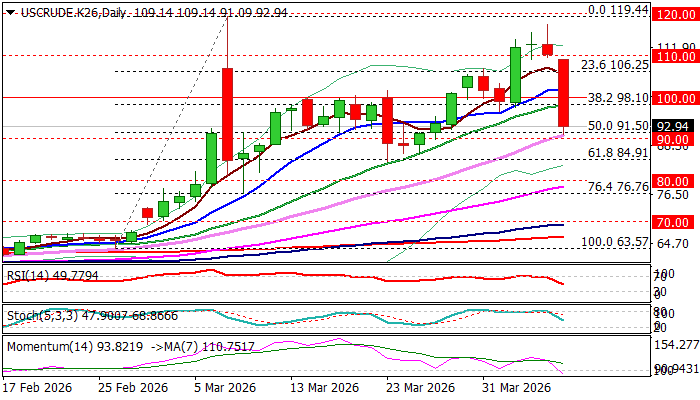
The price of West Texas Intermediate crude fell sharply on Wednesday, losing about $18 in early Asian trading, in response to a two-week ceasefire decision between the US, Israel and Iran and the (not fully closed) reopening of the Strait of Hormuz providing relief.
The deal represents the first step towards long-term peace in the region and temporarily neutralizes fears of further escalation that would make oil prices rise significantly and cause a domino effect on the global economy (higher inflation, higher interest rates, and slower economic growth will lead to a recession).
Although the ceasefire remains fragile, oil prices fell significantly in an immediate reaction that boosted optimism.
The technical picture on the daily chart has weakened after the recent sharp decline that formed a large bearish daily candle (biggest daily loss since March 9), with 14-day momentum breaking into negative territory and the RSI/Stochastic trending south, contributing to a bearish signal on the breakout of the $100 area (psychological) and $98.00 area (38.2% Fibo from $63.57/$119.44/). 20DMA).
The bears found a temporary foothold at the $91.00 area (after breaking through the 50% retracement at $91.50) as the move takes a breather after a huge loss earlier today.
The consolidation is likely to be preceded by a new push lower (if the situation on the ground continues to inspire optimism), with a violation of the $90 area validating the negative signal and exposing the next breakout point at $84.50 (higher low on March 23), the loss of which would complete the double top pattern on the daily chart and further weaken the structure in the near term.
A daily close below the broken support at $98.10 would be the minimum requirement to keep the new bears intact and offer better levels to re-enter the bear market, while a return and close above $100 might raise the bears’ suspicions.
Accuracy: 96.50; 98.10; 100.00; 101.93
SOP: 91.09; 90.00; 86.45; 84.50