

- Bitcoin price faces the risk of a prolonged downtrend to $57,000 amid the collapse of the bear flag.
- Market participants expect the Fed to maintain current interest rates in the near term.
- Cryptocurrency Fear and Greed Index of 9% indicates weak market sentiment
Leading cryptocurrency Bitcoin showed low volatility in sideways trading during US market hours on Friday. The daily candle highlighted a short-bodied neutral candle at around $66,929, reflecting the confrontation between buyers and sellers. The uncertainty can be linked to a strong March 2026 Job dataWhich reduced investors’ expectations of an interest rate cut by the Federal Reserve later this month. However, the latest market data shows that the Bitcoin price has matured into a leading indicator of Fed policy rather than a reactive asset. Here are the key levels that investors should watch in April 2026.
BTC deviates from Fed policy as institutional demand rises
In March 2026, U.S. nonfarm payrolls rose by 178,000, the highest monthly growth since December 2024 and the first positive growth in two months, with the previous month showing a revised decline of 133,000. The unemployment rate fell to 4.3 percent from 4.4 percent the previous month.
This reversal comes against the backdrop of stagflation fears stemming from mixed signals and external demands such as the current battle with Iran and rising oil prices. Market participants expect the Fed will likely keep current interest rates unchanged during its next meeting, as it faces inflation threats and is uncertain about growth potential. This would be a typical drag for risky assets, like Bitcoin and the rest of the cryptocurrency industry.
However, Bitcoin appears to be reflecting a future economic recovery before official policy changes. Before 2024, it was Bitcoin Loosely threaded With Fed decisions, prices rise after any cut and fall after any increase. The introduction of spot Bitcoin ETFs has changed the structure by attracting institutional investors who invest capital depending on what is expected to happen six to twelve months in advance, rather than in response to today’s events.
By having institutions as marginal price setters, Bitcoin has become the leader of expected action from the Fed rather than a late one. Easing cycle data provided by Binance Research indicates that Bitcoin followed policy adjustments with a pre-ETF correlation of +0.21. After the ETF, it turned negative to -0.778 in a fifteen-month lag, meaning that Bitcoin is currently anticipating seeing up and down cycles rather than reacting to them.
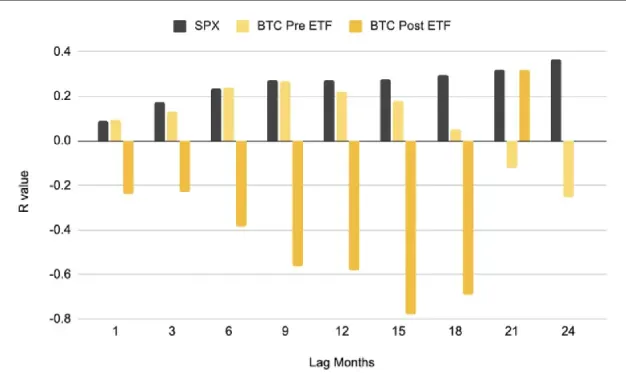
The recent price movements represent temporary fluctuations in a market that has become rich in terms of institutional participation and increased global liquidity facilities.
Bitcoin price eyes $57,000 amid bearish pattern breakdown
During the past two weeks, Bitcoin price It saw a steady correction from $76,000 to the current trading price of $67,000, recording a loss of approximately 12%.
While the decline came on the heels of broader market uncertainty amid geopolitical tensions in the Middle East, the currency price saw a significant collapse from the flat, inverted pattern on the daily chart. This chart pattern is commonly spotted among an established downtrend as the temporary relief rally it brings allows sellers to regain their downside momentum.
With the recent collapse, Bitcoin price holds higher odds for a sustained correction towards the immediate support level at $62,500, followed by a deeper decline towards $57,000.
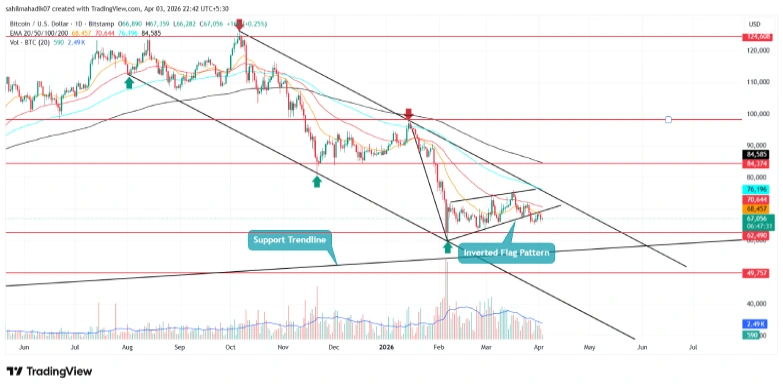
Conversely, a bullish breakout from the $72,000 mark could push Bitcoin price above the major resistance trend line of the current correction trend.



