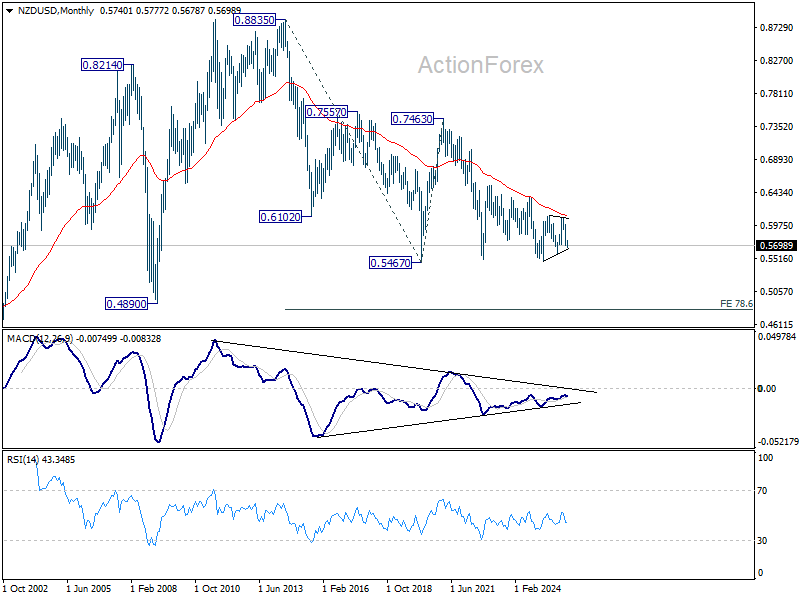
The Reserve Bank of New Zealand is widely expected to leave the policy rate unchanged at 2.25% in the upcoming Asian session, with the consensus biased strongly around a hold. NZD/USD could see a comfortable bounce if the RBNZ delivers a hawkish hold, but the broader downtrend is unlikely to reverse as weak domestic demand and global risks continue to limit the upside.
With the decision largely decided, attention will shift to the statement and post-meeting press conference, where tone – not action – will drive market reaction. The key issue is how the Reserve Bank of New Zealand interprets the current oil-induced inflation surge against the backdrop of falling domestic demand.
This puts the central bank in a familiar dilemma: Oil-driven inflation versus fragile growth. The headline inflation rate is hovering above the top of the 1% to 3% target range at 3.1%, but policymakers may choose to “see through” the shock if it is seen as temporary. However, no worries about Effects of the second roundEspecially with regard to wages and expectations, it would make the situation more stringent.
At the same time, signs of economic fragility began to appear. GDP momentum has declined and unemployment has tended to rise towards 5.4%. This makes policymakers cautious about tightening monetary policy prematurely, even as inflationary pressures remain high.
The outcome is likely to depend on future guidance. A Tight contractemphasizing stable core inflation and leaving the door open for future price rises, could lead to a comfortable bounce in the NZD/USD pair. A A dovish decadeThe focus on excess capacity and weak demand is likely to reinforce downward pressures.
Technically, the NZD/USD pair, which is trading at around 0.5700, remains trapped within a one-year consolidation pattern that started at 0.5484 (April 2025). It is possible that the consolidation pattern has completed with three waves to the level of 0.6092 (January 2026). But the subsequent downside momentum does not guarantee a range breakout yet.
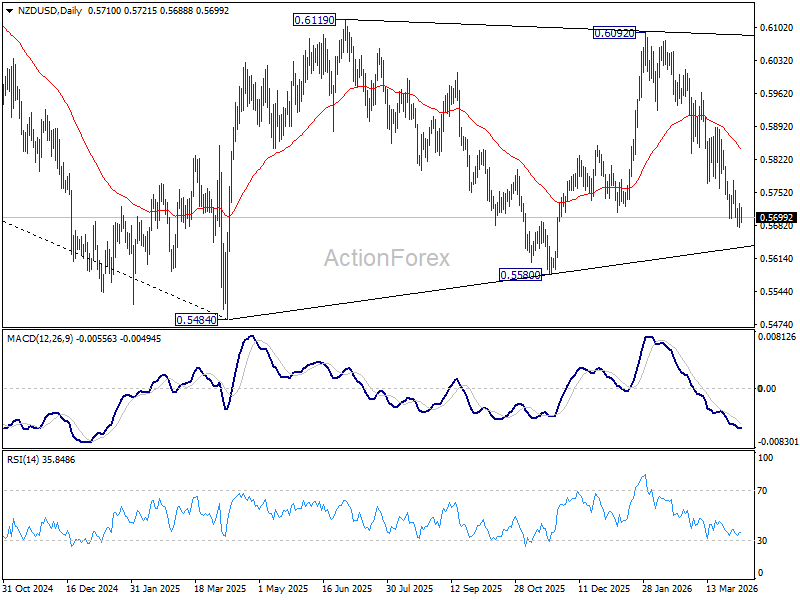
In the near term, the risk will remain on the downside as long as the 55 D moving average (now at 0.5843) holds in the event of a recovery. Any future downward acceleration, and a break of the support at 0.5580 will indicate that the long-term downtrend is ready to resume through 0.5484.
On the other hand, a strong breakout of the 55 D EMA will indicate that the consolidation pattern is indeed a five-wave triangle, and we will see another bounce towards the 0.6092 resistance level before the consolidation is finally completed.