
Institutional cryptocurrencies are now focusing on controlled access. Large financial companies use on-chain systems for repo operations, treasury activity and cash management within environments built around compliance and permissions. Meanwhile, public DeFi still provides liquidity, persistent markets, and programmable financing. In 2026, these two systems will begin to communicate.
This setup results in an on-chain market with different users, tools, and priorities. While permissioned networks give institutions management and oversight, public chains provide liquidity and applications that institutions still want access to.
Symbolic vaults It is also gaining status as a low-risk asset for compliant capital, while cross-border settlement still depends on whether legal and compliance systems can work across jurisdictions. Retail users enter through fintech apps with accumulation in mind, while early cryptocurrency holders are more focused on preservation.
To explore where all this is headed, BeInCrypto spoke exclusively with Federico Variola, CEO of VimexFernando Lillo Aranda, Marketing Director at Zomexand Pauline Shanjit, Chief Organization Officer at Change now.
Permitted chains still need public liquidity
TradFi’s connection to public DeFi is formed through regulated gateways. Institutions want access to cross-chain liquidity and settlement, but they also need identity verification, permissions, and compliance controls. As a result, the market is developing systems where regulated participants can operate in gated environments while remaining connected to public chains.
The gap between private institutional networks and open DeFi is already making room for a more connected model, says Shanjeet. She says”
“For years, people have been acting like permissioned institutional chains and public DeFi are oil and water. One is for compliance and one is for actual liquidity. What they are doing is building pipelines, not just mixing.”
Avalanche is one example. Evergreen’s work around Spruce has been used in coding testing, while Avalanche Warp Messaging allows communication between Avalanche-based environments. ZKsync It seeks to achieve a similar idea through enterprise-focused systems tied to Ethereum.
The result is a market where institutions can connect to public cryptocurrencies without giving up control over access, counterparties, and governance.
Tokenized Treasuries are becoming the standard, but not for everyone
Tokenized treasury bills and government bonds have become a standard asset for cross-chain compatible capital. By late March 2026, the token US Treasury market reached approx $12.31 billionWhich gives the category real weight in digital asset markets.
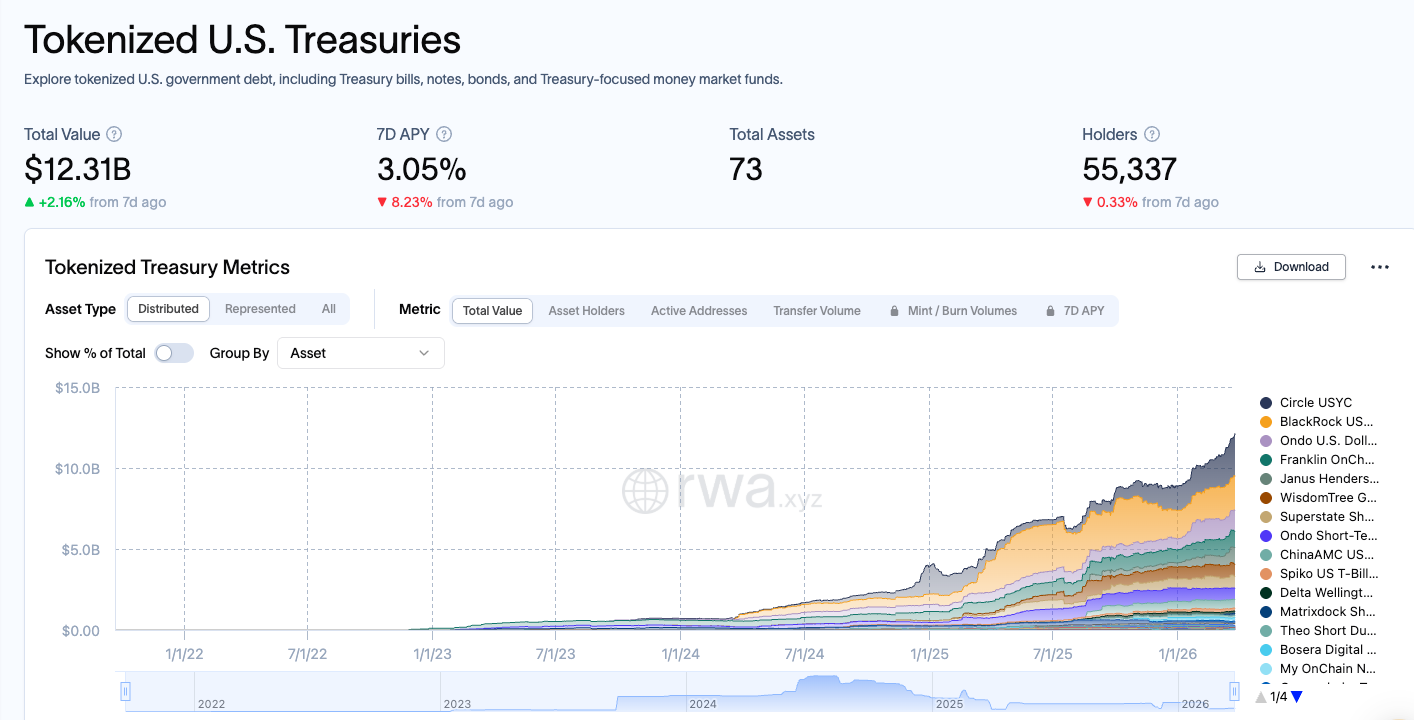
Variola sees this as a strong sign of DeFi’s evolution:
“Yes, the tokenization of treasury bills and government bonds is perhaps one of the clearest signs of maturity for the DeFi ecosystem. The larger this market becomes, the more mature the DeFi space is considered to be. This may also indicate that participants in the DeFi ecosystem are gradually moving away from purely risk-prone transactions towards risk-averse capital preservation strategies.”
“In this sense, it could represent a shift where the cross-chain economy begins to move from pure speculation towards something closer to traditional finance, but with the benefits of simpler cross-border settlement and more efficient international money transfers.”
For funds, Treasuries and other compliant investors, token government debt provides a familiar, low-risk asset with yield and convertibility.
Shanjit agrees, but says this standard serves a specific part of the market:
“Look, the numbers don’t lie. Tokenized Treasuries and government bonds are now worth over $10 billion, up from nothing 18 months ago. BlackRock’s BUIDL alone is $2.5 billion, and they move it through Solana, Arbitrum, and BNB Chain, where institutions mainly want to store cash. Ondo’s OUSG and USDY do the same thing with slightly different compliance wrappers.”
“So, yes, on-chain Treasuries are real, and for the KYC crowd, ‘we have a compliance team,’ they have definitely become a risk-free standard.”
In her view, tokenized Treasuries have become a standard for regulated capital, while retail DeFi users still rely more on stablecoin lending rates and permissionless money markets.
The difficult problem is legal certainty
Cross-border settlement still faces the same problem every time capital moves between jurisdictions. Tokens can move instantly, but legal and operational conditions do not. Different countries apply different rules on custody, disclosure, transfer restrictions, and compliance, so technical settlement and legal finality do not always go together.
Lilo Aranda says the real challenge lies beyond blockchain speed:
“The biggest hurdle is not the coding itself — it’s the interoperability between legal, technical, and operational systems that were never designed to move at the same speed.”
“From a technical perspective, 24/7 settlement requires synchronized standards around identity, messaging, collateral recognition, finality, and compliance automation. A token can move instantly, but that does not mean surrounding regulatory obligations settle with it instantly.”
“Different jurisdictions will also define asset classification, custody, disclosure, and transfer restrictions differently. So the real bottleneck is not the throughput of the blockchain — it is the fragmentation of cross-border regulatory logic.”
“In other words, we already know how to move value globally in real time. The challenge is to make this movement legally interoperable, auditable, and institutionally acceptable across multiple systems simultaneously.”
His point gets to the basic issue. The technology is ready for continuous compromise, but the operating environment is still dependent on fragmented national rules and standards.
Shanjeet makes a similar point. In her view, the hardest part is convincing countries and financial systems to accept compatible rules at the same time.
For on-chain finance, this leaves cross-border settlement in the lurch. Continuous transportation is possible. Continuing orderly settlement across multiple jurisdictions remains much more difficult.
Retail piles up while OGs maintain
Retail crypto users They enter the market with a different mindset than first-generation stockholders. The previous cycle rewarded conviction and tolerance for volatility, while the current cycle breeds consistent portfolio building through fintech apps, frequent purchases, and products with accessible returns.
The split comes down to incentives, says Shanjeet
“I think the difference is not age or wealth. It’s when you got in and what you’re trying to do. There are two groups operating in parallel realities… one in accumulation mode, the other in conservation mode.”
“Wealth accumulation (Robinhood/Revolut crowd). This is the grinding stage. They’re not waiting for 100x. They’re DCA’ing 10+ assets, chasing 5-15% returns, and using apps that now allow them to buy into proprietary tech trades like Databricks along with their cryptocurrencies. It’s methodical, returns-aware, and boring by design. The goal is to accumulate consistently, not to win the lottery.”
“Wealth Preservation (Early Adopters). These people bought BTC at $500 or did ARB airdrops. They’re not trying to 10x anymore, they’re trying not to lose what they already have. This means rotating speculative bags into productive assets like staking, tokenized treasuries, and lending on Morpho. They’re also exiting the casino early because the token supply per user has exploded 24x since 2021. Their cold storage holds With the basic stack only for yield and tax efficiency.
“So one group is building a strong, diverse kingdom. The other group already has a kingdom and is just trying to keep the walls from collapsing.”
One group gradually builds positions through mainstream applications. The other focuses on protecting wealth and reducing volatility. In 2026, retail cryptocurrencies will be divided between accumulation and safekeeping.
Final thoughts
Institutions want to control access to public liquidity. Tokenized Treasuries have become a reference asset for compliant capital, while cross-border settlement still depends on whether legal and operational systems are able to work across jurisdictions on an ongoing basis.
The experts in this article point to the same conclusion from different angles.
- Federico Variola sees tokenized government debt as evidence of a more mature DeFi market built on preservation of funds as well as return.
- Fernando Lillo Aranda identifies the main challenge in cross-border finance as legal and operational interoperability rather than blockchain speed.
- Pauline Changit describes a market in which permissioned networks and public DeFi connect through controlled access, while institutional and retail users continue to follow different paths.
What will emerge in 2026 is an on-chain financial system that services different types of capital in different ways.
Public cryptography provides liquidity and composability. Structured finance brings governance, compliance and familiar, low-risk assets. The meeting point lies in the links between them.
this post The economy is divided across the chain into two parts appeared first on BeInCrypto.



