

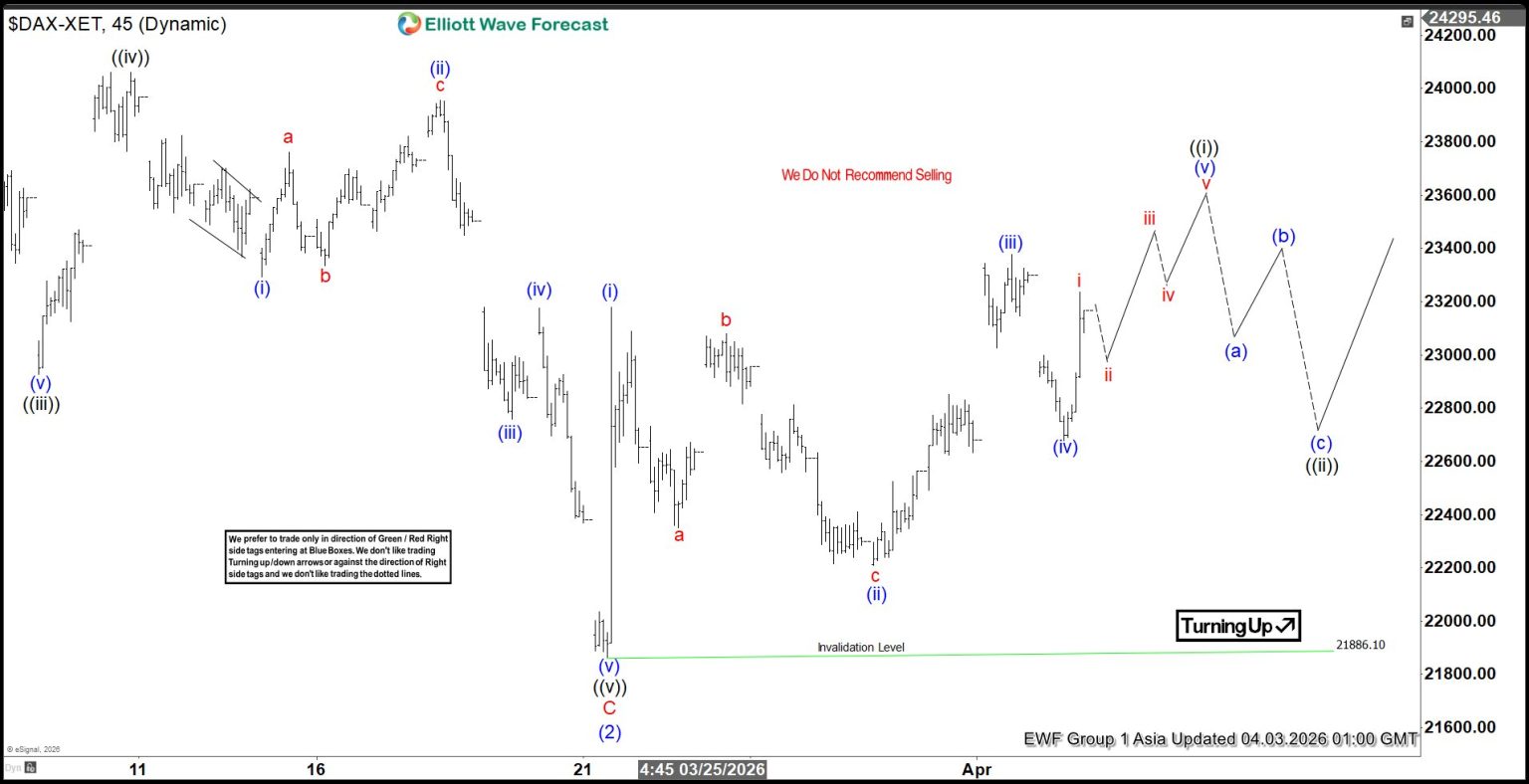
The DAX saw a notable correction from its high on July 11, 2025, appearing in a complex flattening and expanding Elliott wave structure. From that peak, wave A concluded at 22,943.06, followed by a rise in wave B that ended at 25,507.79. The indicator then reverses down into wave C, which splits into a clear five-wave impulse. Specifically, wave ((i)) ended at 24,349.54, wave ((ii)) fell to 25,405.97, and wave ((iii)) fell to 22,927.55. A modest recovery in wave ((iv)) reached 24,061.15, before the final wave ((v)) fell to 21,886.1. This completed wave C of (2) at a higher degree, indicating the end of the corrective phase.
From this bottom, the indicator turned upward in wave (3). However, confirmation of the ongoing bullish cycle requires a breakout above the previous high of wave B at 25507.79. Without this, the risk of double correction remains. From wave (2), wave (i) advanced to 23,178.7, while wave (ii) retreated to 22,209.45. The subsequent rise in wave (iii) reached 23,377.65, followed by a decline in wave (iv) to 22,677.92. It is expected that another wave upward will complete wave (v) of ((i)). After that, the index is supposed to undergo a corrective phase in wave ((ii)), processing the cycle from the low of March 23, 2026, before resuming its upward path.
In the near term, as long as the pivot at 21886.1 remains intact, declines are expected to attract buyers. These corrections are likely to unfold in 3, 7 or 11 swings, supporting further upside potential. This structure underscores the importance of maintaining the main pivot awaiting confirmation by a decisive break above 25507.79
45-minute Elliott wave chart for DAX
Dax Elliot Wave Video
You are currently viewing placeholder content from shortening. To access the actual content, click the button below. Please note that doing so will result in data being shared with external service providers.



