

- USD/JPY price analysis is leaning to the upside as the dollar recovers due to the Fed taking control and the US Senate agreeing to avoid a shutdown.
- The Bank of Japan remains very accommodative, making the yield spread unattractive to yen buyers.
- Currency market intervention warnings keep yen losses under control.
USD/JPY is consolidating after recent gains. The pair remains supported by yield spreads. US Treasury bond yields are still higher than Japanese government bond yields. This keeps carry trades attractive.
Markets tempered aggressive expectations for interest rate cuts from the Federal Reserve. Stronger-than-expected US data and flat services inflation have delayed the timing of targeted easing. Futures now point to a slower, shallower path to rate cuts. This supports the US dollar side of the pair. Furthermore, an agreement was reached between President Trump and the US Senate to prevent a shutdown, giving bulls more room to maneuver.
–Are you interested in learning more about ETF brokers? Check out our detailed guide-
On the Japanese side, the Bank of Japan has moved away from strict yield curve control. However, the policy remains very accommodative. Japanese short-term interest rates remain near zero.
Compared with the United States, real yields in Japan are low and unattractive. This makes it difficult for the yen to continue rising. However, the risk of verbal intervention by Japanese authorities remains high. Officials have reiterated that they will retaliate if the yen loses much of its value.
Sharp moves above key psychological levels have prompted the Bank of Japan to act in the past. This could cause sudden, short-term pullbacks in the USD/JPY. But intervention alone may not be sufficient to change this trend for the better unless the gap between policies is narrowed.
Positioning is another factor that drives the pair. Many investors buy USD/JPY through carry structures. When risk sentiment changes, it can make moves bigger. Falling yields in the US, equity corrections, or growing recession fears may prompt investors to trim their positions. This would support the yen for a short period.
Going forward, USD/JPY is likely to track US Producer Price Index data today. Upside risks remain if US bond yields rise again and the Fed signals they will be “higher for longer.” Downside risks arise if growth slows in the United States, inflation falls more quickly, or markets reprice previous cuts. Any sign of more decisive normalization from the Bank of Japan would favor the Japanese yen as well.
Technical price analysis of USD/JPY: W pattern
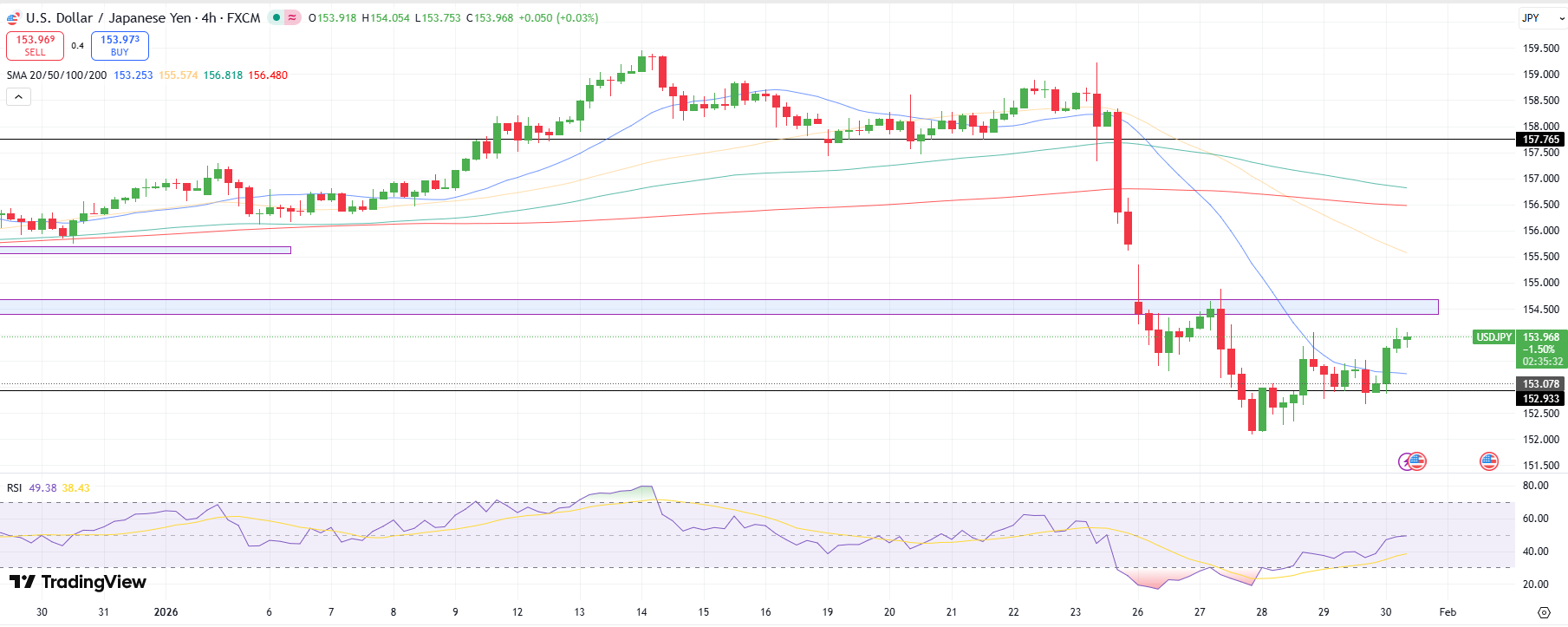
The 4-hour chart of the USD/JPY pair is showing a bullish reversal forming a “W pattern”. The pair moved above the 20-period moving average, while the RSI also rose to 50.0. The broken central demand zone around 154.50 now acts as a major hurdle for buyers.
–Are you interested in learning more about Forex brokers in south africa? Check out our detailed guide-
A sustained move above 154.50 may gain more momentum and test the 100-day moving average at 155.60 to fill the bearish gap formed at the beginning of the week. On the downside, the pair may test Thursday’s lows around 152.70 before weekly lows around 152.00.
Are you looking to trade Forex now? Invest in eToro!
68% of retail investor accounts lose money when trading CFDs with this provider. You should consider whether you can afford to take the high risk of losing your money.



