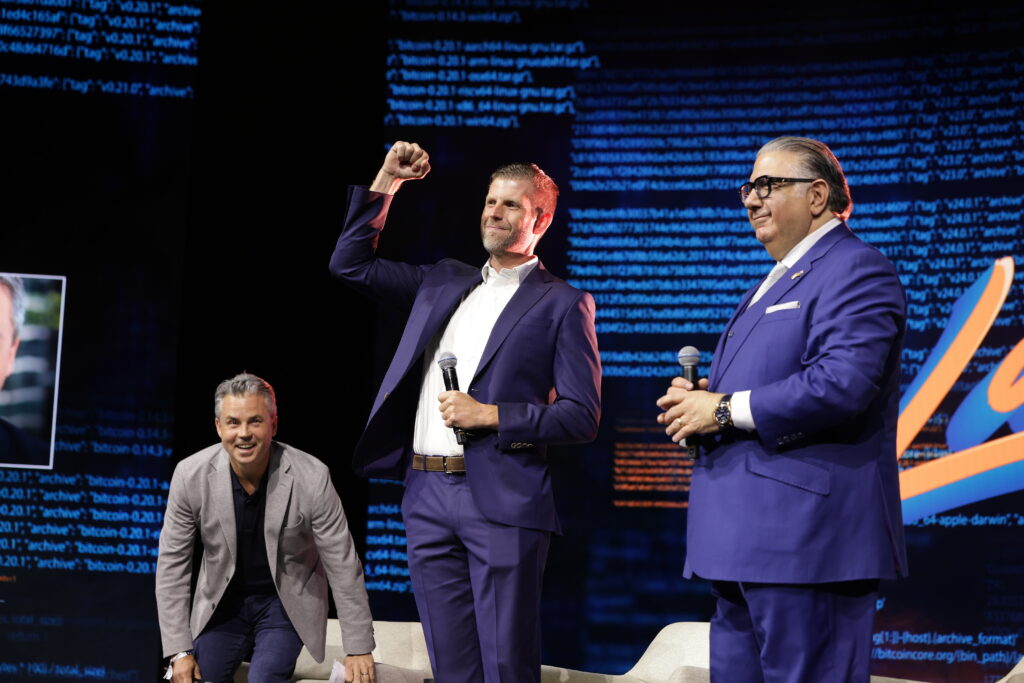
At Bitcoin 2026 in Las Vegas, Eric Trump and Calamos Investments CEO John Koudonis sat down with Bloomberg’s chief ETF analyst. Eric Balchunas For a panel that covered Bitcoin’s maturation from a speculative instrument to a global reserve contender.
The conversation ranged from institutional adoption, shrinking government banking, currency devaluation, and the challenge of winning over mainstream investors who still view bitcoin as too risky, too complex, or both.
It was a panel that reflected how much the room had changed — a mix of long-time Bitcoin believers and new institutional money who, a decade ago, would have rejected the caucus entirely.
Trump: Bitcoin is a sticky asset with limited supply
Trump opened his speech with a structural theme, arguing that Bitcoin has become “sticky.” He said the US government now owns approximately 300,000 bitcoins and will not sell them, a claim consistent with the creation of bitcoin. US Strategic Bitcoin Reserve.
Corporate treasury buyers e.g strategy and Meta Planetwhose holdings exceeded 40,000 BTC by the end of the first quarter of 2026, is doing the same. The world’s largest financial platforms – Trump named Charles Schwab and Morgan Stanley -I also moved in.
American Bitcoin, the company Trump co-founded, mines bitcoin and holds each coin rather than selling it.
“We are squeezing Bitcoin,” Trump said. “There is a limited supply.”
The argument, in essence, is that natural sellers are leaving the market as a new class of permanent holders take their place.
Koudonis places the argument for bitcoin supply compression in the context of a broader capital shift. quote research He predicted $124 trillion in wealth would be transferred across generations through 2048, and said the $60 billion that has moved into spot Bitcoin ETFs so far represents a small fraction of what is to come.
For context, $60 billion is roughly the size of the total book of a mid-tier US asset manager. In exchange for transferring $124 trillion of accumulated boom wealth to the heirs of Millennials and Generation Z who are much more comfortable with digital assets, it reads as a starting line.
Coudonis told the audience that the institutional conversation has already begun. “The question was: ‘Are you buying Bitcoin?’” he said. “Now the question is: What percentage will you allocate?”
Its conclusion is complete Institutional entry What it means for the asset: “Once institutions are involved, it’s game over.”
How can Bitcoin attract retail customers?
Balchunas pressed the two men about the hash challenge, asking them how they would sell bitcoin to his mother — an alternative for an older generation of investors who still worry about volatility and complexity. It’s a question the industry has never fully answered.
Bitcoin’s price history, with its 80% withdrawals and euphoric recoveries, is not a comfortable proposition for someone managing a steady retirement income.
In response to this quandary, Koudonis said Kalamos has built a line of protected bitcoin ETFs that limit downside and smooth returns, turning a perceived deterrent into an advantage for conservative investors who want exposure without the full ride.
The goal, he said, is to add bitcoin exposure to products that already look familiar to traditional investors.
Trump’s answer to the same question was more direct. He said that fixed income is not a real alternative in light of current returns.
“Do yourself a favor and invest in fixed income at 4%,” he said. “I’m going to invest in Bitcoin. I’m going to ride out the volatility and we’ll see who wins this equation over a 10-year time frame.”
He claimed that Bitcoin has averaged annual growth of nearly 70% per year over the past decade, and described it as “better gold,” adding that “every country in this world needs it.”
Trump’s overall argument wasn’t just about returning. He pointed to the weakness of the currency and geopolitical instability Iran specifically – As reasons why traditional store-of-value assets are under pressure, he argued that BTC’s ability to move value across borders without a banking intermediary is an advantage that becomes more valuable the more fragile existing systems appear.
He added that currency depreciation is real and ongoing, and that Bitcoin is designed to resist it. “Would you rather have the euro, or would you rather have bitcoin, an asset that has been growing 70% a year on average, year after year over the last decade? It’s not even close,” he asked.
Koudonis: Banks can “charge you” at any time
When asked why he became a preacher at all, Trump’s answer was personal. He described how major banks closed hundreds of Trump Organization accounts — covering buildings, golf courses and restaurants — in the wake of the Jan. 6, 2021, Capitol riot.
JP Morgan It has since been confirmed Those accounts were closed. Trump and the Trump Organization later Suit filed Against Capital One due to similar closures.
“They threw us away like dogs,” Trump said on stage.
His experience with banks, combined with what he described as slow and crowded bank transfers, led him to design censorship-resistant Bitcoin. “That’s why I’m so passionate about this industry,” he said.
In terms of usability, Trump acknowledged that early cryptocurrency technology was outdated, but said banks’ entry into the space will be the force that ultimately makes the experience simple.
“The industry will grow when the user experience is simple, easy and painless,” he said.
Coudonis expanded the dismantling argument beyond the Trump family. He relied on personal history, as he narrated the events of Greece in 2015 Debt crisiswhen the government imposed daily withdrawal limits on bank accounts that lasted nearly four years before capital controls were fully lifted.
Citizens woke up one day to find that the state had placed a cap on the amount of their own money they could access.
“You don’t have to be like Trump for banks to target you,” Koudonis said. “This could happen to anyone. You, me, any of us.”
The banks told you to stay away, and then you “infiltrated” Bitcoin
Koudonis then highlighted the behavior of the financial industry. While banks spent years publicly rejecting Bitcoin and warning customers away from it, they were building the infrastructure to invest in it out of sight.
“The banks got the proof,” he said, and gave the audience a clear summary: “You guys won.”
Trump concluded his speech with three statements that sparked the largest reaction in the committee. He called government spending “dangerous” and pointed to a federal investigation that found some government spending fraudulent, citing it as evidence of why a transparent, programmable, decentralized form of money has real value beyond circulation.
He said that if fraud of this scale is difficult to eradicate in the best-run country on Earth, it is a structural problem that Bitcoin’s transparent ledger is designed to address. He acknowledged that the overall backdrop has been difficult for coin holders over the past three months, but asked the public to stay the course.
He then concluded his remarks in clear terms: “I have absolute conviction that Bitcoin will reach $1 million… I have never been more optimistic about this asset class in my life.”