
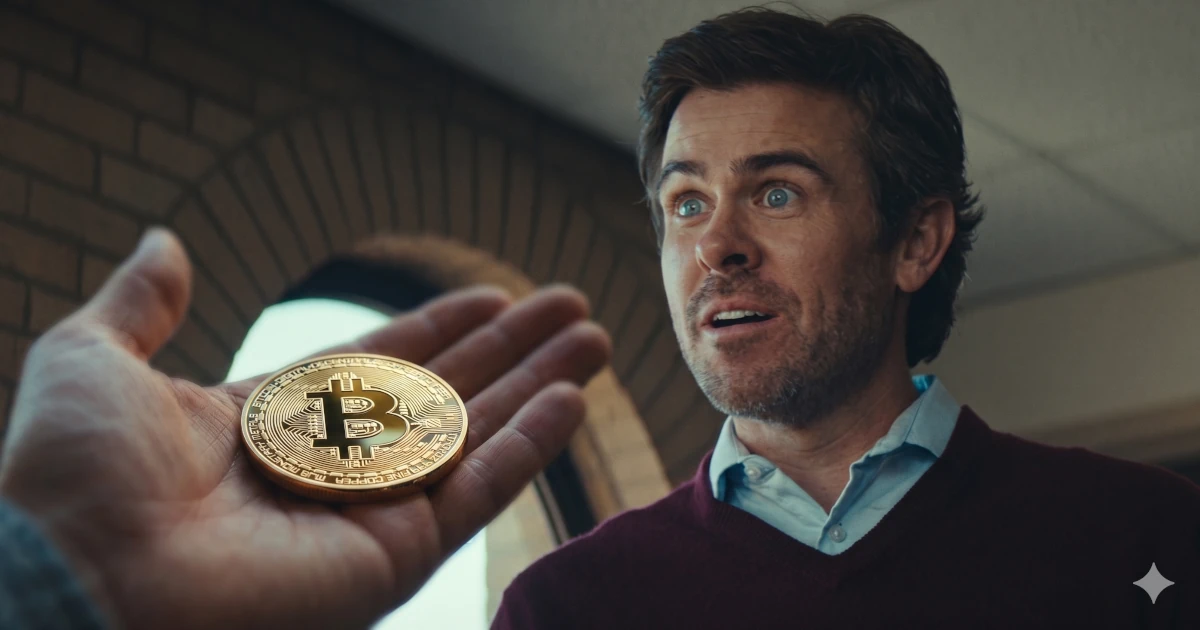
Into the Wild West of finance, where a forgotten password to your Bitcoin wallet can mean the difference between fortune and ruin, comes this 31-minute Bitcoin thriller. Self-custody (2026). Co-directed by Garrett Patten (who also plays the desperate lead) and Fernando Ferro, the small feature is produced by Patten’s company TBK Productions in association with Tucci & Company.
The film features Entourage alum Adrian Grenier in a key supporting role, along with UFC champion and Olympic gold medalist Henry Cejudo in his acting debut, and house star Odette Annable. After its Sundance special and receiving distribution from Inaugural Entertainment, Self Custody (2026) has arrived on Tubi and Plex before hitting Amazon Prime Video – offering a compact, terrifying yet entertaining story drawn from real-life stories of lost Bitcoin wallets.
Scott, the head of the family, finds himself in financial trouble after failing to get his finances in order when a family friend and accountant calls him. It turns out that Scott received a signing bonus from some of the tech companies he worked for in 2014, paid for in Bitcoin. Today, and presumably in 2020, that bounty is worth more than $14 million. The film follows Scott as he tries to claim this bitcoin, and soon realizes that his self-save setup is done incorrectly, and he doesn’t remember the wallet’s PIN.
The film is generally negative regarding self-custody as a practice, presenting the absolute worst-case scenario for a Bitcoin or cryptocurrency owner. A series of mistakes, presented as innocent but actually resulting from a lack of study or knowledge of technology and industry, results in Scott suffering a huge loss, in a very entertaining and action-packed way. It’s a testament to the maturity of the Bitcoin and broader cryptocurrency industry that a movie called “Self-Incubation” could end up on Amazon Prime, even if it paints a widely negative image of the technology, which is reimagining the financial system.
Overall, the film is worth watching, and we hope the directors and producers fall further down the rabbit hole and tell the stories of Ukrainians and Iranians who fled the war with their savings thanks to Bitcoin, to show the other side and upside of radical financial sovereignty.
Spoiler alert – detailed review
The film begins with a chilling statement: “It is estimated that more than 20% of all Bitcoin, valued at more than $200 billion, has been lost or stolen beyond recovery.” The prompt appears in white text on a black background, setting the stage for a story that is unlikely to have a happy ending.
The statement is also incorrect. The widely reported claim that 20% of Bitcoin is inaccessible, roughly 4 million Bitcoins, specifically refers to “missing” funds. This type of research is possible in part because we can see coins not moving for more than a decade and, in many cases, being mined to old addresses or wallet types that are obsolete or rarely used today. The primary source for the study is likely Chainalogy, in their 2017-era work on the subject, although the film does not provide a source for this claim.
According to the Investopedia websiteThe 3.7 million coins in question were lost, not stolen. Bad wallet setups, many in the early days of Bitcoin mining, have been lost, and much of this claim remains speculative, as it is not easy to prove that such currencies are truly inaccessible. The claim that many coins were stolen – especially from the self-guard – is not supported by the facts at all, and this claim is clearly there to set the mood of the film, in what we can generously call an artistic freedom over the reality at hand. If anything, a much larger amount of Bitcoin would have been stolen from centralized custodian exchanges trying to bring legacy, bank-like financial institutions into the Bitcoin world.

The first scene introduces the audience to Scott and his family’s financial advisor and friend Cooper, who delivers the good news. Scott, thanks to a Bitcoin-paid signing bonus from working with a tech company in 2014, is now rich! But there’s a problem: he has to have access to bitcoins, whatever that means.
Soon Scott is sitting in front of his computer, opening a folder containing $14 million in Bitcoin. We see a Trezor hardware wallet and what appear to be some seed boards. It’s unclear whether the plates are metal or just paper to write the 12 to 24 words that underpin a Bitcoin wallet, but what will soon become clear is that there are no words. Whenever Scott created this portfolio, he failed to write the magic words. Mistake number one.
It’s useful to note that in a normal self-custodial setup, you typically wouldn’t store magic words with a hardware wallet, which defeats the purpose of a hardware wallet’s PIN protection and advanced security features. If someone opened Scott’s desk drawer and found a Trezor, he could put it down and take the spare words—he had them backed up. Alternatively, a savvy Bitcoiner might engrave the words onto metal plates, of which there are many products on the market, and then bury them or hide them somewhere safer than his desk drawer.
The Trezor will then serve as its secure computing environment, which is connected to computers that can access the Internet. Trezor signs transactions within its own chip, and transmits the signed transaction to the user’s computer via a USB cable, creating holes in the user’s private keys, from the user’s computer that is most likely compromised. But this can happen if the user has the password, which Scott does not.

The user begins by trying to guess the pins and soon realizes that he or she has a limited number of attempts. This is not just to make life difficult for people; It’s a security feature that prevents a thief from trying pins forever until they find the right one. Once 10 failed attempts are made, the device deletes its contents, performs a factory reset, and deletes the Bitcoin keys. By the time Scott realizes he has no idea what the secret code is, he has two attempts left, which is not a good situation. Typically, the user will have the backup passwords somewhere to regain access even if the hardware wallet is wiped due to incorrect PIN attempts. But not Scott! No, he didn’t get one thing right.
It turned out that the 12 words had disappeared, and it is not clear where they went. Most, if not all, Bitcoin wallets are very annoying to the user about typing those words, with pop-ups and reminders. Even in 2014, wallets were very clear that not backing up these words could result in loss. Scott, we have to assume he didn’t take due care during the setup, and he didn’t listen to his boss at the time, Kevin, who we got to know later.
Scott’s wife, Amy, finds him lying on the office floor in disarray, papers and devices everywhere. He finally opened up to her about the situation after a bad fight the night before about the family finances. I convinced him to call Kevin, the cryptocurrency expert, the rich man who hired Scott in 2014.
We soon see Kevin in an airport hangar walking up to a cool-looking special assistant who is passing the phone to her boss, with Scott on the line. Kevin finds it in his heart and busy schedule to give a speech to his old employee and former friend, berating him for not writing the magic words, giving a speech about financial cryptocurrency revolutions, and coming across as a condescending and detached Silicon Valley billionaire. At one point, Scott asks if Kevin has ever had children, which he mocks. The conversation ends with Kevin putting Scott in touch with “the guy” who can break into Tresor.
Here’s the thing: There’s a lot wrong with this picture, at least when it comes to Bitcoin. Most of the rich Bitcoin users I have met are family men and women. They don’t spend their fortune on private jets; Instead, they are building their homes, home-schooling their children, and—much as in America—accumulating weapons. Far from the stereotype of the narcissistic high-tech billionaire portrayed here or on shows like Silicon Valley.
Also, a wealthy person may have better connections than scammer Kevin recommends via a single text message with a phone number. In fact, there are companies that specialize in recovery services, mostly focusing on locked wallets like Scott Wallet. Some of them are definitely scams, and as the movie points out in its credits, large-scale refund scams have been shut down by the feds. So it is important to do deep research about the people you are working with to recover a locked wallet. When it comes to cryptocurrencies stolen through hacking or fraud, there’s not much anyone can do about it; Cases can be reported to the Federal Bureau of Investigation (FBI), but there are few successful examples when it comes to anonymous cybercrimes.
One company that has gained a good reputation in providing wallet recovery and self-custody consulting services is Bitcoin methodAnother famous company in this field is Casa.
Anyway, the recovery contact Kevin passed along convinces Scott to drop the Trezor into an anonymous drop box, and well… let’s just say things don’t go well from there. But I’ll let you Experience the ending for yourselfbecause it’s rather entertaining.
The film ends with this on-screen rant that requires some context: “In 2025, American consumers lost more than $9.3 billion to cryptocurrency scams.” What the statistics miss is that financial and identity fraud exceeds $50 billion for legacy financial crimes.
In 2012, for example, $24 billion in identity theft was reported. Double what was collected from other forms of theft in the same year. According to Business Insider, the Bureau of Justice Statistics shows that “identity theft cost Americans $24.7 billion in 2012, a Home burglary, car theft, and property theft With a total value of only $14 billion. Eight years later, that number had doubled, at great costs to the Americans 56 billion dollars in losses in 2020. If this trend continues, which there is little reason to assume has slowed, we can expect financial identity fraud related to 2026 to reach up to $70 billion annually in the United States. So fraud is generally rampant in this day and age, and trusting legacy finance with all your information is not a solution.
Overall, the film is an interesting exploration of nightmarish scenarios of self-retention and may serve as a great metaphor for improving education on this topic.
Editorial disclaimer: We leverage AI as part of our editorial workflow, including supporting research, image generation, and quality assurance processes. All content is directed, reviewed and approved by our editorial team, responsible for accuracy and integrity. AI-generated images only use tools trained on properly licensed material. In Bitcoin, as in the media: don’t trust. Confirms.



