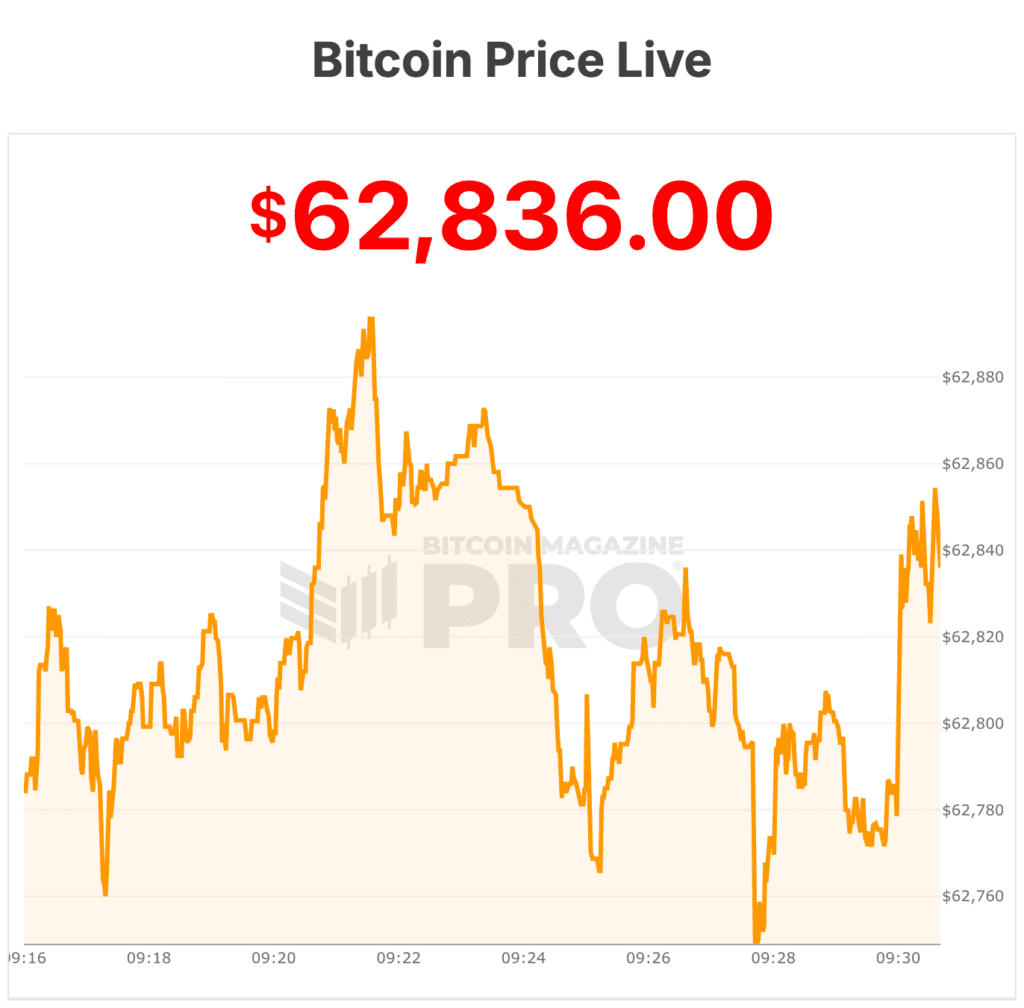
The price of Bitcoin fell below $63,000 on Friday, as a new wave of US air strikes on Iran and a new political dispute between Washington and Beijing prompted investors to turn away from risky assets.
Bitcoin’s price was trading near $62,800, an extension of Thursday’s 1.4% decline from $65,000, according to Bitcoin Pro Magazine Data. The symbol fell below its 50-day simple moving average, a measure of near-term momentum that many traders are watching.
Bitcoin’s price decline follows a widespread decline in global markets. Japan’s Nikkei 225 decreased 4% and entered a correction, down more than 10% from the peak reached on June 25, when memory chip maker Kioxia lost 16.1%. Hong Kong’s Hang Seng Index fell 2%, while the Shanghai Composite Index fell 3.1% to its lowest level in 11 months.
Nasdaq-linked futures pointed to a 1.6% decline, an echo of Thursday’s decline on Wall Street, as chip stocks from Nvidia, Micron, Broadcom and Qualcomm rose. Under pressure Because of fears that the rise of artificial intelligence has outpaced its profits.
Bitcoin price, Iranian escalation, and uncertainty in Washington
Iran’s semi-official Fars News Agency, citing Hormozgan Province, said the US air strikes He hits Five bridges in the Southern Governorate.
Separate missile strike harmony Marine control tower in the Iranian port of Chabahar. West Texas Intermediate crude rose near $79 a barrel, up nearly 15% over five sessions, a move that renewed concerns about inflation and the path of interest rates.
A second front of uncertainty has opened in Washington. US President Donald Trump declassified intelligence reports stating this Allegedly Chinese interference in the US elections and claimed that Beijing obtained 220 million voter records, a threat he described as a danger to democracy. The Chinese embassy denied these accusations.
The dispute itself does not carry much market weight, although traders fear it could strain relations ahead of Trump’s September meeting with Xi Jinping. The Australian dollar, a trade proxy linked to China, fell against the US dollar.
Bitcoin price market dynamics
Against this background, some analysts say that the sell-off hides a market whose fundamental drivers have changed little. Bitcoin’s price bar reflects macro data more than geopolitical hedging, said Nikolai Sondergaard, a research analyst at Nansen.
“The inflation and liquidity channel does more work here than the geopolitical hedging narrative,” Sondergaard said. He pointed to the June Consumer Price Index report Released July 14, which showed headline inflation at 3.5% versus 3.8% expectations and a core reading of 2.6% versus 2.9%. The dollar index fell to nearly 100.77, a multi-month low, and the 10-year Treasury yield fell to 4.57%.
A softer print restored the Fed’s expectations. The odds of a rate hike at the July 28-29 meeting fell from more than 40% to record lows, according to CME FedWatch data.
“The FOMC meeting on July 28-29 is the actual bilateral meeting,” Sondergaard said. “If CPI data holds and the Fed signals a credible pivot path, conditions for sustainable ETF flows will fall back into place.”
Onchain flows support its reading. Spot bitcoin ETFs attracted $510 million over three sessions this month, ending a string of $2.73 billion outflows, with BlackRock’s IBIT leading the way. Nansen data shows that large portfolios held their ground during the strike.
“Net outflows were -18.3 BTC per strike hour, then returned to the post-shock average of +0.67 BTC per hour, meaning buyers returned during the same session,” Sondergaard said.
Sondergaard framed design as constructive rather than fragile. Funding rates remained near zero, a sign that leveraged long positions are not crowded, and smart money buy/sell ratios stood at 1.58 with no rotation to stablecoins. Retail traders held a ratio of 1.79, which is a step ahead of the pros but in the same direction. Seven-day inflows were concentrated in liquidity stakes, DeFi lending, decentralized exchanges, and risk allocation.
Sondergaard said the sequence is consistent with past traumas. “Previous escalations in the Middle East have produced the same pattern: short-term flow, resumption of accumulation,” he said.
“The MVRV is at 1,205 with a realized price of about $53,000 and a long-term rack cost basis of about $49,900, which sets the structural floor,” Sondergaard said. “This is not a market profile that plays to geopolitical sentiment.”
At the time of writing, Bitcoin’s price is $62,836.