

CryptoQuant CEO Ki Young Ju says Bitcoin’s current distribution phase may be less a sign of structural weakness and more a significant transfer of supply from legacy market participants to US financial institutions, ETFs and new long-term holders.
In a Series of posts Regarding X, Key argued that the selling by Bitcoin OGs and long-time miners is part of a widespread “changing hands” and not evidence that the asset has exhausted its cycle. The main question, in his view, is not only limited to the volume of supply that is sold, but also to who absorbs it in the end.
“I think selling by Bitcoin OGs and Miners for a long time “It is part of a major shift in hands, a shift to traditional US financial institutions, investors and ETFs,” Key wrote. “So, I disagree with the claim that Bitcoin will no longer perform well once the shift is complete and there is no more liquidity.”
The Bitcoin ownership base is changing
Key’s thesis focuses on the formation of Bitcoin holders. For any asset, the long-term market setting depends largely on the capital base behind it, he said. If the new owners are institutions able to attract larger pools of liquidity over time, the turnaround could ultimately support another upward cycle, he said.
“For any asset, what ultimately matters is who owns it,” he wrote. “If the people holding them now are entities that can bring in greater liquidity in the future, I think we can look forward to the next rally at any time.”
The argument represents a notable framework for the current market. Bitcoin has seen intense selling pressure even as large institutional buyers continue to absorb supply. Key described the current distribution phase as a “huge change of hands,” referring to a market where old owners distribute ETFs, strategy Newer regiments take the other side.
Related reading
According to Key, Bitcoin investors Average cost basis About $53,000. Historically, bear markets only ended after the price fell below the realized price, he said. It was previously thought that this level would be difficult to revisit due to institutional inflows and limited selling of the strategy. But he said recent price action indicated “unusually strong selling pressure.”
The scale of absorption is central to his concerns. Since January 2023, Strategy has bought 711,206 BTC and sold just 32 BTC, removing a net 711,174 BTC from circulation, according to Ki. Since March 2024, when Bitcoin was also around $63,000, ETFs have absorbed 509,102 BTC while Strategy bought another 650,706 BTC. Together this amounts to 1,240,808 BTC, however the price has returned to the same level.
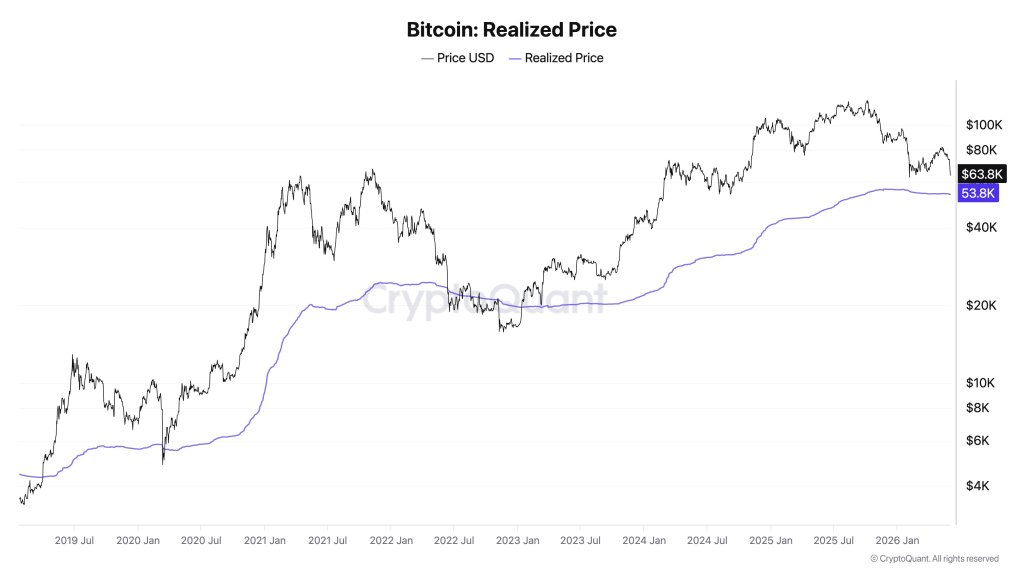
In the context, Key indicated that exchange reserves amount to about 2.7 million bitcoins, while… Satoshi Nakamoto It is estimated to contain around 1 million BTC. In other words, an amount of Bitcoin larger than the sum of what Satoshi estimated, and roughly half of the exchange reserves, was absorbed without achieving a sustained price rise.
Short-term buyers are maturing
Key also pointed to a major shift within the structure of the achieved cap. Bitcoin is about the same price as it was two years ago, but its holder base looks materially different, he said. The 6-month to 2-year group, which represents investors who entered during this cycle, now represents 53% of the maximum achieved, compared to 15% two years ago.
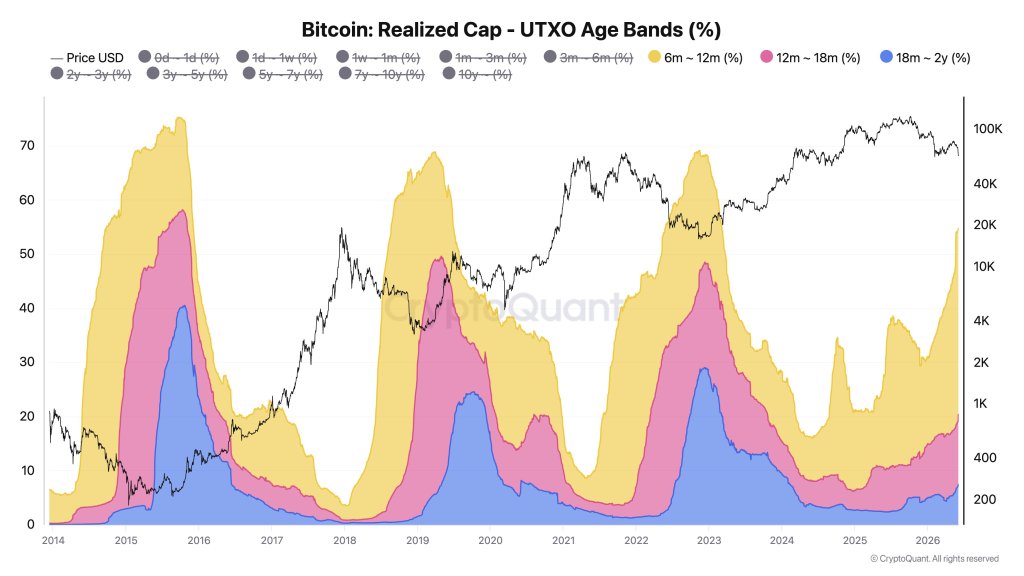
This is important because, in Key’s interpretation, Short term owners They gradually became long-term owners. Compare the current figure with the previous cycle, when Bitcoin bottomed after the same group reached 68% of the maximum achieved. “Short-term holders evolve into long-term holders,” he wrote.
Related reading
The setup is not without risks. Key reposted a separate note from Julio Moreno stating that overall demand for Bitcoin, including speculative and spot demand, is shrinking at a monthly rate of 232,000 BTC. Moreno argued that the current correction is directly related to demand conditions for Bitcoin, not stocks, oil or macro indices, noting that stocks are at all-time highs while manufacturing activity is improving.
Key’s posts therefore present a divided picture. On the one hand, current demand is shrinking and selling pressures remain intense despite historical institutional absorption. On the other hand, the Bitcoin ownership base is migrating towards institutions and new pools are maturing that may provide a deeper demand base in the future.
Key acknowledged that this shift comes at a cultural cost. “Frankly, in terms of asset appreciation, I think traditional financial institutional investors may provide a stronger demand base than Bitcoin OGs,” he wrote. “Of course, in the process, some cypherpunk values may be diluted. I really regret that part as well.”
For markets, the debate now is whether Wall Street’s growing share of Bitcoin ownership can offset the supply leaving out older owners and miners. Key’s conclusion remains constructive, but is conditional on this transfer becoming a source of liquidity in the future rather than a cap on the upside.
“However, I believe there will definitely be another bull cycle for Bitcoin,” he wrote. “As an investor, I still believe in Bitcoin and think it is worth waiting a little longer.”
At press time, Bitcoin was trading at $62,696.
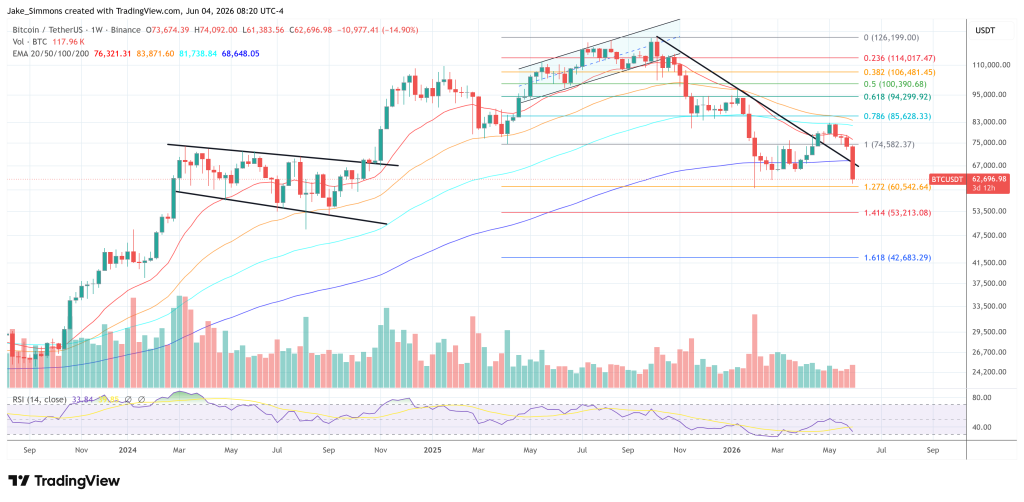
Featured image created with DALL.E, a chart from TradingView.com



