
US-based bitcoin ETFs returned to net outflows on Friday after briefly snapping a record string of withdrawals, with BlackRock’s IBIT leading the declines as bitcoin fell below key $60,000 support and investor sentiment deteriorated.
summary
- Bitcoin exchange-traded funds recorded outflows of $325.7 million, led by BlackRock’s IBIT with a withdrawal of $213.7 million.
- Bitcoin’s price fell below $60,000 to a low near $59,100, while analysts linked continued ETF outflows and a more hawkish Federal Reserve outlook to a market decline.
- Analysts say the $60,000 level remains a key support, with downside risk towards $55,000.
According to data from SoSoValue, ETFs recorded $325.69 million in net outflows on June 5, which reversed the modest $3.05 million outflow recorded the previous day.
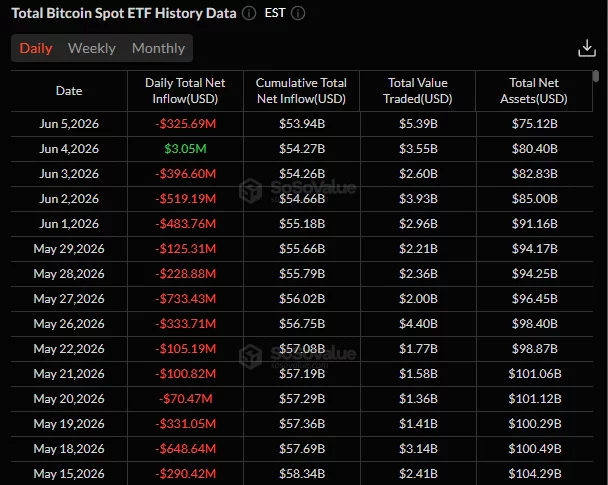
The latest withdrawals brought cumulative net flows across the category down to $53.94 billion and highlighted the continued pressure on institutional demand for Bitcoin after nearly three weeks of continuous withdrawals.
BlackRock’s IBIT accounted for the lion’s share of losses, recording outflows of $213.65 million on June 5. Fidelity’s FBTC and Grayscale’s GBTC followed with a withdrawal of $59.69 million and $60.84 million, respectively. VanEck’s HODL and Morgan Stanley’s MSBT were the only two products to attract new capital, bringing in a combined $8.5 million.
The selling of renewable ETFs coincided with a sharp decline in Bitcoin prices. According to data from crypto.news, Bitcoin (Bitcoin) The price fell to an intraday low near $59,100 before rebounding above $61,000 at the time of writing. The move pushed the asset to its lowest level since October 2024 and extended a broader correction that has erased more than $15,000 from its recent highs.
Why are Bitcoin ETFs seeing renewed outflows?
Recent ETF flow trends have attracted increasing attention from Wall Street analysts. In a recent note, Citigroup Argue Investors may be underestimating the role ETF demand plays in Bitcoin price performance.
The bank also disputed the narrative that Bitcoin’s recent decline was primarily driven by a strategy decision Sell 32 Bitcoin for preferred stock dividends, arguing that continued ETF outflows played a much larger role in weakening prices.
like I mentioned According to crypto.news earlier, Bitcoin ETFs recorded $2.43 billion in net ETF inflows during May and another $1.40 billion during the first three days of June, which played a major factor behind Bitcoin’s recent weakness. The recent recovery of $325.69 million suggests that institutional demand remains fragile despite the brief interruption in the outflow trend on Thursday.
Pressure has also become evident in ETF holdings. Data from CheckonChain shows that spot bitcoin ETFs in the US currently hold approximately 1.277 million bitcoins. While this number is still slightly above February levels, it is still approximately 7.2% below the record level reached in October, indicating that funds have not yet recovered the bitcoin sold during the recent redemptions.
Broader market conditions added to the pressure. Stronger-than-expected US labor market data this week has lowered expectations for an interest rate cut by the Federal Reserve and prompted traders to reduce risk exposure across digital assets.
The shift in sentiment intensified after BNP Paribas abandoned its previous forecast for a stable monetary policy and The Fed is expected to raise interest rates three times Starting in December, which effectively means reversing the three interest rate cuts introduced in 2025.
The bank cited persistent inflation pressures and a resilient labor market as reasons policymakers may need to tighten policy again, helping to trigger a wave of selling that pushed Bitcoin below key technical support levels.
This bearish outlook helped spark a wave of selling that pushed Bitcoin below key technical support levels.
Where could Bitcoin price go next?
Technical indicators indicate that Bitcoin is approaching an important decision point after reaching significantly oversold conditions.
On the daily chart, Bitcoin briefly fell below the Murrey Math support area near $60,000 before recovering. The daily RSI has entered the oversold territory while the MACD continues its downward trend, reflecting strong downward momentum but also increasing the potential for a comfortable rally.
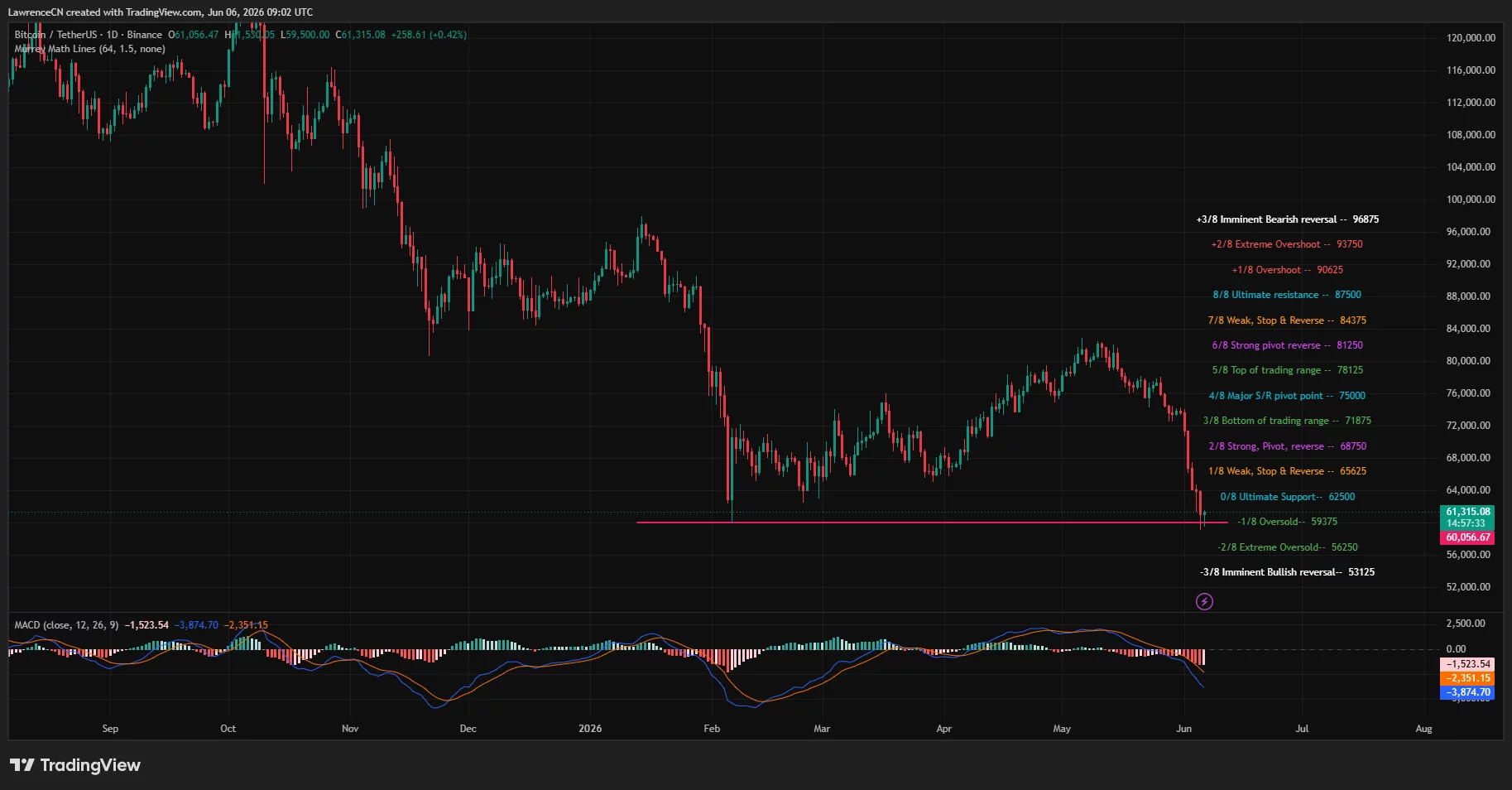
According to For analyst Camille Ouray, buyers need to defend the current area to prevent a deeper decline.
“Bitcoin saw a sharp decline with all markets. It reached 60K, which we have long pointed to as an important level. Consolidating buyers at this level could at least lead to a rally in the form of a correction of the decline.”
According to Ouray, the first resistance level is around $67,500, followed by a broader resistance zone between $74,000 and $75,000. However, he warned that failure to maintain the $60,000 area could expose Bitcoin to a deeper decline towards the $55,000-$50,000 range.
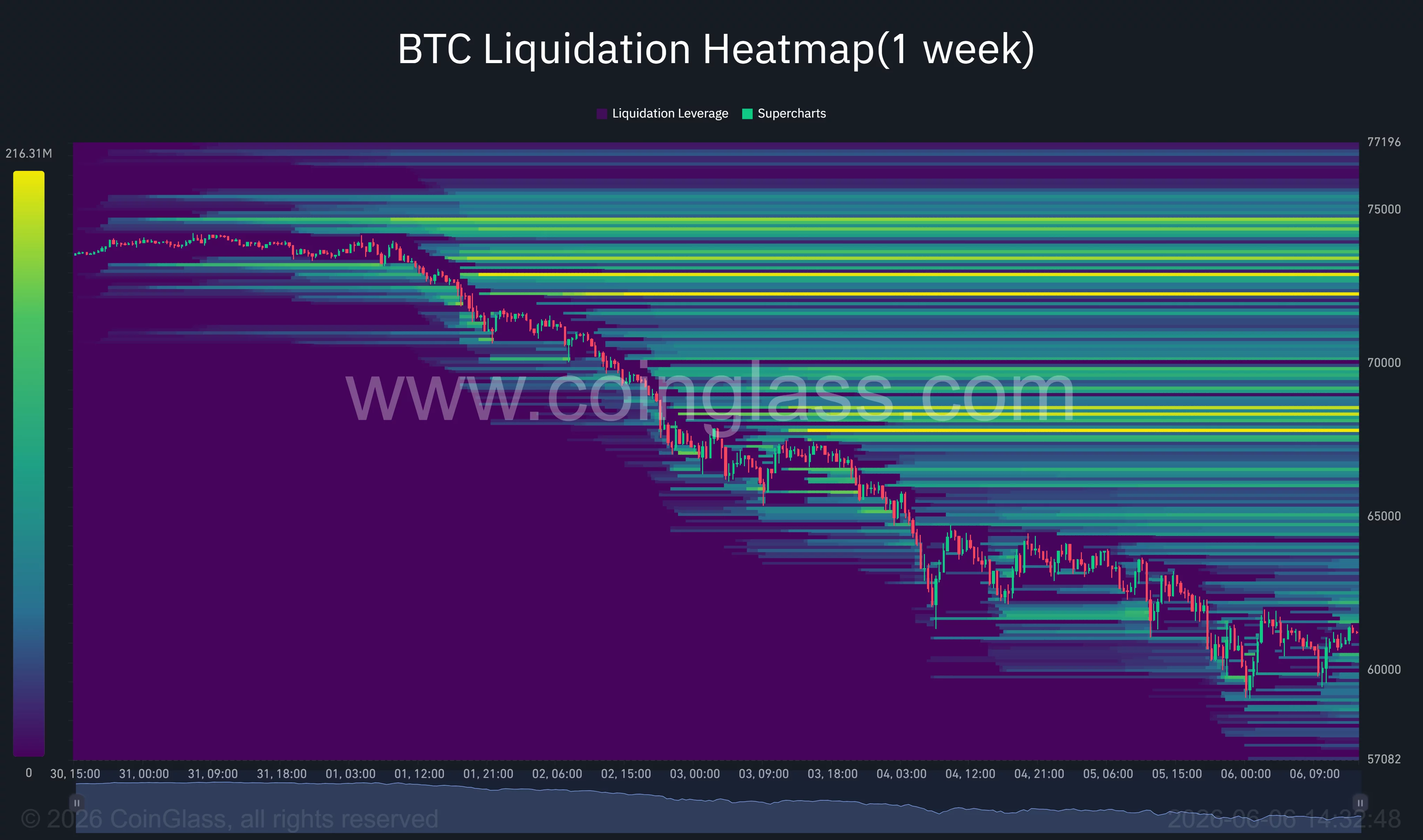
Derivatives positioning also indicates increased volatility in the future. CoinGlass liquidation heatmap data shows large clusters of leveraged positions concentrated between $67,000 and $75,000. If Bitcoin makes a rebound, these levels could become targets for liquidation, accelerating the bullish momentum.
On the downside, analyst Ali Martinez noted that Bitcoin’s 1.0 and 0.8 MVRV pricing ranges currently stand at around $53,900 and $43,130, respectively, levels he described as historically attractive risk-reward zones during major market corrections.
At the time of writing, Bitcoin was trading near $61,300, leaving traders closely watching whether support around $60,000 could hold as ETF inflows continue to weigh on market sentiment.
Disclosure: This article does not constitute investment advice. The content and materials contained on this page are for educational purposes only.



