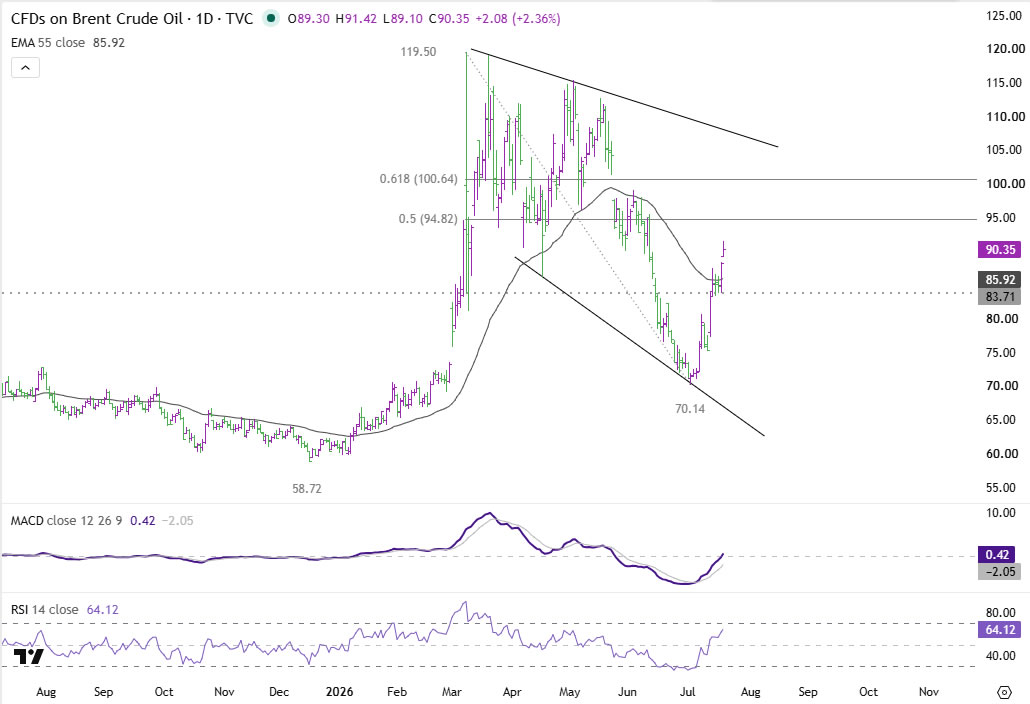
Brent crude oil started the week with a gap higher, surpassing the key psychological level of $90, as markets reacted to another round of deteriorating developments in the US-Iran conflict. Reports of American deaths, an attack on a Kuwaiti energy facility, Iran’s declaration that the ceasefire is no longer valid, and renewed claims that the Strait of Hormuz has been closed all reinforce expectations that the crisis will remain unresolved in the near term. However, despite the significant geopolitical backdrop and the technically significant breakout, buying momentum in Asian trading has been relatively restrained.
Why didn’t Brent rise more strongly?
The muted follow-up suggests that much of the weekend’s escalation has already been accounted for. Brent crude rose more than 17% last week, recording its strongest weekly gain since April, as markets steadily raised the possibility of renewed supply disruptions. Recent headlines have largely validated these fears rather than providing an entirely new shock. For now, investors still appear to view the reopening of the Strait of Hormuz as the most likely outcome, limiting the urgency to chase prices significantly after the weekend gap.
What could push Brent to $100?
The answer depends on time, not headlines. During the short period following the interim agreement in June, when sanctions were eased and the blockade was lifted, Iran was exporting an estimated 2.2 million barrels per day. This offer is now being withdrawn again with the return of the siege. Every additional day that shipping remains disrupted increases the likelihood that markets will shift from treating the crisis as a negotiation tactic to viewing it as an actual disruption of supplies. Under this scenario, Brent crude could quickly accelerate towards the $100 level, as traders begin to price in tighter global balances rather than just geopolitical risks.
Why might this crisis be more serious than the one that broke out in March?
Unlike the escalation in March and April, when releases from strategic petroleum reserves helped mitigate the impact of supply concerns, the market today has much less buffer reserve. Some estimates suggest that if the current unrest continues, significant material shortages could emerge within about ten weeks. This would force consuming countries, especially in Asia, to compete for increasingly scarce barrels, fundamentally changing the pricing dynamic from a geopolitical risk premium to a premium driven by an actual supply deficit. In that environment, a retest of this year’s highs would not be considered an extreme scenario.
What does the artistic image suggest?
Technically, Brent’s strong break above the 38.2 retracement level from 119.50 to 70.14 at 89.00 strengthens the case that the advance from 70.14 is developing into an uptrend reversal and not just a corrective rebound. More importantly, the decline from 119.50 to 70.14 appeared as a well-defined three-wave corrective structure, suggesting that the broader long-term uptrend is not yet complete.
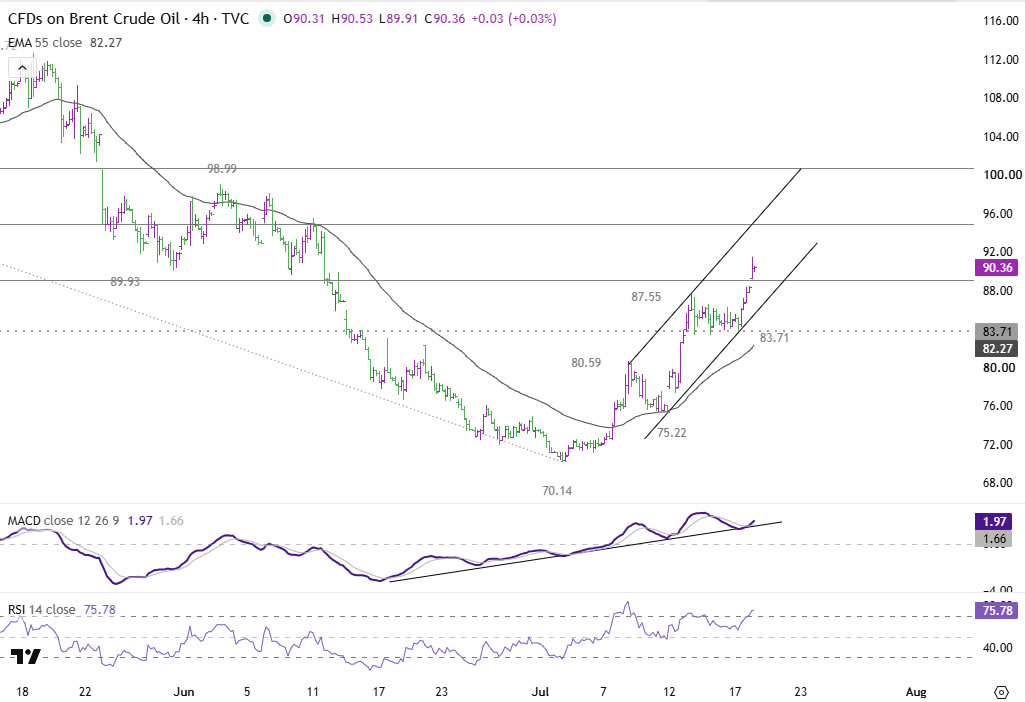
As long as support at 83.71 holds, further gains remain preferable. The next major test comes around the 95 level, where the 50% retracement level at 94.82 converges with the ceiling of the near-term ascending channel. A decisive break through this resistance would likely signal that markets are abandoning their base case of near-term normalization, and are instead pricing in a long-term disruption to Gulf supplies. This would open the way through the 61.8% retracement at 100.64 and to a retest of the March high at 119.50.