

Key takeaways
- Ethereum has corrected nearly 50% from its October 2025 peak at $4,700 to current levels around $2,300, yet accumulation patterns suggest institutional buying.
- The buy/sell ratio has risen to levels not seen since January 2023, indicating strong demand pressure
- Network activity shows that smart contract deployments have reached all-time highs based on a 180-day moving average
- Ethereum ETFs recorded $155 million in net inflows last week, marking the third straight week of positive inflows.
- Critical Price Areas: $2,400 represents general resistance while $2,200 represents bearish support
The price of Ethereum has seen a significant decline, losing nearly half its value from its October 2025 peak near $4,700 to trade today at around $2,300. However, beneath the surface fluctuations, blockchain metrics reveal a different narrative – one of strategic accumulation.
According to CryptoQuant metrics, the 30-day moving average of the buy/sell ratio has risen to its highest reading since the beginning of 2023. This indicator measures the intensity of market orders on the buy side compared to sell-side pressure.
Data indicates that market participants are aggressively holding onto ETH even as the price’s downward momentum continues. Such patterns usually indicate that sophisticated investors systematically build their positions during periods of market weakness.
Network growth conflicts with weak prices
Additional analysis from CryptoQuant reveals that the 180-day moving average of newly published smart contracts has reached an unprecedented peak. This shows that developer participation continues to expand despite the downward price movement.
Historical patterns show that increases in smart contract deployment activity have often foreshadowed price reversals. The current disconnect between strong network usage and suppressed token valuation suggests that fundamental strength may not yet be reflected in market prices.
According to SoSoValue data reported by Odaily, Ethereum ETFs attracted $155 million in net new capital during the week of April 20-24. This represents the third consecutive week of positive institutional flows.
BlackRock’s ETHA dominated inflows with $138 million for the period, pushing its cumulative net inflows to $11.97 billion. BlackRock’s ETHB contributed an additional $60.9 million. Conversely, Grayscale’s ETHE saw the largest outflow at $49.2 million. The total combined net assets across all Ethereum ETF products currently stands at $13.79 billion.
Market analyst Ted (@TedPillows) noted that Ethereum remains within a range and warned that the collapse of peace negotiations between the US and Iran could lead to increased volatility in the coming days. He stressed that a successful retracement of $2,400 could open the liquidity area between $2,470 and $2,500, while a breakdown below $2,300 could lead to a retest of the $2,150 and $2,200 area.
Technical forecasts and critical areas
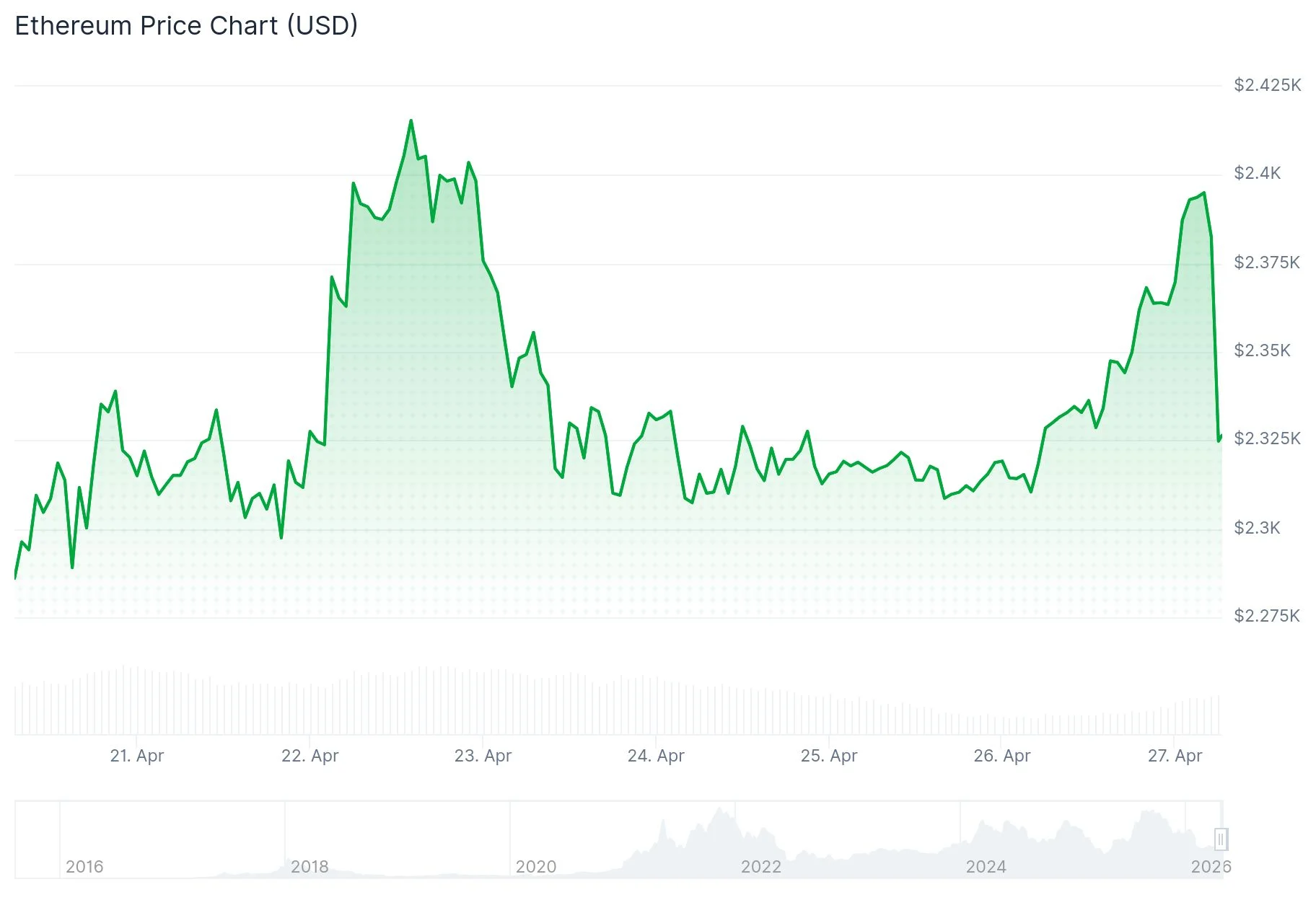
Check the hourly time frame, Ethereum Successfully broke the bearish triangle formation with resistance at $2,320. The rally extended to $2,404 before entering a consolidation phase. Currently, ETH is maintaining its position above $2,370 and the 100 hourly simple moving average.
The nearest resistance barrier is at $2,400, followed by $2,420 and $2,450. A decisive break above the $2450 level could spur momentum towards $2500 and possibly extend to the $2550-$2565 range.
For downside protection, $2,330 represents the initial support level. Below this threshold, the $2,285 and $2,200 areas appear as critical defensive areas.
In a notable development, Bitmine Immersion Technologies, linked to market strategist Tom Lee, has revealed plans to purchase 10,000 ETH directly from the Ethereum Foundation through an over-the-counter transaction worth $23.9 million. This acquisition will bring the company’s total Ethereum holdings to 4.98 million ETH.




