
Written by Peter Kennedy
First Atlantic Nickel Company (a fan-TSXV, So stop-OTCQB, P21 FSE) positions itself to be Atlantic Canada’s first major bulk nickel producer and a supplier of critical metals for use in the electric vehicle, energy storage, stainless steel and aerospace sectors.
First Atlantic’s efforts are focused on the 100%-owned Pipestone XL Nickel-Cobalt Alloy Project, a large-scale asset located in central Newfoundland close to existing energy and road infrastructure including a hydroelectric power station located adjacent to the property.
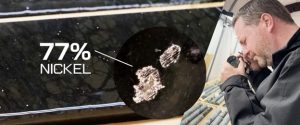
The project is located 45 kilometers from Grand Falls-Windsor, where nickel is found in the form of awarite, a naturally occurring magnetic alloy of iron and nickel that is sulfur-free. Awaruite’s properties allow for simple magnetic separation and flotation recovery, reducing the need for energy-intensive smelting, allowing the company to identify a large tonnage resource that can be processed onshore, supporting the mining supply chain directly to the refinery.

This strategy is being led by First Atlantic CEO and Director Adrian Smith, a geologist with First Atlantic 19 Years of mining and prospecting experience under his belt. In that time, he was involved in taking the project from discovery to more than 7.0 billion tons identified over a two-year period. He has also been involved in two recent porphyry discoveries in British Columbia and several resource expansion projects.
In an interview with Resource World, Smith said he could envision a large-scale, multi-pit mining operation with a central processing facility. High-quality, refining-ready nickel and cobalt alloy concentrates will be shipped directly from the project to global markets via deepwater ports in Newfoundland.
It is worth noting that FPX Nickel Company (FPX-TSXV) in British Columbia through its alliance with the Japan Mineral and Energy Security Organization (JOGMEC) and equity investments from a unit of Sumitomo Metal Mining Co. Ltd. of Japan and Outokumpu, a large European global stainless steel producer. An unnamed strategic investor has already taken a 9.9% stake in First Atlantic.

The Pipestone project could be eligible for U.S. government support after First Atlantic was recently accepted as a member of the U.S. Defense Industrial Base Consortium (DIBC), an entity that serves as a consortium-based contracting vehicle under the Office of the Assistant Secretary of War for Industrial Bases Policy. The Dubai World Trade Center enables the War Department to make the direct investments necessary to secure vital supplies to Nickel and cobalt are classified as “critical minerals” in both the United States and Canada.
The Pipestone XL project covers an area of 21,850 hectares and is located on the Pipestone Ophiolite Complex, a 30-kilometre-long supermagnetic ophiolite belt enriched in nickel, chromium and cobalt. It contains multiple mineralized zones, suggesting the possibility of a zone-scale model containing multiple deposits. The project’s potential was first identified in 2010 by Altius Minerals and Cliffs Natural Resources. Atlantic Project Senior Geologist Mike Beeler completed his 2012 undergraduate thesis on the awarite formation in the Pipestone Ophiolite Complex while working with Altius.
After agreeing to acquire a 100% stake in November 2023, First Atlantic has completed an extensive data collection exercise to reprocess geophysical data and digitize 134 historical reports. This work resulted in a historical database of over 8,900 historical specimens, including 4,581 newly added specimens. More than 4,600 samples show elevated nickel values across the 30 km core zone.

In 2024, drilling began at several high-priority targets, including RPM, Chrome Pond and Super Gulp. After the success of the summer exploration program, which revealed the appearance of large surface grains. Drilling in the Super Gulp and RPM areas began in the fall of 2024.
In a press release issued on January 27, 2026, the company announced positive assays and metallurgical results for Davis Tube Recovery from the final four holes of the RPM Zone Phase 2X drilling program. She said the results increased the length of the RPM zone by 50% to more than 1.2 kilometers and expanded the lateral width to more than 800 metres. All 14 drill holes in the RPM zone have returned positive magnetically recoverable results, the company said. The company said that expansion potential is still open in the west, north, south and in depth. Inspection results (see press release dated January 27, 2026).
In an April 8, 2026 press release, First Atlantic said drilling had begun in a second large-scale nickel-cobalt target zone, known as Alloy Max, extending seven kilometers north of the current RPM zone.

The initial drilling program at Alloy Max is designed to test the awaruit mineralization over a large area through four drill holes distributed approximately 2.4 kilometers long and 950 meters wide within a target area of 4.0 kilometers by 1.2 kilometers. region
Davis Tube Recovery (DTR) surface sampling at Alloy Max returned numerous positive magnetically recoverable nickel values consistent with surface sampling grades observed in the RPM region. In the RPM zone, this pattern is well established, with core drill samples consistently returning higher DTR grades than weathered surface samples, indicating the potential for stronger nickel grades at depth in Alloy Max.
Having raised $7.8 million without guarantees since December 2025, First Atlantic is well positioned to execute drilling programs on both Alloy Max and RMP this year. The company plans to carry out drilling work at a depth ranging from 5,000 to 10,000 meters in 2026.
Meanwhile, the company recently announced the acquisition of mineral claims in the Bay of Ophiolite Islands Complex (BOIC) in western Newfoundland. It has been named the Ophiolite Peer-reviewed Memorial University calculated the theoretical CO2 storage capacity of the entire BOIC to be equivalent to more than 13 years of global emissions, while natural springs within the complex drainage dissolve through active serpentinization. This process is of such great scientific importance that NASA researchers have identified the Tablelands Massif at BOIC as a Mars analog site to study serpentine environments.

Also, a 2024 study, funded by the Government of Quebec, evaluating 27 potential natural hydrogen source rocks, identified ophiolite complexes as the first major area of interest for geological hydrogen exploration, with BOIC as a reference counterpart.
In March 2025, First Atlantic said it launched a research partnership with the Colorado School of Mines to explore the geological hydrogen potential in Newfoundland ophiolites. Exploration data provided to the Colorado School of Mines will support academic research on geological hydrogen as a potential energy source, with the potential to generate additional value from the project.



