

Gasum, a Nordic gas sector player and energy market player, and Ukrainian state-owned energy company Naftogaz Group have acquired long-term LNG capacity at an LNG terminal in Lithuania, operated by KN Energies (KN).
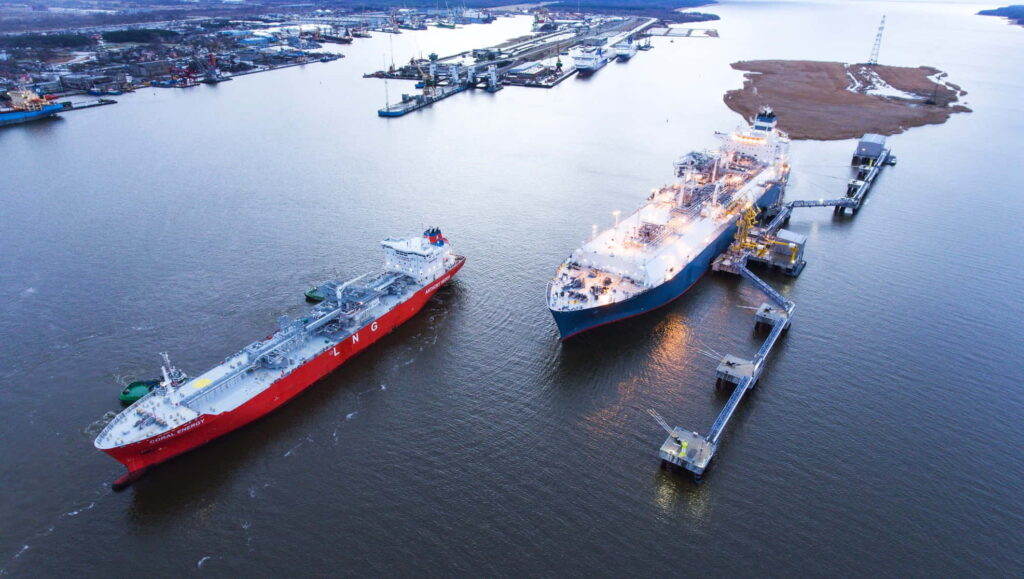
The Finnish company Jasum has reserved the capacity of the liquefied natural gas terminal in Klaipeda LNG A terminal in Lithuania for the period 2033-2040 to support its capacity to supply the northwest European market with LNG and bio-LNG (bio-LNG) over the next decade.
The Klaipeda terminal has been part of the Scandinavian player’s supply chain for some time, with the LNG terminal used primarily as a reloading point for its own transport and vessel vessels, but also to support natural gas operations in Finland and the Baltics.
The Lithuanian terminal, which is strategically located for the company’s LNG terminal network in Finland, Sweden and Norway, will also enable the company to leverage capacity to serve its offshore customers directly in and around the Danish Straits.
Anders MalmJassum’s Senior Vice President of Supply and Trade confirmed: “Securing capacity in Klaipeda supports Jasum’s long-term strategic supply capability and gives us the flexibility to optimize deliveries to our terminal network and offshore customers. It also supports our commitment to being a reliable partner in the energy transition.”“.
Another player that has chosen to reserve capacity at the Klaipeda LNG terminal is Naftogaz, which has secured access to the European LNG terminal for the period from 2033 to 2044. A total of five companies have obtained the right to use the terminal on a long-term basis, including Norway. moderationLithuania on fireand Latvia LatvinergoAlong with Jasum and the Ukrainian company.
Sergey KoretskyNaftogaz CEO said: “This represents a new level of cooperation and supply planning. Such decisions are of strategic importance for Ukraine’s energy security. They expand our access to the global LNG market and enhance the resilience of Ukraine’s gas supply in the long term.
“I would like to thank the Government of Ukraine and our Lithuanian partners for their cooperation and trust. This is another important step towards strengthening energy security in Ukraine and the wider European region“.
With demand for LNG expected to grow, especially in the maritime market, with the number of LNG-powered ships set to increase significantly in the coming years, the maritime industry is facing increasing pressure to transition to low-emission fuels, with the United Nations Maritime Organization (IMO) and the European Union setting goals and targets to reduce greenhouse gas emissions.
Jasum believes the capacity at Klaipeda could be used to virtually liquefy pipeline-fed biomethane into bio-LNG, through mass balancing and biomethane certifications, as a growing number of the company’s customers seek greater fuel lifecycle emissions reductions than LNG alone can deliver.
KN Energies, as operator of the Klaipeda LNG terminal, explained that the majority of the capacities on offer, more than 20 TWh, have been allocated: 8 TWh until 2044 inclusive and a further 12 TWh until 2040.
Demand for long-term capacity bookings at Klaipeda is in line with broader trends in the European LNG market, where long-term capacity has been offered or allocated to market participants through several European LNG terminals, including terminals in Croatia, Greece, the Netherlands, Germany and Poland.
Zygemanthas faecinasThe Minister of Energy confirmed: “The results of the long-term capacity allocation of the Klaipeda LNG terminal once again confirm the strategic importance of this infrastructure for the energy security of the Baltic region and Europe as a whole. It is particularly important that, for the first time, we see both Ukraine’s Naftogaz and Finland’s Jasum among the long-term customers.
“This is a clear signal of confidence in Lithuania’s energy infrastructure and the expanding role of the plant from the Baltic region to Northern Europe and Ukraine. It enhances regional energy resilience and contributes to long-term supply diversification across Europe“.
The Klaipeda LNG Terminal is seen to remain important in the wider regional context, as integration between the Baltic and Northern European gas markets continues to grow, as the terminal has become a strategic gateway enabling customers to serve regional consumers and the wider European market through the Amber Grid-operated gas transportation system and regional interconnection.
The capacity allocation procedure was launched on 25 March 2026, giving the market the opportunity to reserve up to 28 TWh of regasification capacity per year from 2033 to 2044, divided into seven equal packages of 4 TWh per year, giving market participants the option of choosing periods of eight or 12 consecutive years, as approximately 1 TWh corresponds to one conventionally sized LNG cargo.
Taking into account the results of this measure, as well as the long-term capacity package of 4 TWh until 2044 allocated in 2023, the total utilization of the LNG terminal will reach approximately 75% of the terminal’s nominal capacity.
Final capacities of unallocated LNG terminals can be brought to market through recurring long-term capacity reservations and annual capacity allocation procedures on a year-by-year basis.

Boost your brand with marine energy ⤵️
Steal the spotlight and establish your brand in the heart of the outside world!
Join us to make a greater impact and grow your presence at the core of the marine energy community!



