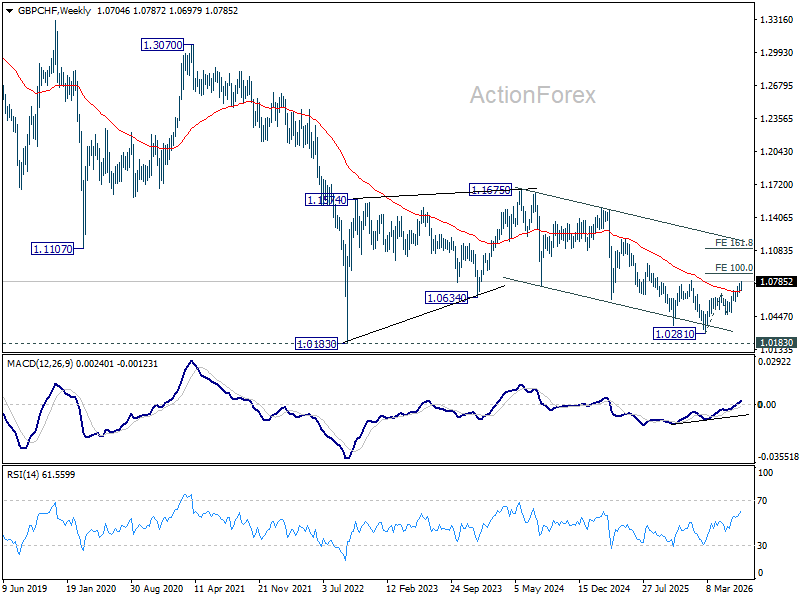
The rise in sterling was about more than just feeling better about the UK. This was driven by the disappearance of one of the largest bearish trades in the market. As political uncertainty faded following the resolution of the Labor leadership transition, investors who had built large short positions in sterling found themselves on the wrong side of the market. This process is still unfolding, which helps explain why the pound clearly outperforms cross currencies and not against the dollar alone.
Prior to the resignation of UK Prime Minister Keir Starmer, political uncertainty encouraged investors to build significant bearish positions against the pound. The decisive result of the Makerfield by-election on 18 June removed much of this uncertainty much more quickly than markets had expected. For traders who sold sterling on the hope of a long-term political transition, the rationale for the trade weakened almost overnight.
What followed was not necessarily a wave of new optimism towards the UK economy, but rather a mechanical buyback of sterling. Société Générale estimates that speculative accounts still held short positions equivalent to 35.5% of open interest as of late June. Although some of these positions have already been resolved, the bank says the remaining short base is still large enough to support further gains as investors continue to close bearish trades.
At the same time, the underlying background has become quietly more supportive. Bank of England Governor Andrew Bailey has pushed back against expectations for early policy easing, suggesting that interest rates may need to remain tight to ensure the inflationary effects of this year’s oil shock fully dissipate. With the interest rate remaining at 3.75% Sterling retains a significant yield advantage Above the Swiss franc (0.00%), the euro (2.25%) and the Japanese yen (1.00%), providing an additional incentive for investors to hold the currency.
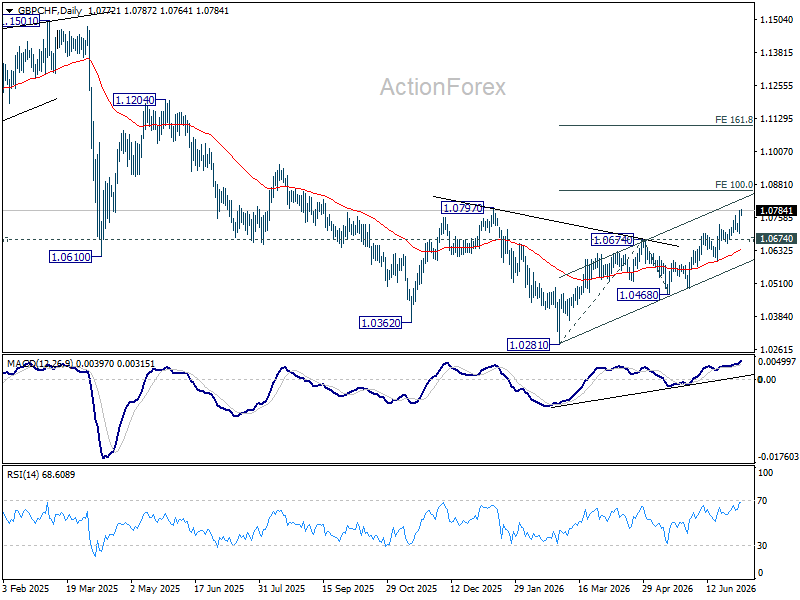
These macro and positioning forces are now converging at a technically important moment. The GBP/CHF pair has resumed its advance from the March low at 1.0281 and is approaching the important resistance area around 1.08. Provided the support remains at 1.0674, the path of least resistance continues to point upward.
The importance of this area extends beyond a simple breakout. A decisive move above 1.0797 would break the medium-term downtrend that has been in place since the 2024 high at 1.1675. A subsequent break above the 100% forecast at 1.0821 to 1.0674 from 1.0468 at 1.0861 would reinforce the view that the recovery has turned from a corrective bounce into a new impulsive advance, raising the possibility of an acceleration towards the 161.8% forecast at 1.1104.
The technical background also improves in the long term. GBP/CHF has regained its 55 W moving average (now at 1.0689) and successfully defended the key low at 1.0183 established in 2022. Coupled with the ongoing unwinding of short positions on GBP and the Bank of England’s relatively restrictive policy stance, the technical picture suggests that GBP’s recent strength could mark the beginning of a broader medium-term reversal rather than just another short-term recovery.