

Tldr:
- Bitcoin is still trading above its real price, the level where all major bear market bottoms have historically tested first.
- CryptoQuant CEO Ki Young Ju warns that Bitcoin may need to fall further before a true on-chain cycle bottom is confirmed.
- Spot ETF inflows and institutional demand have changed how Bitcoin absorbs selling pressure compared to previous cycles.
- CryptoQuant’s Bull-Bear Cycle indicator turned green in May 2023, which contradicts Ju’s bearish long-term forecast.
The most pressing question for Bitcoin now is whether the market has finally reached the bottom of its cycle. CryptoQuant CEO Ki Young Joo He says The answer, based on on-chain data, is still no.
His argument centers around the realized price, which is the average acquisition cost of all bitcoins in circulation weighted by the last on-chain movement.
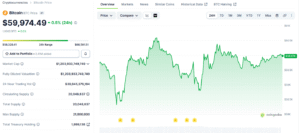
At press time, Bitcoin is trading at $59,974.49, up 0.5% in 24 hours but down 5.46% over seven days, keeping the bottom debate very much alive.
What on-chain data says about Bitcoin’s bottom
The achieved price has historically served as the final checkpoint before Bitcoin is confirmed Bear market floor. During the 2015, 2018 and 2022 cycles, the spot rate approached this level or briefly fell before any sustained recovery took hold.
These moments marked the peak of unrealized losses across the network and preceded the most important accumulation phases of each cycle.
Ki Young Joo points out that risks and rewards tend to improve sharply as the price approaches investors’ cost basis, and that each major cycle has previously touched the realized price.
Bitcoin has pulled back hard from its 2025 highs, yet is still trading above that mark. This gap is what Joe identifies as unfinished business during the current downward phase.
Ki Young Joo warned that unless “this time is different,” Bitcoin may still need to fall further before a true cycle bottom is formed.
This phrase carries weight in cryptocurrency circles, where ignoring historical patterns has cost market participants time and time again. Logarithmic chart analysis shows that the current structure does not yet resemble the previous confirmed lows.
Joe adds that if Bitcoin If its achieved price remains untouched in the current session, this may indicate that the market dynamics are fundamentally shifting.
This warning is important. It leaves room for a new bottom structure driven by forces that were not present in previous cycles, including spot ETFs and institutional custody flows.
Why might this cycle go differently?
today Bitcoin market It carries a much larger institutional infrastructure than any previous landing stage. Spot ETFs, corporate treasury programs, and derivatives desks are now absorbing selling pressure in ways that can prevent the kind of capitulation seen in previous cycles.
This structural change may be the reason why the achieved price has not yet been tested despite months of falling prices.
Ki Young Joo noted that despite rising selling pressure and growth in realized capitalization, the price of Bitcoin has fallen, indicating only a shift in holdings among existing investors rather than real new demand entering the market.
This reading suggests that the market is still operating through distribution rather than one that has liquidated excess supply.
CryptoQuant’s Bull-Bear Cycle Indicator turned green on May 12 for the first time since March 2023, a signal that historically corresponds with the beginning of more positive market conditions.
This reading runs counter to Joe’s long-term P&L framework, showing conflicting signals even within the same analyst firm. The dichotomy reflects how difficult it is to pinpoint a bottom time using any single metric.
Analysts track ETF flows, Coinbase Premium, Stablecoin liquidityAnd miners’ selling activity along with the realized price to get a fuller picture of real demand.
Bitcoin’s rebound towards $61,000 was treated as a relief bounce rather than a certain reversal, as market participants evaluate whether demand is strong enough to sustain the move or whether selling pressure will return around key liquidity areas. Until new capital clearly enters the market, the fundamental question remains open.




