
Japan’s Financial Services Agency has finalized rules allowing trust-type stablecoins issued abroad in its payment system, with changes to be published on May 19, 2026, effective June 1.
The decision reshapes how global stablecoins enter and reach Asia as Washington develops its own cryptocurrency legislation.
What do Japan’s new stablecoin rules actually mean?
A trust-type stablecoin is a digital token that is fully backed by reserves held in a trust structure, and is redeemable on par with fiat currency. Japan’s updated framework now allows eligible foreign issues to serve as regulated payment instruments.
Until now, stablecoins issued abroad have faced real currencies Regulatory friction within Japan. Regulators often classify many of them as securities or leave them in a gray area that prevents the use of daily payment.
repair, published Under Prime Minister Sanae Takaishi, reclassifies eligible credit-type stablecoins as electronic payment instruments under the Payment Services Law. This single change integrates them into Japan’s official financial path.
Follow us on XTo get the latest news as it happens
At its center is a strict standard of equivalence. Foreign exporters must prove that their local jurisdiction complies with Japanese rules on licensing, auditing, anti-money laundering controls, and currency reserves themselves to limit exchange rate risk.
Local brokers have the primary responsibility for verifying compliance. Big local players are already gearing up, with SBI VC Trade exploring licensed services Which involves global stablecoins such as USDC.
This way, the June 1st start date will be closely monitored. Success could accelerate global capital flows and open new payment applications, from remittances to token settlement systems.
How does the US Clarity Act fit into the landscape?
Across the Pacific, the United States is developing its own cryptocurrency framework. Senate Banking Committee He recently moved the CLARITY Act forward On a bipartisan vote of 15 to 9.
The Digital Asset Market Clarity Act seeks to define regulatory jurisdiction between the SEC and the CFTC. It also builds on the previous GENIUS Act to directly address issues related to stablecoins.
One major compromise involves yield. The bill generally prohibits deposit-like negative interest on payment stablecoins while allowing users activity-based rewards.
“Congress has an opportunity, before this bill advances further, to tightly close the loophole and ensure that any ban on interest on stablecoins is watertight — applying not only to issuers but also to exchanges, affiliates, and any intermediary offering the same economic return through a different institutional shell.” He said Gene Fidoni, CEO of Penn Community Bank.
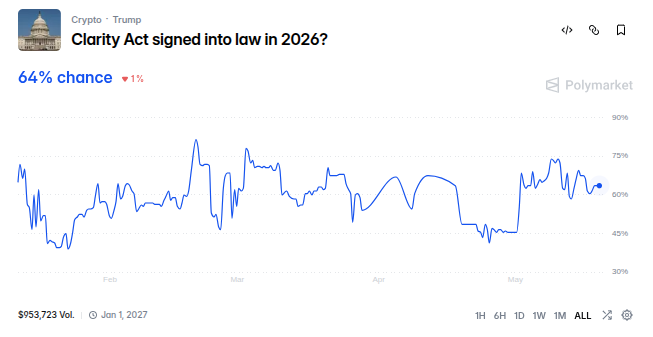
Analysts are cautiously optimistic. Alex Thorne of Galaxy Digital Estimates The chance of the CLARITY Act becoming law in 2026 is approximately 65% to 75%, compared to previous odds of close to breakeven. Meanwhile, traders at Polymarket put a 64% chance that the bill will become law in 2026.

Together, both stories point in the same direction. Japan’s regulatory improvement and US legislative push highlight a global stablecoin ecosystem that is steadily moving from early experimentation toward true, regulated integration.
For issuers and brokers, this dual momentum suggests that clarity has finally arrived, one jurisdiction at a time. Regulated frameworks on both sides of the Pacific could unleash cross-border payments, institutional adoption, and more transparent and inclusive financial systems around the world.
Subscribe to our YouTubeA channel to watch leaders and journalists provide expert insights
this post Japan adopts the law of reverse clarity with foreign stable currencies appeared first on BeInCrypto.



