

Over the years, Bitcoin has evolved from a pure store of value into a more usable asset, with increasing adoption in the payments sector.
As a result, consensus protocols and fee payment transactions are coming into greater focus, as described in the BIP-110 proposal. However, not everyone is convinced that this is the right direction, and one of its biggest critics is Michael Saylor.
In a post on X, Michael Saylor laid out 110 reasons why he thinks BIP-110 is a bad idea.
His criticism targets version 1.0.0 of the proposal, known as the “temporary soft fork of reduced data,” which reached full state on June 25, 2026. The proposal introduces a soft fork, prioritizing fee-paying Bitcoin transactions over non-financial data.
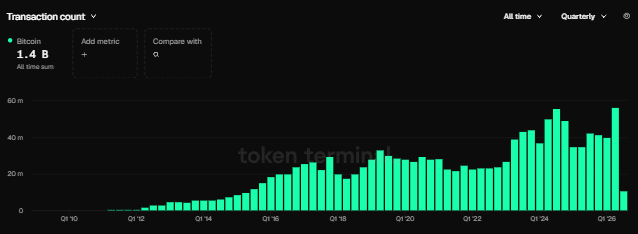
Notably, on-chain data already reflects an increased focus on transaction activity.
As the chart above shows, Bitcoin processed more than 56 million transactions in Q2 2026, setting a new quarterly record and surpassing the previous record of 55 million set in Q3 2024.
This rise indicates growing usage of the network, furthering Bitcoin’s shift beyond its role as a long-term store of value.
Against this background, it is easy to see why Michael Saylor has doubled down on his criticism of BIP-110. In a follow-up post on X, he said so Bitcoin (BTC) The long-term strength lies in deeper adoption by public companies, rather than protocol changes aimed at expanding utility.
Interestingly, when viewed alongside the main variation in the series, Saylor’s argument begins to gain more weight.
Bitcoin’s valuation goes beyond network adoption
Bitcoin’s valuation is rising faster than its adoption.
This comes even as Bitcoin transaction activity reaches a new all-time high. Despite the strong push for greater utility through the BIP-110 soft fork, Bitcoin’s market capitalization continues to grow faster than user activity.
This growing gap indicates that speculation is playing a larger role in driving BTC’s valuation.
As the chart below shows, Bitcoin’s Metcalfe ratio is currently around 3.23. When the ratio rises, it means that the price is moving away from the growth in network participation.
In essence, Bitcoin’s price is rising faster than adoption, highlighting growing speculation side from the current session.
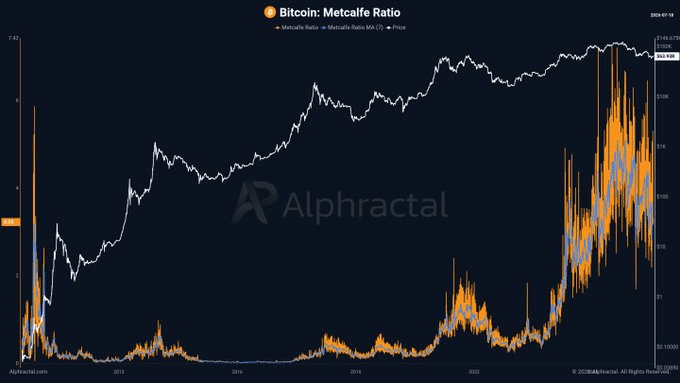
In this context, Saylor said: pays For more exposure to BTC among public companies, it makes sense.
As the market focuses more on consensus upgrades, network efficiency, and overall scalability, the debate over Bitcoin’s long-term fundamentals continues to grow.
At the same time, increased speculative activity raises questions about whether Bitcoin’s store-of-value narrative needs stronger institutional adoption.
Combined, these factors put Bitcoin’s valuation narrative under greater scrutiny, as the market weighs the network’s growth and adoption against the growing speculation driving the current cycle, creating massive liquidity pools around key Bitcoin levels.
Final summary
- Bitcoin network activity is increasing, with record transaction levels and an increased focus on utility through proposals like BIP-110.
- Bitcoin valuation is rising faster than adoption, showing that speculation is playing a larger role in the current Bitcoin cycle.



