Morgan Stanley warned that the Fed may have to raise interest rates this year under certain economic conditions, even as it kept its policy outlook unchanged.
summary
- Morgan Stanley expects the Fed to keep interest rates steady, but warns that there are two conditions that could change these expectations.
- BNP Paribas and Citadel Securities expect interest rates to be raised by the Federal Reserve later this year due to ongoing inflation concerns.
- Neel Kashkari and market pricing suggest that investors remain alert to risks of renewed policy tightening.
According to For Morgan Stanley, its base forecast remains that the Fed will leave interest rates unchanged this year. However, the bank warned that a stronger labor market or stubborn inflation could require policymakers to tighten monetary policy again.
The bank pointed to two specific risks. A fall in the unemployment rate below 4% indicates continued strength in the labor market, while inflation remaining above the Fed’s target may leave officials with no choice but to remove monetary easing.
Recent inflation data has kept these concerns in focus. like I mentioned Earlier, the US PCE price index accelerated to 4.1%, its highest reading since 2023. Meanwhile, oil prices fell following the US-Iran peace deal, a development that could ease energy-driven inflation and support Morgan Stanley’s forecast that interest rates will remain steady.
Other institutions still expect interest rate increases
Although Morgan Stanley does not currently expect a rate increase, many financial institutions have taken a more hawkish view.
As crypto.news reported earlier in June, BNP Paribas abandoned its previous forecast that interest rates would remain steady and now… expected The Fed is expected to reverse the three interest rate cuts it introduced in 2025. The bank expects three consecutive interest rate increases starting with the Federal Open Market Committee meeting in December.
BNP Paribas said policymakers may need to withdraw part of the monetary stimulus if inflation continues to rise while employment conditions remain resilient. The bank also expected the unemployment rate to gradually fall to about 4% by the end of the year, giving the Fed more room to prioritize inflation over labor market support.
Citadel Securities has taken a more aggressive stance. In a recent client note, the company to caution The Federal Reserve could start raising interest rates as early as September 2026 if inflation continues to spread through the economy.
According to Qalaa, inflation is no longer driven solely by energy prices. The company claimed that accommodative financial conditions, ongoing supply chain disruptions, continued labor market strength, and rapid growth in investment in artificial intelligence are all contributing to ongoing price pressures.
Citadel estimated that AI-related capital expenditures could reach about $750 billion in 2026 before rising to about $1.25 trillion in 2027.
The company’s expected policy path includes raising interest rates in September and December 2026, followed by another increase in March 2027.
Fed officials and markets remain divided on the outlook
Fed officials also acknowledged the possibility of additional monetary policy tightening if inflation fails to moderate.
Talk about that interview With Bloomberg, Minneapolis Fed President Neel Kashkari said he was among the policymakers who expected a rate hike this year. He explained that his decision was based on indicators of continued inflation throughout the economy and not on concerns limited to the conflict in the Middle East or the disruption of global oil supplies.
After the Federal Open Market Committee meeting in June, nine of the Fed’s eighteen officials Expected At least one interest rate increase this year, while six policymakers expect multiple hikes, according to previous reports by crypto.news.
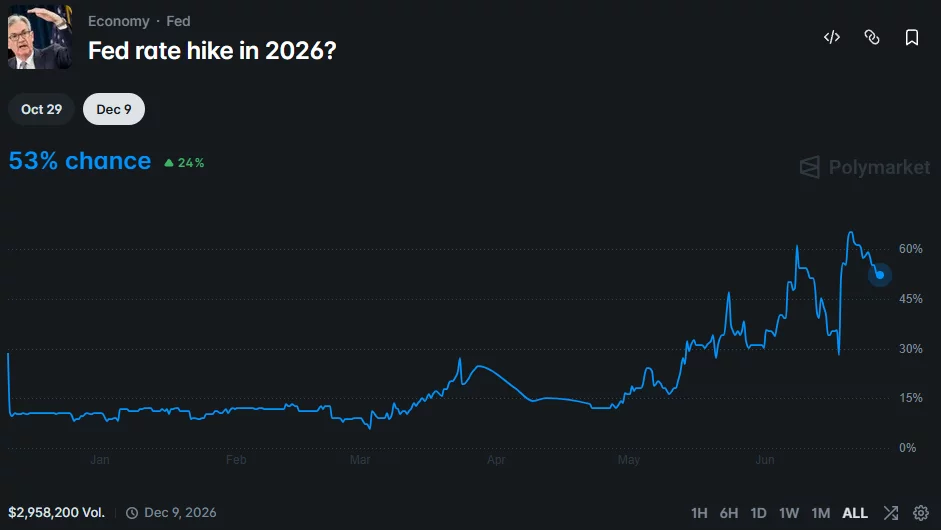
Financial markets also continue to assign meaningful probabilities to policy tightening. Polymarket data suggests a 53% chance the Fed will raise interest rates this year, while CME FedWatch suggests Data It appears that traders are pricing in potential increases in policy meetings in September, October and December. The September meeting currently carries a 46.8% probability of a rate hike.