- An elusive deal between the US and Iran keeps inflation fears alive amid resilient risk appetite.
- US jobs data will highlight increasingly hawkish Fed statements.
- The Eurozone’s rapid CPI is also set to come into focus as the European Central Bank prepares to raise interest rates in June.
- But will the yen steal the spotlight when it returns to the 160 area?
US-Iranian drama keeps traders confused
It has been seven weeks since the United States and Iran agreed to a ceasefire and enter into talks aimed at negotiating a permanent agreement that would not only end hostilities and reopen the Strait of Hormuz, but also resolve the long-standing nuclear issue.
Under any circumstances, reaching such a deal would be a major achievement. Hence, it should come as no surprise that negotiations are ongoing and there are still significant differences that need to be overcome. However, investors believed a deal was imminent.
But that did not turn out to be the case, and instead, the barrage of missile and drone attacks turned into a barrage of headlines about the diplomatic efforts. But what is even more surprising is that, apart from oil prices, market volatility has been steadily declining during this time, even as traders grapple to make sense of Trump’s daily comments and conflicting reports from various Iranian sources about the status of the talks.
However, the most important issue for the global economy – the Strait of Hormuz – remains at an impasse, and therefore, there has been no reduction in the severity of the ensuing energy crisis. It is somewhat worrying that the markets seem to be enjoying the US-Iranian drama. A Netflix limited series where the finale has already been recorded would certainly be the preferred scenario for what seems like a never-ending TV series.
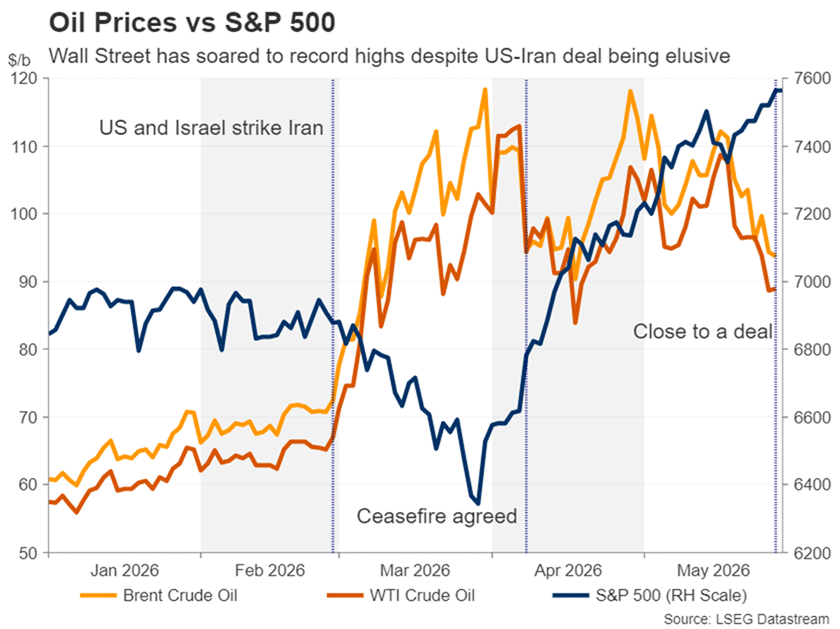
Are investors fooled into thinking a deal is close? Is there a risk of reality checking? Perhaps, but there would have to be a very significant escalation for markets to take notice, as the skirmishes of recent days have barely bated an eyelid, at least in stock markets, where the AI boom has pushed Wall Street to new highs. This may change if incoming economic data continues to boost interest rate hike expectations for the Federal Reserve and other major central banks.
Will the NFP and ISM PMIs elicit much reaction?
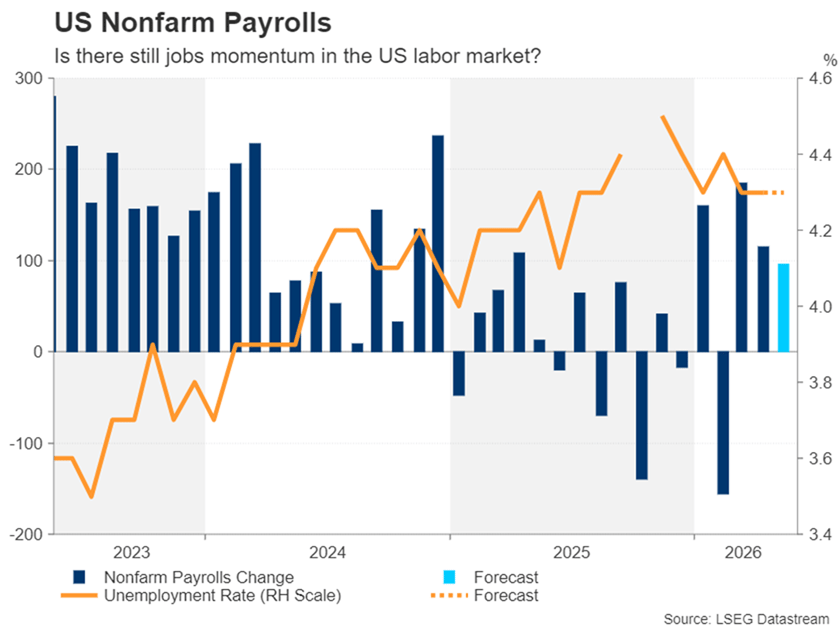
Next Friday’s non-farm payrolls report certainly has the potential to change market expectations, as a weak labor market is the only excuse for the Fed to keep the option of a rate cut on the table. Recent NFP data has been mixed, as contradictory unemployment rate readings or revisions to previous numbers offset the initial reaction to key payrolls.
For May, analysts expect job gains of 96K versus 115K in April. The unemployment rate is expected to remain unchanged at 4.3%, while average hourly earnings growth is likely to accelerate slightly on a monthly basis to 0.3%.
Ahead of the jobs report, ISM Manufacturing and Services PMIs will be closely watched on Monday and Wednesday respectively. Any rise in price indices could raise inflation fears. But of course, the impact will be limited if employment indicators move in the opposite direction.
Other US releases include the April JOLTS job openings report on Tuesday, the ADP factory orders and employment report on Wednesday, and the May Challenger layoffs on Thursday.
A broadly strong set of numbers would weaken the Fed’s case for maintaining its accommodative bias at its June 16-17 meeting, which could create a dilemma for new Chairman Kevin Warsh’s first meeting.
However, for the dollar, investors will continue to balance geopolitical risks with interest rate hike bets, which have eased slightly on hopes of a US-Iran deal getting closer.
The Euro awaits CPI data before the expected rise
In the Eurozone, traders are already preparing for the first interest rate hike since September 2023. Signals from ECB policymakers have become louder, so the focus is now shifting to the pace of increases next rather than the June decision itself. The preliminary May CPI estimates on Tuesday will be the last major update from the bloc before the meeting and are therefore vital to the decision.
The headline CPI jumped to 3.0% year-on-year in April — the highest level, incidentally, since September 2023. The core measure that excludes food, energy, tobacco and alcohol fell slightly to 2.2% year-on-year. If core CPI remains near 2.0%, the ECB will likely be hesitant to set a sharp path to raising interest rates, which could weigh on the euro.
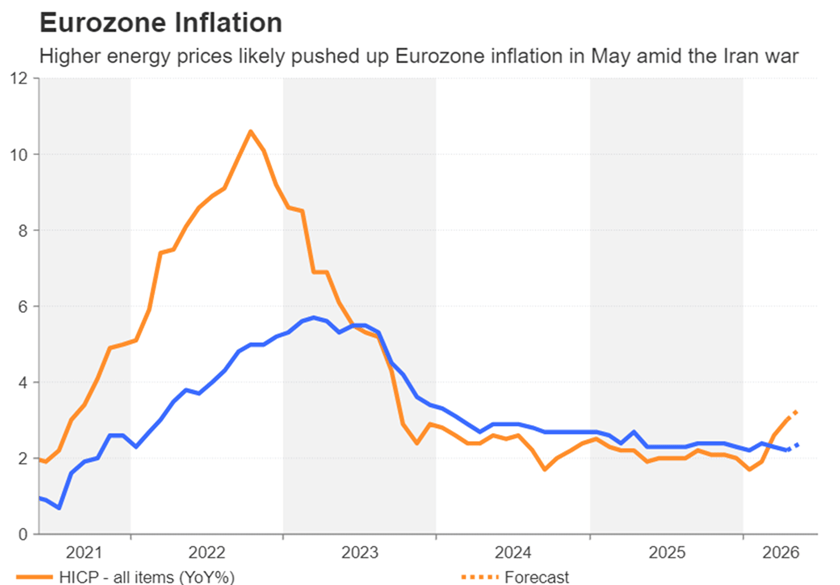
However, it is also possible that the euro could benefit from lower-than-expected inflation numbers, as a less aggressive ECB would reduce the risk of stagflation and improve the eurozone’s outlook somewhat.
In fact, the euro may be more vulnerable to pressure from hotter-than-expected inflation readings or a major wave erupting in the Middle East that would fuel recession fears.
The paths of the Australian dollar and the Canadian dollar are diverging
The energy crisis had unexpected effects on two major commodity currencies. Oil exporter Canada saw a slight decline in the value of the Canadian dollar against the US dollar, while resource-rich Australia saw unusual resilience in the risk-sensitive Australian dollar.
Canada’s struggling jobs market and relatively low inflation compared to the more robust Australian economy and 4%+ inflation have something to do with this. Although Australia relies heavily on fuel imports for transport, it does not need much to generate electricity, while its resource and mineral exports have benefited from the AI boom. On the other hand, the Canadian economy is suffering from the ongoing trade dispute with Trump and the renegotiation of the United States-Mexico-Canada Agreement (USMCA) hanging over its head, facing some of the effects of higher oil prices.
Importantly, the RBA is already on the path to raising interest rates, but the Bank of Canada has not embarked on that path yet. Investors do not expect the Bank of Canada to start raising interest rates before October. If Friday’s employment numbers for May are disappointing, the timing may be pushed back to the year.
However, the Reserve Bank of Australia is expected to resume raising interest rates in August after an apparent pause in June. First-quarter GDP estimates due on Wednesday are unlikely to significantly change interest rate expectations, but a strong performance before the start of the war with Iran will give the Reserve Bank of Australia less reason for caution.
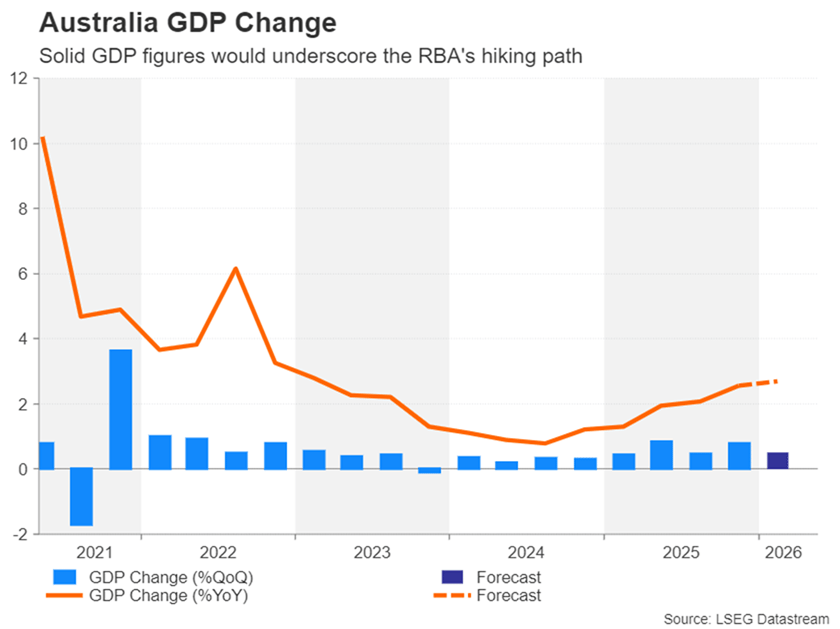
Australian traders will also be watching China’s May manufacturing PMIs, with official and S&P Global releases due on Monday.
Is a new yen on the cards?
In Japan, government energy subsidies helped reduce inflation during the conflict in the Middle East, although this did not prevent the Bank of Japan from acknowledging that underlying price pressures were growing, not only from the energy shock, but also from higher wage growth.
Friday’s earnings data will provide an update on the Bank of Japan’s progress in achieving sustainable wage growth. Household spending data will also be monitored on the same day.
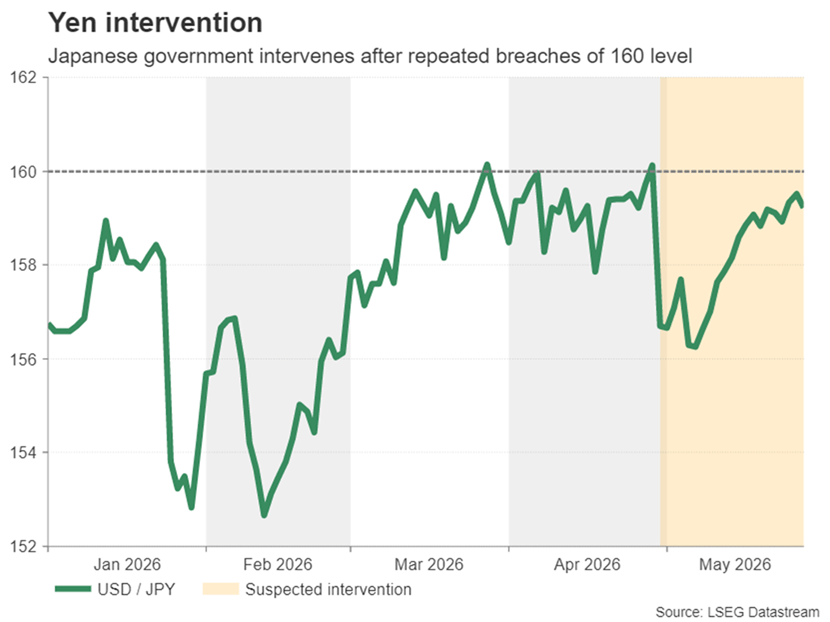
But it is questionable whether any upward surprises will be able to boost the yen. Recent hawkish statements from the Bank of Japan were unable to prevent the yen from returning to the 160 intervention zone. Bank of Japan policymakers continue to play it safe with their forward guidance, refraining from committing to raise interest rates multiple times, while ongoing geopolitical risks have exposed Japan’s over-reliance on the Middle East to meet its energy needs.
With the dollar back above 159 yen this week, the Japanese government may have to intervene again in the coming days if the 160 yen level is breached.