
Tldr:
- The Clarity Act passed the House with 78 Democratic votes, but remained stalled in the US Senate ten months later.
- Binance liquidates roughly 40% of global spot cryptocurrency volume, while Coinbase, the largest US exchange, handles just 6%.
- Senators Gallego and Torres are pushing cryptocurrency legislation to serve Black and Latino working-class voters.
- Tokenization on public blockchains could expand the reach of American financial products to billions of people who lack access to American intermediation.
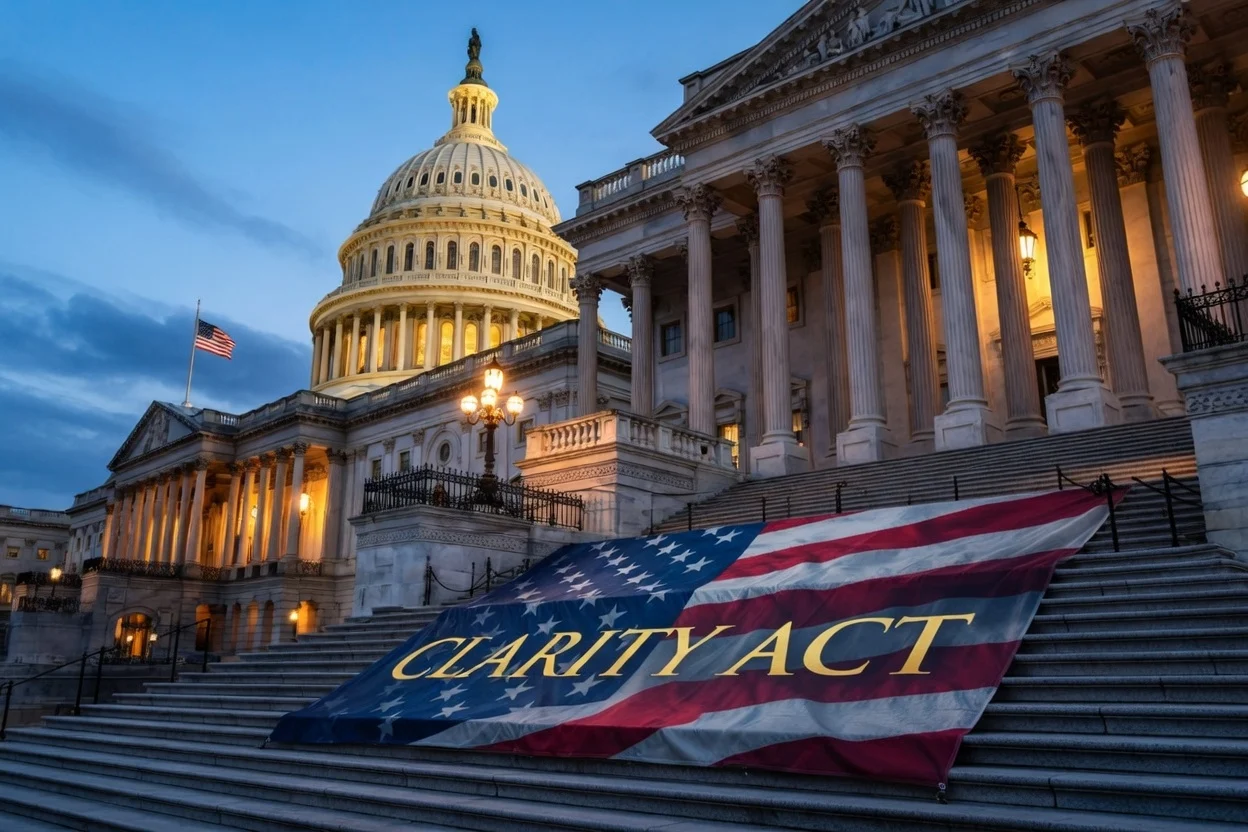
the The law of clarity It remains stuck in the US Senate despite strong bipartisan support in the House. Mike Novogratz, founder of Galaxy Digital, urges Democrats to act on regulating cryptocurrencies.
He argues that inaction is pushing US cryptocurrency activity offshore. With 55 million Americans owning cryptocurrencies, the risks to America’s financial leadership are high.
The longer the Senate delays, the more territory the United States will cede to rival financial centers like Singapore, Dubai, and London.
Senate inaction pushes crypto activity overseas
The House passed the Clarity Act last July with support from 78 Democrats. However, the bill has not been introduced in the Senate, leaving US cryptocurrency companies without a clear legal basis. Novogratz points to this regulatory vacuum as a major driver of outside activity.
Binance, which has no official headquarters but operates under an Abu Dhabi license, liquidates approximately 40% of global spot cryptocurrency volume.
Meanwhile, coinbase, The largest US-based exchange handles approximately 6%. The gap between these numbers clearly tells the story.
The United States pumped $2.4 trillion into cryptocurrency markets in one year, nearly four times as much as the next country. But in the absence of local rules, capital flows through foreign platforms.
Senator Kirsten Gillibrand crossed party lines in 2022 to introduce a bipartisan cryptocurrency framework. write on x, “The Senate’s job now is to get the matter resolved,” Novogratz noted.
Novogratz views the delay not as a policy disagreement, but rather as an attitude problem. An audio slide from the views of the Democratic Assembly Encryption legislation As a corporate gift. He says this view produces the opposite of the intended effect – an unregulated foreign market.
Democratic lawmakers and code could redefine US financial power
Senator Ruben Gallego, Arizona’s first Latino senator, embraced cryptocurrency policy directly because his constituents were asking about it. Many of them are working class, Hispanic, or Black Americans, and have a growing interest in digital assets.
In a statement referenced by Novogratz, Gallego made his position clear: “If your constituents care about this, you should care about it, too.”
Rep. Ritchie Torres, who grew up in public housing in the Bronx, represents one of the poorest congressional districts in America.
He has publicly argued that blockchain technology could “liberate low-income communities from the high fees of the traditional financial system.” Both lawmakers are actively working on legislation while much of the caucus remains on the sidelines.
Beyond local regulation, Novogratz sees a bigger opportunity in coding. Public blockchains could allow US stocks, treasury bonds, and mutual funds to reach billions of people globally who would never open a U.S. brokerage account. The Law of Clarity can make this possible.
Novogratz argues that passing the bill is not just a financial decision – it is a display of American economic power. Countries like Singapore and the UAE are already moving.
Novogratz put it plainly: “Pass the Clarity Act. Show up. This is how Democrats win. This is how America wins.” The United States has the capital markets, demand, and legal infrastructure to lead. What is needed now is legislative follow-up.




