
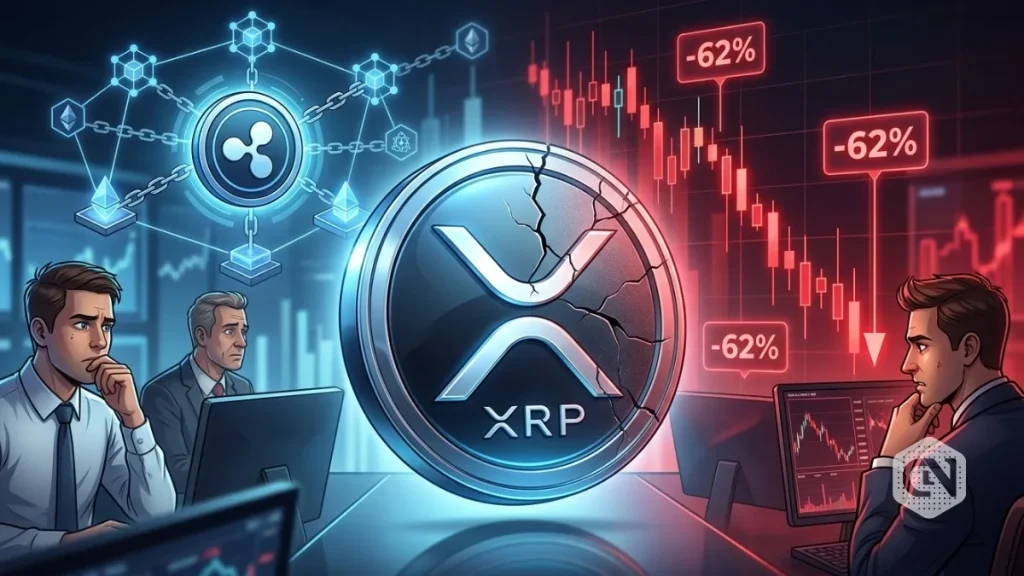
- RLUSD is rapidly expanding across OKX, Bullish, and Ethereum L2s.
- About 82% of the stablecoin resides on Ethereum chains.
- XRP remains 62% below its peak in 2025 despite strong growth of the ecosystem.
It’s been a big week for payments giant, Ripple. From high-visibility billboards all over Las Vegas to a wave of new RLSUD integrations, the company is clearly accelerating its global presence. But these milestones were not reflected in the price of XRP. The token continues to lag, trading 62% below its peak in 2025.
It should be noted that much of the current hype is centered around Ripple’s stablecoin, RLUSD. In the past 24 hours, the RLUSD stablecoin has launched on OKX, entered institutional trading flows on Bullish, and expanded into the Ethereum L2 ecosystem. This confirms that RLUSD has become central to Ripple’s strategy. But does this indicate that the company is sidelining XRP?
Beneath the headlines, there is a growing disconnect. A large share of RLUSD is now on Ethereum. Much of its use bypasses XRP entirely. This shift raises a new debate about whether XRP is still the main driver of value.
Revealing the cross-chain expansion of Ripple RLUSD
In just two days, Ripple has successfully scaled RLUSDits fiat-backed stablecoin, on multiple platforms. While this sounds attractive for XRP, a closer look reveals that the stablecoin is expanding in ways largely independent of XRP.
RLUSD is launched on OKX
One of the biggest updates was from OKX, a prominent cryptocurrency exchange. OKX lists RLUSD across more than 280 trading pairs. This represents a significant increase in liquidity on paper. It puts the stablecoin in front of a huge global user base and allows both individual and institutional traders to access it.
Here, what is more noteworthy is the off-chain implementation. OKX trades on RLUSD can be made within its central order book. This means that they do not directly interact with the XRP Ledger or XRP.
Institutional use is expanding across the board
Another major development is the integration of RLUSD into institutional trading flows. Through Bullish, Ripple Prime clients can now use RLUSD as collateral to trade Bitcoin options. This is a big step towards positioning RLUSD as a serious financial instrument. The post, issued on April 29, stated:
“Bullish options markets are now available to institutional clients of Ripple Prime, providing direct access to Bullish’s BTC options alongside existing access to spot, perpetual and dated futures contracts. Trading is available via existing sub-accounts with no additional KYC requirements.”
The development also indicates increasing institutional adoption. By enabling the stablecoin to act as collateral, Ripple places it directly into a high-value trading environment.
Here too, XRP is not part of the process. Options are settled in the stablecoin, and collaterals are posted in the same currency. XRP does not play a role in margin, settlement or execution.
RLUSD is positioned as a SWIFT alternative
A key milestone shared by Rhys Merrick, Managing Director, Middle East and Africa, is the use of RLUSD as an alternative to SWIFT. Notably, he has positioned the stablecoin, not XRP, as the asset that companies will consider for global payments.
His message comes in the middle Ripple expands into the United Arab EmiratesBy opening a new regional headquarters for the Middle East and Africa in the Dubai International Financial Centre. Merrick also highlighted the company’s ongoing cooperation with the Dubai International Financial Centre.
It is worth noting that Ripple has become the first blockchain payment provider to obtain a license from the Dubai Financial Services Authority. Its stablecoin has been recognized as a certified token within the Dubai International Financial Centre.
Merrick noted,
“Since our early days in the UAE, we have witnessed first-hand the appetite from local businesses for regulated, blockchain-powered payments infrastructure, and it is growing. A larger team, based here in Dubai, will enable us to move forward in supporting our customers and partners across the region and beyond.”
Scaling to Ethereum L2s
Perhaps the most significant development is the expansion of RLUSD beyond XRPL into the L2 spaces of Ethereum. Ripple has confirmed plans to expand RLUSD to include networks such as Base, Optimism, Ink, and Unchain via Wormhole’s cross-chain infrastructure.
Ethereum L2s offer large user bases, active DeFi systems, and strong developer activity. By placing RLUSD on these chains, Ripple benefits from that liquidity and usage.
But these networks do not rely on XRP. Minting and transferring RLUSD on Ethereum L2 does not require interaction with XRPL. As a result, each new integration in this space increases the footprint of the stablecoin – not XRP.
The numbers already reflect this shift. About 82% of the supply of Ripple’s stablecoin is now on Ethereum. This is significantly higher compared to 18% on RLUSD.
Why doesn’t RLUSD growth translate into demand for XRP?
The main reason why RLUSD growth does not boost demand for XRP depends on how it is used. Most stablecoin activity occurs on centralized platforms like OKX, where trades take place off-chain. This eliminates the need for XRP in each transaction. The token is only required when the stablecoin is transferred in or out through the XRP Ledger.
Meanwhile, RLUSD’s major presence on Ethereum is another major reason as well. While these systems are not dependent on XRP, stablecoin activity continues independently.
Interestingly, the payments company is investing heavily to boost the growth of the stablecoin. The team is increasingly positioning itself as a major player in the ecosystem. but Ripple does not see the same effect. The price of XRP is down 62% from its peak in 2025. Broader momentum has also slowed.
Could the growth of stablecoins be a positive catalyst for XRP?
Currently, the growth of the Ripple stablecoin is not a driver of the XRP token. But can it act as a positive motivator? Of course yes. But it needs to change the way stablecoins are used.
Currently, most of the activity surrounding the stablecoin occurs outside of the XRP Ledger. This limits the role of cryptocurrency. If the activity is transferred to XRPL, this could increase the role of XRP and thus increase the demand for it.
Stablecoin supply also plays a major role. The 82% supply on Ethereum once again limits the position of XRPL and the altcoin. For an altcoin to benefit, balance must be maintained, with more stablecoins being issued on the XRP Ledger.



