
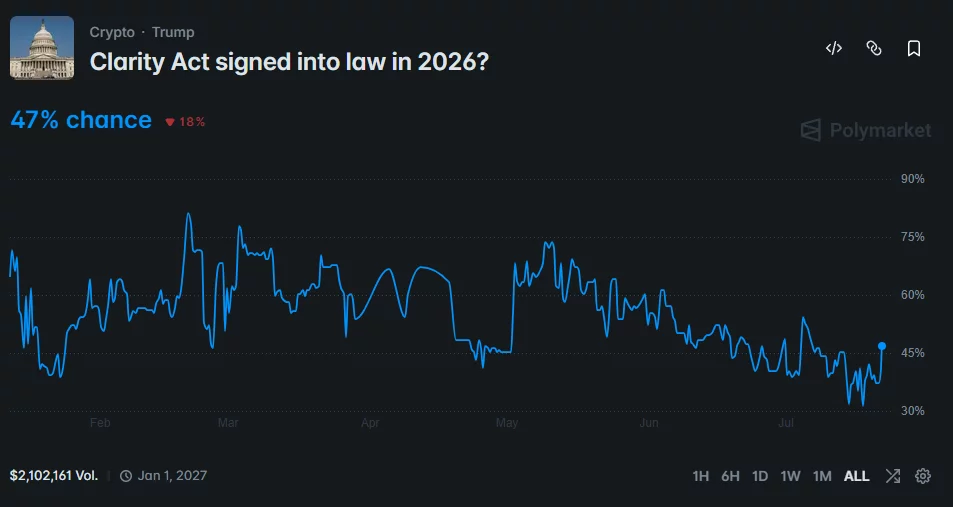
Senate negotiations on the CLARITY Act produced new customer safeguards and an ethics agreement, raising the odds of passage of the Polymarket Act this year to 43% as lawmakers seek a bipartisan vote.
summary
- John Thune sees a good opportunity for a bipartisan Clarity Act agreement.
- Democrats have succeeded in securing stronger consumer protections, while lawmakers have approved ethics provisions.
- Polymarket traders estimate that the bill’s chance of becoming law in 2026 is 43%.
CNBC reported that Democratic senators secured additional customer protection measures during negotiations on the Digital Asset Market Clarity Act, though unresolved details continued to delay the release of the Senate’s final text.
to talk In an interview with CNBC on Monday, Coinbase Vice President Ryan Vangraak described the revised protections as giving the bill “more power.” According to VanGrack, the changes address loopholes in existing rules governing users of digital assets, but he did not elaborate on what requirements lawmakers have added.
Senate Majority Leader John Thune also expressed cautious confidence in the ability of Republicans and Democrats to reach an agreement. In comments shared via X’s post, Thune said there was a “good chance” an agreement could be reached, while warning that the talks could still take a different path.
Lawmakers are working with Democratic senators to secure enough support to get the legislation off the ground, according to Thune. The Majority Leader had previously indicated he wanted a bipartisan agreement before allocating valuable Senate time to the bill.
Republicans control 53 seats in the Senate, but they would need the support of at least seven Democrats to reach the 60 votes generally needed to overcome a filibuster. This calculation has given Democratic negotiators significant leverage over customer protections and ethics in legislation.
Support is close to bipartisan
The agreement covering elected officials’ participation in digital assets has removed one of the major hurdles in the negotiations, crypto.news I mentioned. Democratic lawmakers have pushed for rules that would address potential conflicts related to President Donald Trump’s cryptocurrency interests and government officials’ involvement in the sector.
According to Punchbull News, Trump Listing accepted Of ethical judgments, which helps progress negotiations after weeks of disagreement. The report has not released the full language, and the final restrictions will remain unclear until senators release the updated bill.
Senator Kevin Cramer provided more details about the implementation structure, noting that negotiators had reached agreement on ethics language. Under the approach described by Cramer, the Justice Department would enforce that ruling rather than leave enforcement to individual state prosecutors.
Cramer argued that the bill became clearer as lawmakers resolved each disputed issue. Commenting on the progress, the North Dakota Republican said: “I think we’re almost there.”
Meanwhile, Treasurer Scott Bessent Congress urged To complete the legislation before senators leave Washington for their August recess. Pisant described lawmakers as being on the “one-yard line,” noting that only a few differences remained in the negotiations.
Coinbase presented the customer protection concessions as evidence that Democratic participation has changed legislation rather than simply providing Republican sponsors with the votes they need. VanGrack told CNBC that Democrats used the process to strengthen protections for people who own or trade digital assets.
The Senate’s prior work has already included rules governing customer ownership, fair and transparent pricing, and standards for advertising and fraudulent behavior. The draft published by the Senate Agriculture Committee also would require digital commodity brokers, traders and exchanges to register with the Commodity Futures Trading Commission, subject to exemptions written in the proposal.
Senate Agriculture Committee advanced Its share of the market structure package in January. Committee Chairman John Boozman said at the time that the legislation builds on the bipartisan House-passed CLARITY Act and includes provisions negotiated with Senate Democrats.
The final script still controls the timeline
Despite the recent agreements, CNBC reported that the Senate has not released the full legislative text. Ethics rules remain part of the delay, leaving lawmakers, cryptocurrency companies and consumer groups unable to assess the precise restrictions or enforcement powers under discussion.
Thune said he hopes to bring the Clarity Act to the Senate floor before August, but his comments suggest scheduling depends on Democrats committing to enough votes. A vote without this support could stall the bill before the Assembly considers amendments or final approval.
The House of Representatives has already done so She agreed with her version of the CLARITY ActWhile the Senate prepares its own text. Any disagreements between the two chambers must be resolved before Congress can send a joint version to Trump for his signature.
The legislation seeks to establish federal rules for digital asset markets and clarify the roles of the Securities and Exchange Commission and the Commodity Futures Trading Commission. Senate Agriculture Committee materials show its part would give the CFTC authority over digital commodity brokers and impose registration, custody, anti-fraud and customer ownership requirements.
Traders at Polymarket are currently assigning a 43% probability that Trump will sign the CLARITY Act into law during 2026, down from the 47% previously cited in the negotiations. Prediction market odds can change quickly and do not determine whether Congress will adhere to Thune’s preferred timeline.
For now, the Democratic Agents and Ethics Agreement has improved the path to a bipartisan vote, but unpublished text and the Senate calendar continue to determine whether the bill can reach the floor before the August recess.



