
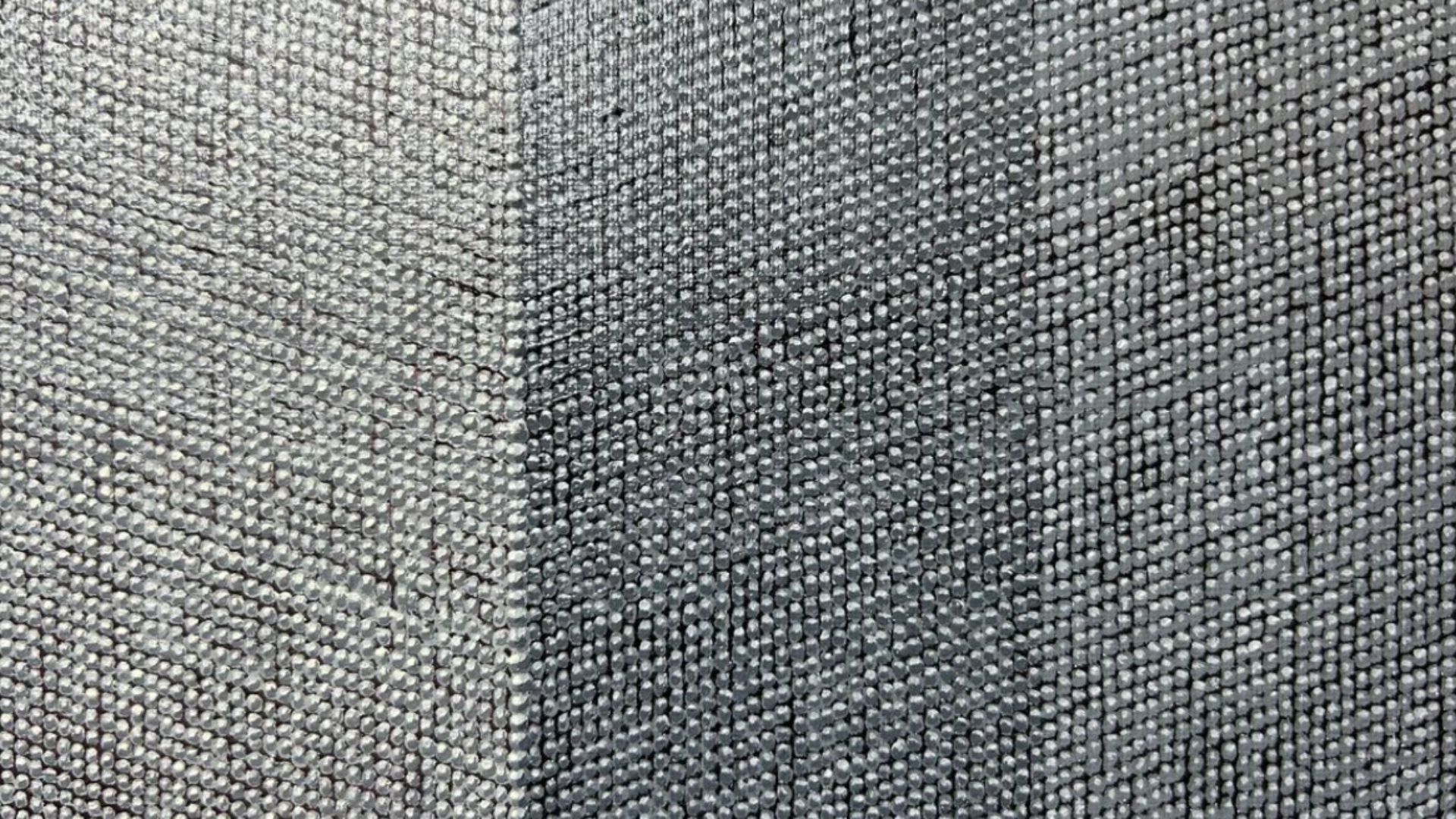
There are 21 million bitcoins. This number is fixed, encoded in the protocol, and limited. It is one of the most important design decisions in the history of finance, yet it remains abstract to most people. Green numbers streak across a black screen like something out of The Matrix, or a talking point being made on a podcast.
Japanese artist On Kawara has spent nearly fifty years hand-painting history on a canvas every day, and if he doesn’t finish it by midnight, he destroys it. Annick Malcolm spent 900 hours drawing 21 million beads. The motivation is the same: make abstraction physical, make counting important, and let the work carry meaning.
“The Entire Universe” is a concept first conceived in early 2025 and is now in its third and most ambitious incarnation: a delicate, large-scale oil painting in which each Bitcoin is represented as an individual bead, hand-painted over the course of more than 900 hours. The work will be shown for the first time at Bitcoin 2026 at The Venetian Resort in Las Vegas.
The premise was fairly simple — show 21 million of something. But while figuring out how to do it, Malcolm stumbled upon something akin to a tesseract—a shape that revealed more dimensions the longer he looked at it. Twenty-one million is not clearly divisible into a cube, as its cube root is an irrational number. But if you round to the nearest integer, 276, and cube it, you get 21,024,576 — exactly 24,576 more than 21 million. Divide this surplus evenly by six (one for each face of the cube), resulting in 4,096 beads that must be removed from each side. The square root of 4096 is 64 — a perfect square and a power of two. Which means that those removed areas can be repeatedly halved: from 64×64, to 32×32, to 16×16, all the way down to 2×2 – mirroring with amazing accuracy the Bitcoin halving mechanism.
He opened the box and the pattern was already inside. For him, business is not an example of Bitcoin, but rather a constant life of it. The most literal depiction that can be offered, it is presented in a form so structurally resonant that it caught the attention of Adam Back.
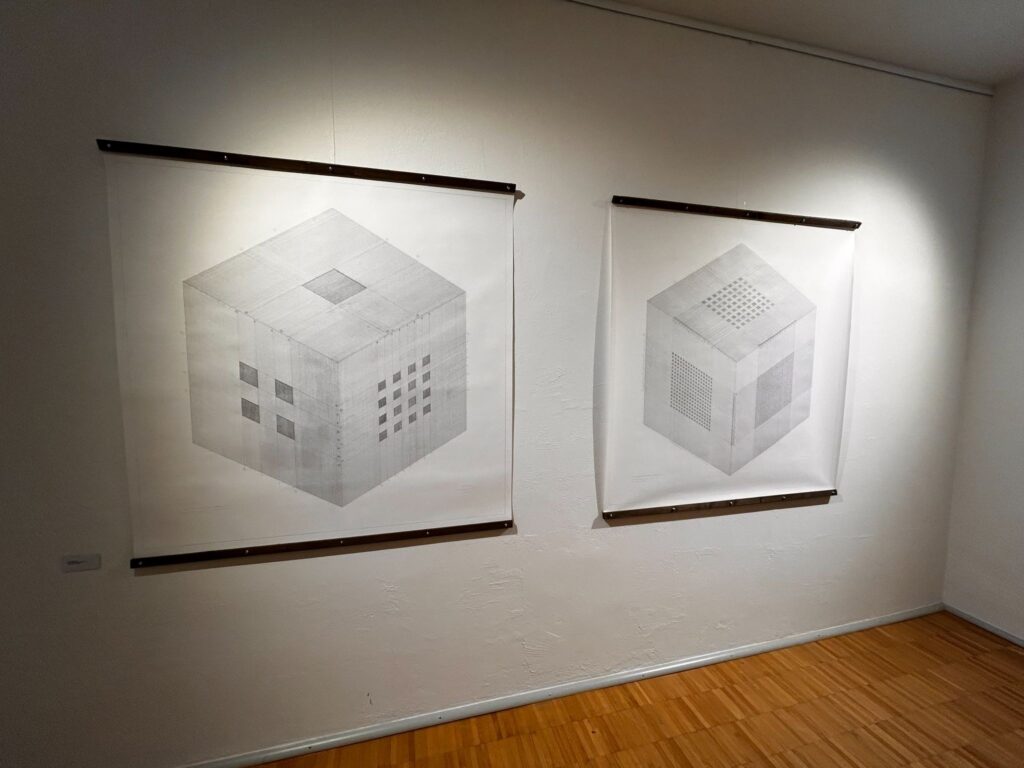
From early drawings shown in Lugano to digital renderings to the oil painting that debuted at B26 — and a massive public sculpture planned for Roatan — the “Entire Universe” exhibition continues to demand a larger canvas.
I spoke with Annick Malcolm about how a simple question produces an extraordinary answer.
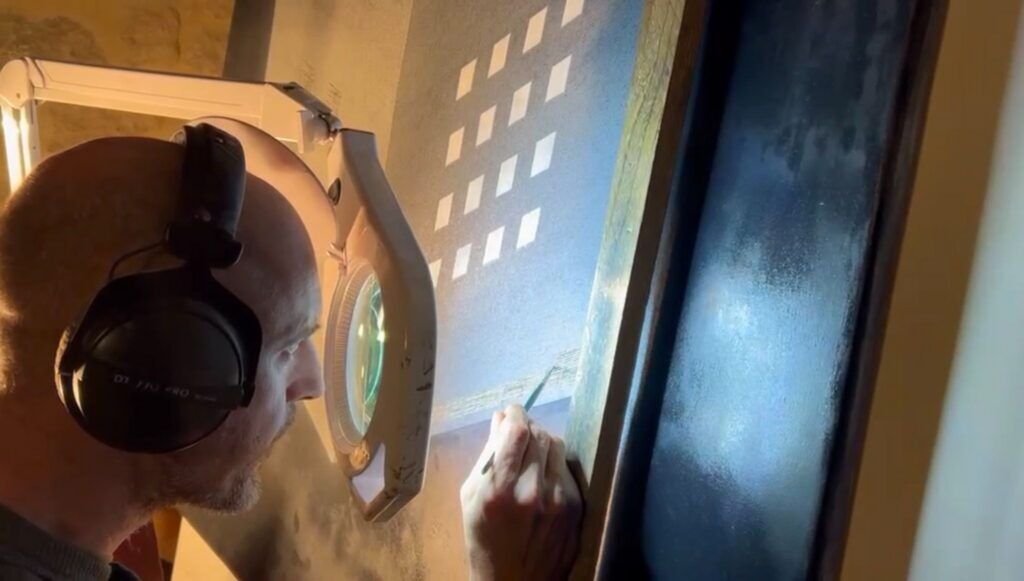
With mag: The entire universe started with a deceptively simple premise – create a work of art that showcases 21 million things. How did you come up with this idea, and what was it like when your wife – an artist and jeweler – suggested a beaded cube? How does this type of creative exchange between partners benefit you?
Anick Malcolm: The original motivation was this simple – it struck me that although the number 21 million is hugely significant to us Bitcoin users, it is also a number that is difficult to understand without seeing it. How large it is at the same time, but also so small and “human” in scale – so I wanted to find a way to bring the figure to life, and make it understandable. My wife Ona and I have collaborated on many projects over the years, both in the visual and audio arts, so we’ve honed the skill well to make it flow constructively. I suggested this idea to her in conversation, and her immediate response was, “A cube of beads.” I liked this for the fact that the cube is a ubiquitous symbol in Bitcoin, both visually and metaphorically, and because the bead was one of the first methods of exchange – the combination made perfect sense, and was additionally manageable in terms of size. I immediately set about solving the practical procedures, calculator in hand, and I could hardly believe what I found…!
With mag: When I set out to see if 21 million could fit in a cube, I stumbled upon a series of mathematical coincidences — 276 cubed, the remainder 4,096 divided evenly by six, and the square root landing at 64 (I can’t help but hear the Beatles lyric “When I’m 64” in my head), the power of two. Walk us through that moment. Did you immediately realize what you were looking at, or did it develop gradually?
Anick Malcolm: Haha – wow, I haven’t connected with the Beatles yet! amazing. Yes, it happened very quickly. Obviously the cube root of 21M was not going to be a rational number, so I knew I would have to make some adjustments to make it fit. I naturally started with the idea of rounding the cube root to 276 and then subtracting from it — as I said before, to arrive at 21,024,576, and it was a real rush when the excess 24,576 was cleanly divided by 6, which meant that I was able to give the required structural symmetry. However, this rush was greatly exacerbated by the fact that I felt like I recognized the number 4096, and I was literally shuddering as I entered “square root of 4096” into my calculator, and when I saw the result I was completely dumbfounded – Una witnessing the whole process in amusement! The fact that I could not only distribute the subtracted number evenly over all six sides, but also do it in perfect squares to get exactly 21,000,000, was like a moment of providence, as if this symmetry had been encoded from the beginning and was waiting to be found, and that perhaps there was some deeper significance that someone might, one day, understand. I immediately realized that I had been assigned a very useful project.
With mag: The pattern I found – squares halving from 64 x 64 to 2 x 2 – mirrors Bitcoin’s halving mechanism. She described the piece as a “bitcoin still life.” How much of this connection did you set out to find, and how much of it did you feel was already built into the issue waiting to be discovered?
Anick Malcolm: Yes – I was so impressed by the initial discovery that I realized, to my greatest surprise, the obvious fact that I could divide 64 into 32, 16, 8, 4, and 2 – only after some time – not only to make the cube more visually interesting, but in the process also representing both the halving function that is integral to the Bitcoin mechanism, but at the same time also the exponential growth which, on the contrary, is a direct result of that halving. I felt like this single cube embodied everything Bitcoin stands for and does, and with such amazing symmetrical elegance – I was and still am, over a year later, in absolute awe of the beauty of it all, which is why I’ve pretty much made it my life’s work, for the time being at least. So to answer the question – I didn’t plan to find it at all, which is why I really feel like I’m just a messenger, a role that allows me to stand strongly behind it because it’s not my making but just a discovery.
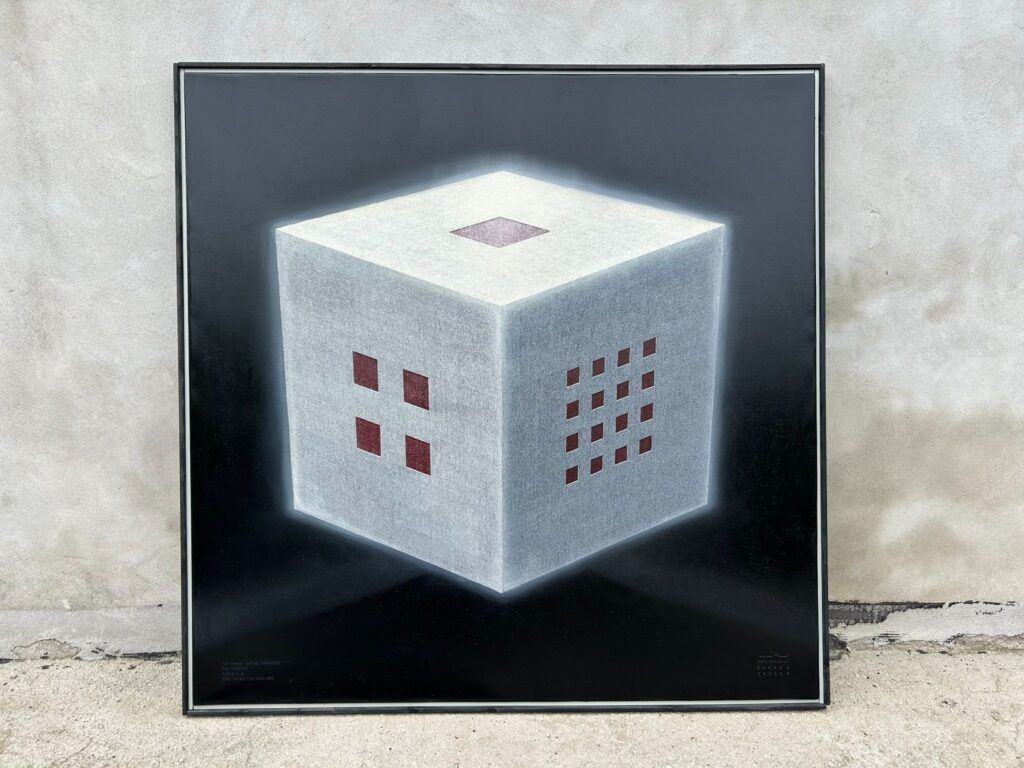
With mag: The oil painting’s Bitcoin 2026 debut took more than 900 hours to complete – each grain representing an individual Bitcoin, hand-painted. What does this kind of sustained, rigorous work do to your relationship with the subject? Does spending all this time with 21 million change the way you think about that number?
Anick Malcolm: This is a very interesting question, and one I thought about a lot during this process. Since it’s a 2D representation of a still theoretical 3D object, I “only” had to draw 227,701 visible beads – each one three times: body, shading, and shadow, not to mention the underlying mesh.
The whole process was, as you can imagine, very meditative, and I found that the “intrusive” thoughts would impact my efficiency, so that in itself became an exercise in recognition, acceptance and letting go – a growth process of the kind that many have reported encountering on their Bitcoin journey.
Then, I realized that music that demanded my attention more would have the same effect, so over time the playlist evolved into a track that resonated with the essence of the cube rather than rubbing against it – Arvo Pärt, David Lang, Kjartan Sveinsson, and the like, which I would also offer to listen to at B26, because it forms an additional dimension to the presence of the artwork.
Third, I began to notice many other patterns within the numbers, many of which were associated with Tesla’s “3,6,9” ideas, and I even spontaneously began chanting a personal mantra as I drew, dot by dot, a 3,6,9 pattern!
So I would say that instead of actively applying meaning to the number and its cubist appearance, I became deeply under its influence as time progressed – physically, mentally and spiritually. There is a certain “sacredness” to Bitcoin that I feel we all agree on to a greater or lesser extent, and my experience representing it in the literal sense of the word has been a true reflection of that.
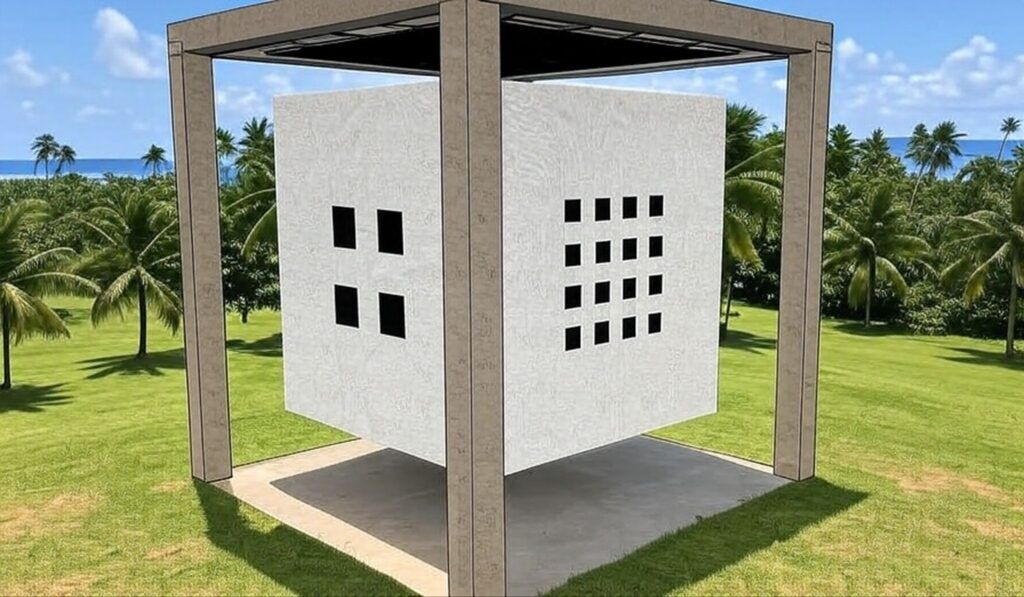
With mag: This concept has gone from sketches in Lugano to digital versions and educational videos to a full-scale oil painting, and you are planning to create a huge public sculpture in Roatan. What is it about this particular idea that continues to demand greater coordination?
Anick Malcolm: In fact, both Logano’s drawings and plate B26 (each 128 x 128 cm – about 4’2″) are on the smallest scale at which I can accurately represent the number! Each bead is 2mm (5/64 inch) in size – even smaller on the top face – so any smaller bead would not fit. I would also like to make a sculpted version in the same or similar size, hopefully within the next 12 months, as 55.2cm (less than 2 inches) is still a manageable size. However, I met someone in Lugano who spent years searching for a suitable idea for a huge Bitcoin statue in Roatán, and I felt like this worked out perfectly. Even at a bead size of just 1cm (roughly ⅜ inch) with a 1cm gap between them for visual and kinetic impact, the cube alone quickly expands to 5.52 meters (about 18 feet), not counting the supporting structure and height from the ground. I feel that being able to be in the presence of 21 million on such a large and majestic scale would be an experience that would do Bitcoin and everything it represents proper justice.
With mag: Adam Back has noticed the action. But if someone walked up to this board at B26 without any mathematical background or special interest in the technical architecture of Bitcoin – what would you want them to see or conclude?
Anick Malcolm: I think my teenage daughter is a good representative of this demographic! She told me one day that she would frequently come into the room where the painting was drying “just to look at it for a while.” As I experienced while painting – I feel there is a profound soothing effect exuded by the sheer symmetry and pattern of the cube, floating and glowing in its abyssal surroundings, and combined with the soundtrack provided, it becomes a very meditative and enjoyable experience. Even at the most basic level of mathematics, there are 21 subtracted squares visible on the board! (Another beautiful coincidence – 1 square is 64², 4 squares are 32², and 16 squares are 16²). I feel, and hope, that both visitors to B26 and the board’s eventual future owner will derive deep and abiding pleasure from this tranquility quietly encoded in this magical number, the way my entire family and I felt during the journey of its creation – a quiet, methodical truth that mirrors the Bitcoin experience as a whole.
Fix the money. Fix the world.
The Entire Universe by Annick Malcolm premieres at the BMAG Art Fair at Bitcoin 2026, April 27-29, at the Venetian Resort, Las Vegas. Preview the work and explore more from the BMAG B26 gallery here. A limited edition t-shirt based on the painting is available here.
The Bitcoin Museum and Art Gallery (BMAG) is the curatorial and cultural programming division of BTC Inc and a Bitcoin conference. Since 2019, the BMAG Convention Art Fair has facilitated over 120 BTC in art and collectibles sales. Learn more about BMAG at Museum.B.Tech. Follow BMAG on Twitter @BMAG_HQ.
Pack your Bitcoin 2026 card with a stay at The VenetianAnd get your fourth night free. Use code AFTERS to get a free After Hours Pass, or Get your own pass here.



