
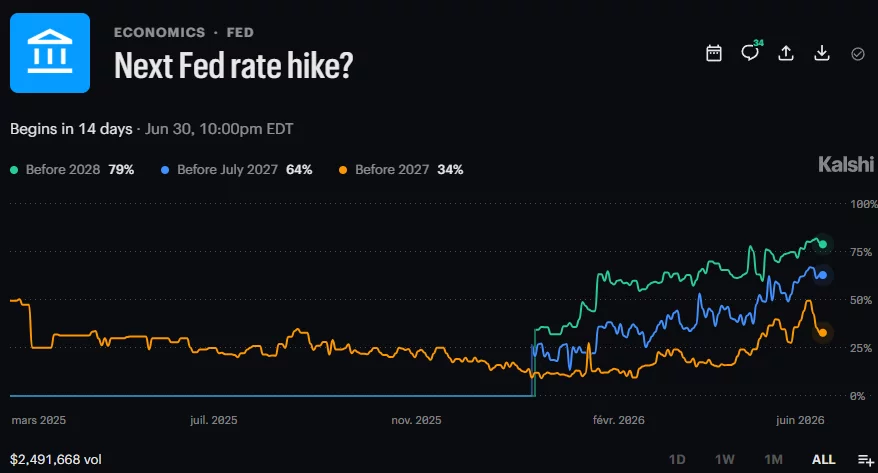
Markets have increasingly factored in a future Fed rate hike ahead of this week’s FOMC meeting, with markets projecting a 64% chance of policy tightening before July 2027.
summary
- Markets are now pricing in a 64% probability of a Fed rate hike before July 2027.
- Economists expect the Fed to leave interest rates unchanged at the Federal Open Market Committee meeting this week.
- Persistent inflation and rising energy prices have reduced expectations for future interest rate cuts.
According to market forecast data from Calci, traders currently assign a 64% probability that the Fed will raise interest rates before July 2027. The increased expectations come as inflation continues to rise and energy prices rise following US-Iran tensions.
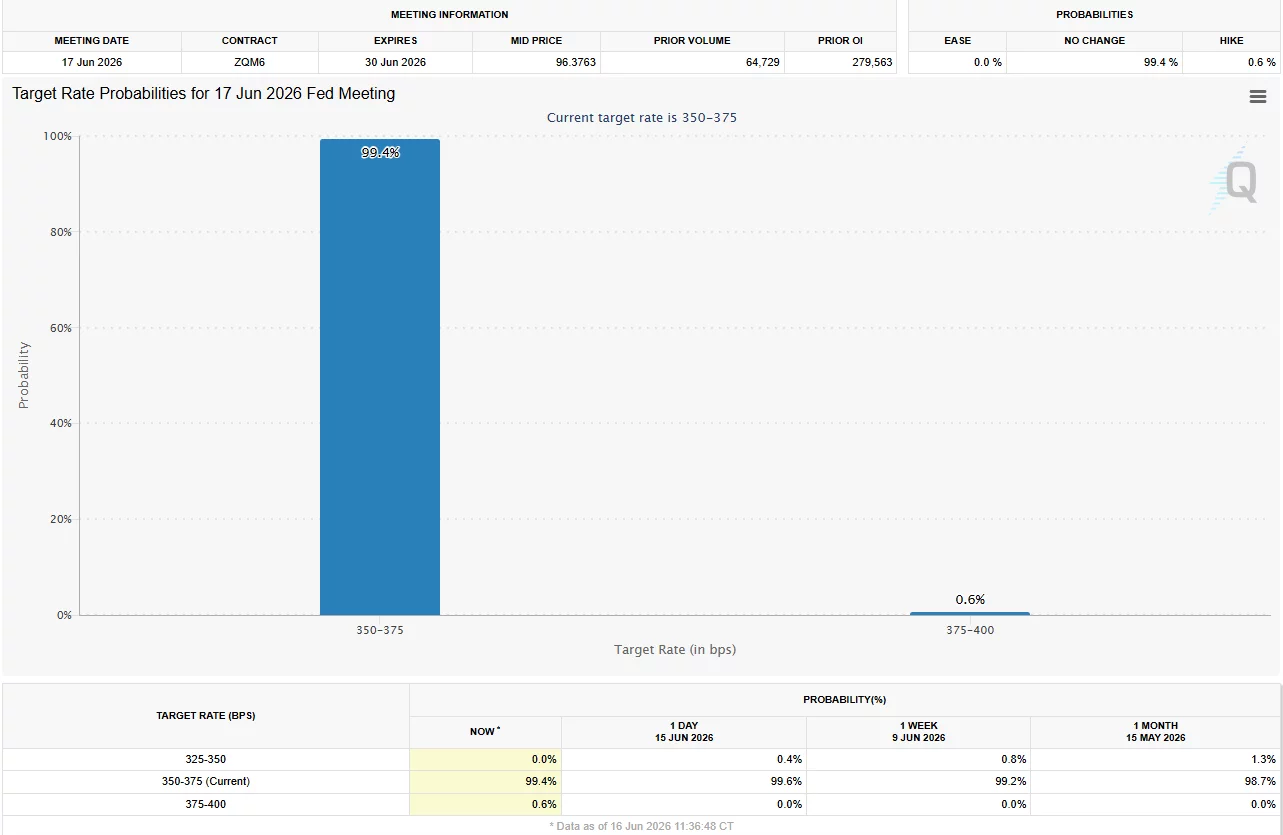
Investors now turn their attention to the Federal Open Market Committee meeting on June 17, where CME FedWatch data shows a 99.4% probability that officials will keep interest rates unchanged.
While no immediate policy move is expected, market participants are closely monitoring any signals about the direction of future monetary policy.
A recent Bank of America poll showed that nearly 40% of respondents expect to raise interest rates at least once in the next 12 months, up from 16% the previous month. Meanwhile, only 28% expect interest rate cuts, indicating a marked change in investor expectations as inflationary pressures persist.
Markets expect policymakers to abandon accommodative bias
Fresh insight from the latest CNBC news Fed survey He points out a similar point of view. Of the 32 economists, strategists and fund managers surveyed by the network, none expect the Fed to change interest rates at this week’s meeting or at any time until 2027.
CNBC also quoted Gregory Daco, chief economist at EY, who said Warsh may face a different political environment than many investors expected.
“While Warsh is generally viewed as a dove, he will inherit a committee that has become noticeably more hawkish.”
While respondents do not expect an outright rate increase, CNBC reported that 88% expect the Fed to remove language indicating its next move is likely to be a rate cut. Such a change would indicate that policymakers are no longer inclined toward easing monetary policy.
Kevin Warsh, who is he? He chaired its first meeting of the Federal Open Market Committee Appointed by President Donald Trump, he enters the meeting at a time when inflation has complicated expectations of interest rate cuts.
CNBC noted that Trump has long pushed for lower interest rates, but rising inflation linked in part to tariffs and the conflict with Iran has pushed those expectations further into the future.
Federal funds futures markets also moved in the same direction. According to CNBC, traders no longer expect real policy easing over the next few years, and instead see interest rates remaining near current levels.
Inflation and oil prices keep pressure on interest rate expectations
Recent economic data has reinforced these concerns. like I mentioned By crypto.news Earlier, US consumer prices rose 0.5% in May from the previous month, while annual inflation accelerated to 4.2% from 3.8% in April.
Rising energy costs have contributed to inflation expectations. Oil prices have risen in recent months as tensions between Washington and Tehran have raised concerns about supply disruptions through the Strait of Hormuz.
However, the CNBC poll found little support for the idea that the Fed would respond by raising interest rates immediately. Instead, participants expect the federal funds rate to remain near its current level of 3.62% through 2027.
Greater uncertainty surrounds how recent geopolitical developments will impact policy decisions. CNBC reported that the potential agreement between the United States and Iran, which was announced after the completion of its survey, could ease the pressure caused by energy prices and give policymakers more flexibility if inflation begins to slow.
According to CNBC, a person familiar with the matter said Warsh may also have more freedom to set monetary policy because President Trump trusts him, which could reduce political pressure around future interest rate decisions.
Disclosure: This article does not constitute investment advice. The content and materials contained on this page are for educational purposes only.



