

USD/JPY rose to 163.81 on Friday, hitting a new 40-year high. Repeated warnings of potential currency intervention have so far failed to halt the yen’s decline amid a broad-based rise in the value of the US dollar.
Markets paid little attention to the Japanese Finance Minister’s statement that the authorities are ready to take decisive action. Reports that the Bank of Japan may allow a faster pace of interest rate hikes than markets currently expect also failed to provide support.
Additional pressure on the yen comes from concerns about Prime Minister Sanae Takaishi’s fiscal policy and the escalating conflict between the United States and Iran. Japan relies heavily on energy imports, making the economy and trade balance particularly vulnerable to rising oil prices.
Headline inflation in Japan reached a six-month high in June, boosting expectations for further interest rate hikes. However, the yen has already lost 0.8% since the beginning of the week and is on track for its worst weekly performance since May.
Technical analysis
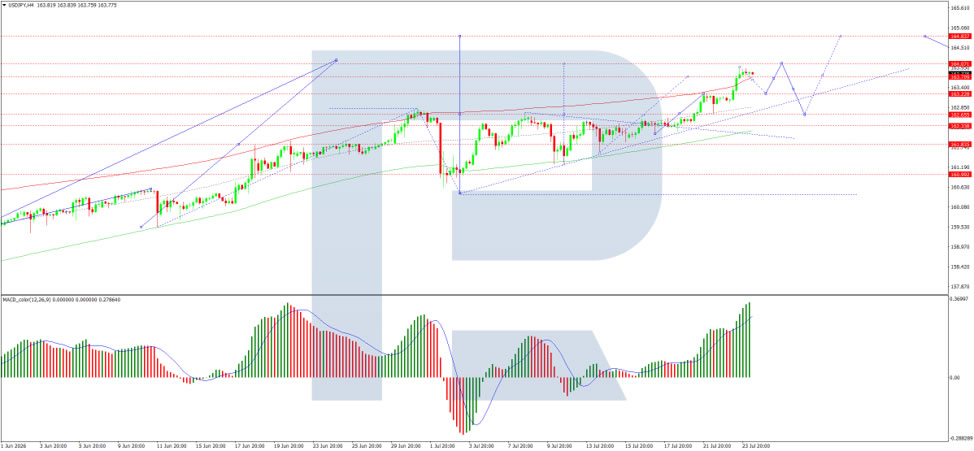
On the H4 USD/JPY chart, the market is forming a consolidation range around the 163.70 level, currently extending between 163.97 and 163.70. It is expected to rise today to 164.27, with room for the trend to extend to 164.84. The MACD indicator supports this scenario, as its signal line is above zero and pointing strongly upward.
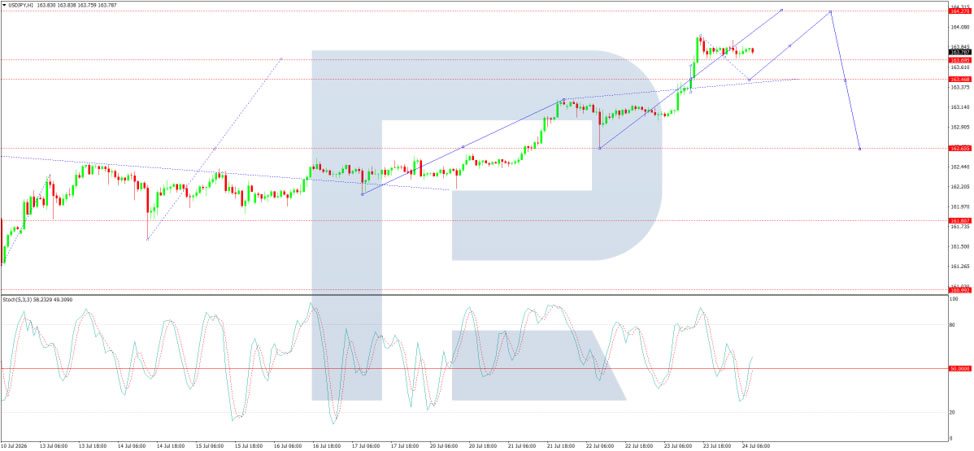
On the hourly chart, the USD/JPY pair completed its downward move to the 163.50 level, with a possible extension towards 163.30. After that, an upward move towards at least 164.30 level is expected. Breaking this level will open the way to continue towards 164.84. The Stochastic indicator confirms this scenario, as its signal line is below the 50 level and pointing down towards the 20 level, indicating the presence of short-term downward pressure before a possible reversal occurs.
conclusion
USD/JPY rose to a 40-year high as the yen remains under pressure amid dollar strength and persistent headwinds. Despite official warnings about potential intervention and indications that the Bank of Japan may tolerate a faster pace of interest rate hikes, markets remain largely unresponsive. The currency continues to face pressure from concerns over fiscal policy, rising tensions in the Middle East, and Japan’s dependence on energy imports. Although domestic inflation accelerated to its highest level in six months, the yen is on track to record its worst weekly performance since May. Technically, further upside towards 164.27-164.84 looks likely, with intervention risks remaining a key factor.



