

The US dollar against the Japanese yen was trading at 159.16 on Friday. The yen is falling slightly, but it appears less weak than before, amid a two-week truce between the United States and Iran. The decline in oil prices after the armistice was announced partly reduced the risks of stagflation and provided some support to the Japanese currency.
Investors are focused on the upcoming talks in Islamabad, where Vice President JD Vance will lead the US delegation. It is expected that the meetings with the Iranian side will clarify the possibilities for further calm.
However, sentiment remains weak. Ongoing strikes in the region and ongoing unrest in the Strait of Hormuz continue to jeopardize the fragile truce, creating market uncertainty.
The yen has been under pressure since the conflict began, losing nearly 2%. Investors are taking into account rising energy prices, which increases inflationary pressures and reduces Japan’s growth expectations.
The market is now awaiting signals from Bank of Japan Governor Kazuo Ueda before the April 28 meeting, which may determine the future direction of monetary policy.
Technical analysis
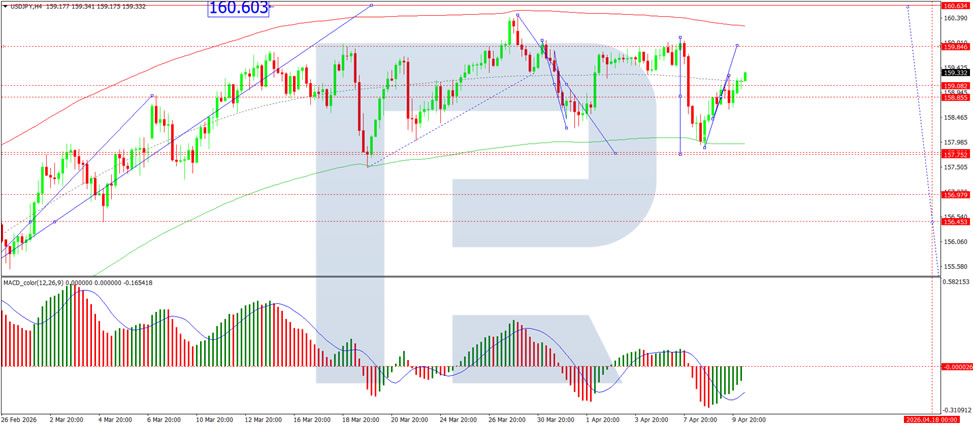
On the H4 USD/JPY chart, the market is forming a consolidation range around the 158.85 level, currently extending to 159.30. Today it is expected to rise towards 159.85 (tested from below). After that, a possible decline towards 157.72 level will be considered. Technically, this scenario is confirmed by the MACD indicator, whose signal line is below zero and points up from lows.
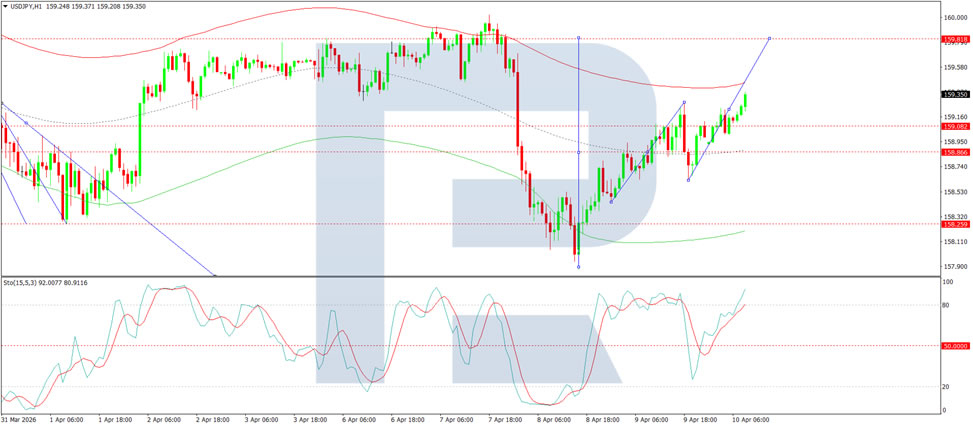
On the H1 chart, the market is forming a wave of growth towards the 159.82 level. It is possible to extend the wave to the level of 160.00. After that, a downward wave to at least 158.85 is expected. Technically, this scenario is confirmed by the Stochastic indicator, whose signal line is below the 80 level and points completely down.
conclusion
The USD/JPY pair stabilized as the yen showed tentative signs of recovery, benefiting from the temporary truce between the US and Iran and the resulting decline in oil prices. However, the fragility of the ceasefire – underscored by ongoing strikes and unrest in the Strait of Hormuz – means that energy-related risks remain very much present. The yen has lost nearly 2% since the conflict began, and the market’s attention is now turning to the upcoming diplomatic talks in Islamabad and BOJ Governor Ueda’s signals ahead of the policy meeting scheduled for April 28. Technically, a short-term bounce in USD/JPY seems likely, but the broader path will depend on whether the calm continues or tensions reignite.



