

As the size of offshore wind columns continues to increase, the erection phase is beginning to emerge as a key consideration in the structural design of jack-up vessels. According to a recent study by GustoMSC, loads generated during lowering a monopole can approach – and in some cases exceed – those associated with extreme survival conditions.
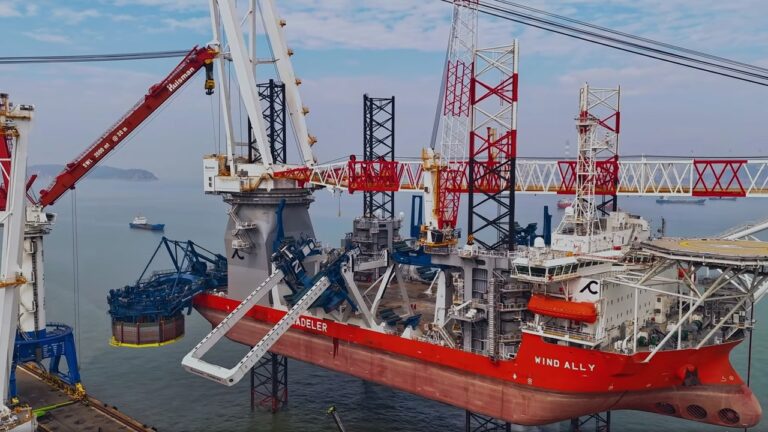
With monocolumn diameters exceeding 10 meters and weights exceeding 2,000 tons, the dynamics of the installation are becoming increasingly complex. The challenge is no longer just about crane capacity. Instead, the interaction between the suspended monopoly and the supporting leverage became the governing factor.
From suspended cargo to double system
During installation, the monopile is lifted from the deck, turned upside down, guided into the gripper, and lowered through the spray zone to the seabed.
The most demanding condition occurs during partial immersion, when the monocolumn remains fully suspended from the crane while being restrained laterally by the gripper.
At this stage, the monocomplex behaves as a hydrodynamically active macrostructure rather than as a passive cargo. As more of the pile enters the water, the forces generated by the wave increase rapidly. Since the monoblock is heavy and flexible, its movements begin to interact dynamically with the movements of the lever.
For large diameter monocolumns, the hydrodynamic loads on the pile can exceed those on the lifting legs themselves, making the monocolumn the dominant source of horizontal loading.
What the study showed
To better understand these effects, GustoMSC analyzed the lowering of a large monocoque vessel from a modern four-legged crane vessel comparable to a Cadeler A-Class vessel.
The study examined monocolumns with a diameter between 10 and 12 meters and weighing up to 2,500 tons at a depth of 40 meters underwater. Different wave durations, directions and sea states were evaluated for installation.
The simulations included structural flexibility of the hoist, lever and clutch arrangement, single-shaft dynamics and hydrodynamic loading.
The results showed that the most critical phase occurred when the monocolumn was submerged by approximately 10 to 15 metres. At this point, much of the pile was exposed to wave action while the full weight remained suspended from the crane.
Under certain wave conditions, the movements of the monopile and the lever reinforced each other, creating dynamic amplification effects.
In the case analyzed, the bending moments at the lower guide reached values 20% higher than those associated with 50-year North Sea survival conditions – even though the sea state itself is relatively mild.
The study also showed that wave direction plays an important role. Some ship heads generate much higher loads because they excite movement around the clutch more effectively.
Installation loads can control the design
The results demonstrate that installation conditions can govern the design of specific structural components.
Foundation reactions at the most loaded leg approached the bearing capacity envelope during the same critical partial submergence phase. The governing load combinations resulted from the interaction between the high vertical crane loads and the large lateral hydrodynamic forces transmitted from the monocolumn.
One major conclusion is that simplified stabilization models may underestimate structural demand if the monoblock is treated as a suspended weight only. Important hydrodynamic interaction effects can be missed.
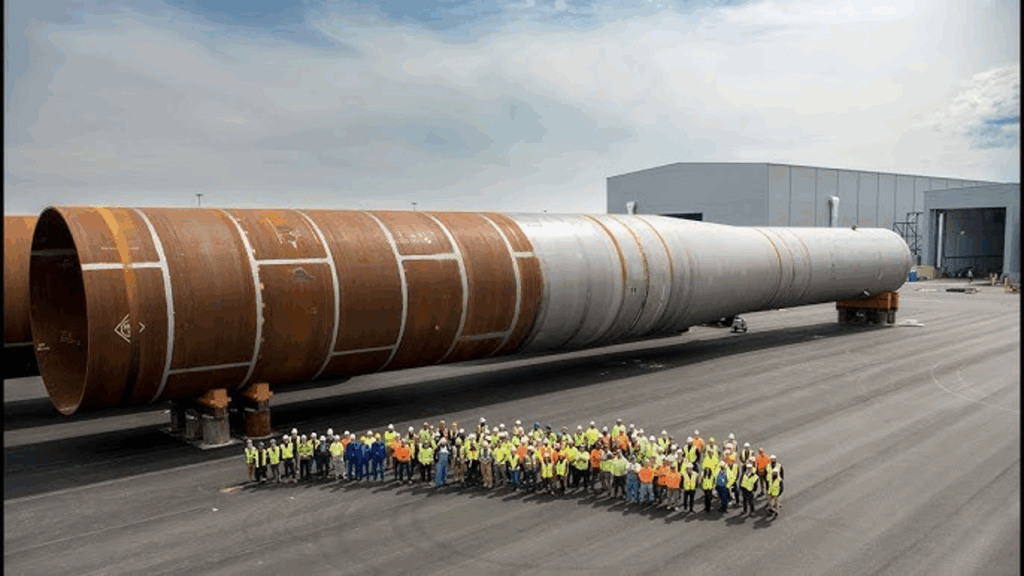
As monoliths continue to grow in diameter and mass, these coupled dynamics will become increasingly important. Larger foundations attract greater hydrodynamic forces, while heavier structures alter the response of the combined bowl-pile system.
For future projects, installation evaluations will increasingly need to consider multiple wave titles, varying inundation depths, structural flexibility, and combined vertical and horizontal foundation loads.
Lowering a monopile across a spray zone can take only minutes, but for next-generation offshore wind foundations, this has become one of the most demanding stages of the entire installation process.
For more information:
www.nov.com/products/engineering-and-consultancy-services
Note: The opinions, beliefs and viewpoints expressed in this article do not necessarily reflect the views of offshore-energy.biz.



