
To get the latest idea, read the article below; Here is the French version.
And watch the video: English | French
There’s a stretch of road in northwest Quebec where the forest seems endless, an undulating sea of spruce and boulders that give away nothing at first glance.
But in the early 1930s, at the height of the Great Depression, a handful of prospectors looked at this same harsh land and saw something else entirely: potential. They will transform a remote area of the Abitibi wilderness into one of Canada’s most legendary gold camps, a place built on risk-taking, resilience and the firm belief that fortune favors those willing to go further.
The timing couldn’t be more desperate. Canada was reeling. Jobs were gone, banks were bankrupt, and men across the country boarded trains heading north and west, or wherever it was rumored that work, or better yet, gold, might be on offer. In the Abitibi region of Quebec, those rumors began to take shape.
This discovery did not come from one dramatic nugget, but through persistence, and a series of discoveries that hinted at something bigger beneath the surface. Prospectors such as Jean-Jacques “Jacques” Sullivan, a powerful Irish-born miner with a nose for opportunity, began laying claim to what would soon become the Val d’Or region.
In 1931, Sullivan and his partners discovered what became the Sullivan Consolidated Mine, one of the first major discoveries in the camp, and close strikes at Lamac, Sigma and elsewhere quickly followed. The pattern was unmistakable. This was camp.
A town is forming
At first, there was little in the place. There are no roads, no electricity, no real infrastructure, just jungle, rocks and a scattering of tents and huts.
Gold accelerated the pace of change, and within a few years, a settlement was reached. Wooden buildings lined the muddy streets, drilling rigs dug into the ground, and supply trucks rolled along the newly carved roads connecting the camp to the railway line at Seneter.
The city took on a name that reflected its promise and ambition: Val d’Or, Valley of Gold. People came quickly, not just miners, but merchants, engineers, cooks, and dreamers. Like Dawson’s decades earlier, it had become a place where fortunes could be made or lost in a single season.
Val-d’Or was distinguished not only by its gold, but also by the people who pursued it. Steadfast and uncompromising, Sullivan became one of the camp’s early pillars, along with businessmen, financiers and geologists, many of them backed by capital from Toronto, the growing nerve center of mining finance that helped turn discoveries into working mines.
Build a camp
At the Lamac mine, one of the richest in the region, underground workings expanded rapidly, producing high-quality ore that justified the effort to build a mine in a remote area.
At Sigma, engineers dug deeper into the gold-bearing veins, extending shafts and improving the underground approaches that would define the camp.
Together these operations made Val-d’Or one of the most important shale gold regions in Canada, an area that would prove to be more than a passing rush and instead a sustainable industrial centre. By the late 1930s, the shift was clear. Val-d’Or is no longer just a camp. It was a city.
Electric lights replaced lanterns. Schools and hospitals followed mines. Railroad and road lines connect the region to the rest of Quebec. What had been a wilderness became one of the country’s most productive gold regions, and unlike many express towns, it has proven durable. Gold necklace.
During the Great Depression, the war years and the decades that followed, the mines continued to produce. Workers went underground not for a quick strike, but for fixed wages, a rarity in those turbulent times.
Styles changed as the camp matured. Hand-digging steel and mule-drawn ore gave way to mechanization, deep shafts and more sophisticated processing as exploration spread outward across the Abitibi greenstone belt, one of the richest gold regions on Earth.
The camp became a training ground for generations of miners, engineers and geologists, many of whom went on to shape projects across Canada and around the world.
Permanent camp
Over time, a different type of operator emerged, focusing less on discovery and more on extending the life of the mine. Companies like Agnico Eagle Mines (TSX, NYSE: AEM) have come to define this next phase. Although he was not among the original pioneers of Val-d’Or, Agnico Eagle became one of the dominant forces in Abitibi and beyond, operating across the same gold-rich belt that gave rise to the camp.
Its Goldex mine, located just outside the city, is a direct link to Val d’Or’s mining tradition, while operations such as La Ronde and Canadian Malartic cement the wider region as one of the world’s most prolific gold regions. While early prospectors proved the presence of gold, Agnico Eagle and its peers showed they could endure.
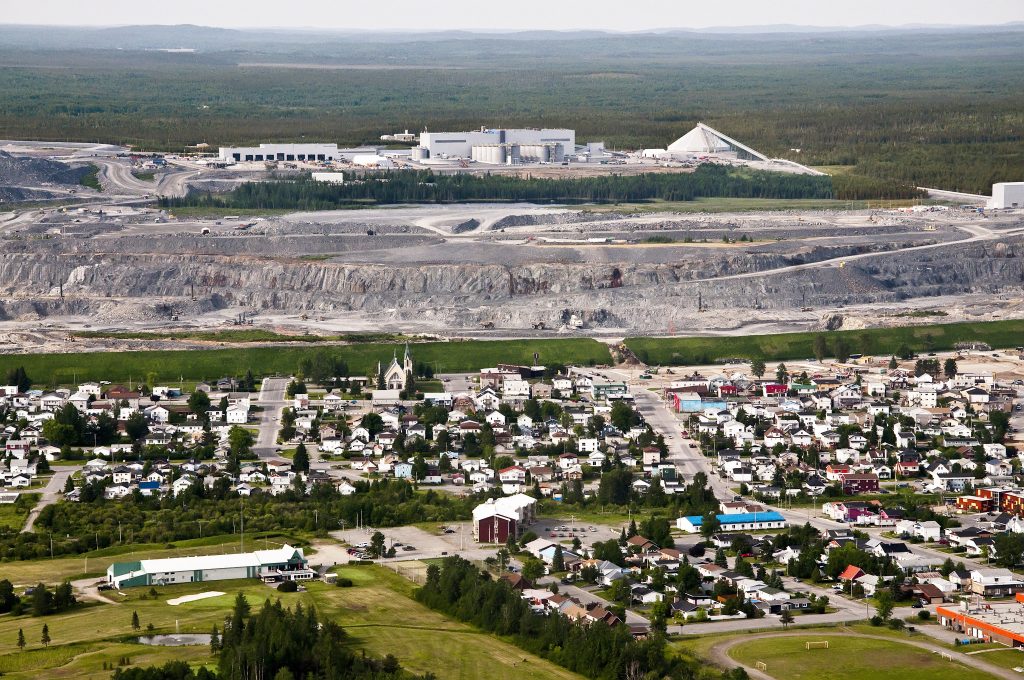
Today, Val-d’Or remains a cornerstone of Canadian mining, with modern operations, including revived and expanded projects around the historic Lamaque and Sigma mines, continuing to produce from the same geological structures identified nearly a century ago.
But the true legacy of Val-d’Or isn’t just about ounces, it’s about endurance. Like Dawson, Val-d’Or bears the imprint of prosperity and renewal, and like the Golden Triangle, it reflects the tenacity of those who delve into the unknown. As in Argentina, in Newfoundland, it appears that even when the first dream fades, something permanent can still take its place.
The road to Val-d’Or today does not lead to a ghost town or a relic of the past. It leads to a living city, still unmistakably linked to the rock beneath it. Head structures rise above the horizon, base huts buzz with activity, and trucks weave in and out carrying the next chapter in a story that began in the darkest of times.
Nearly a century later, this foundation still stands.
810-419-227
Source link



