
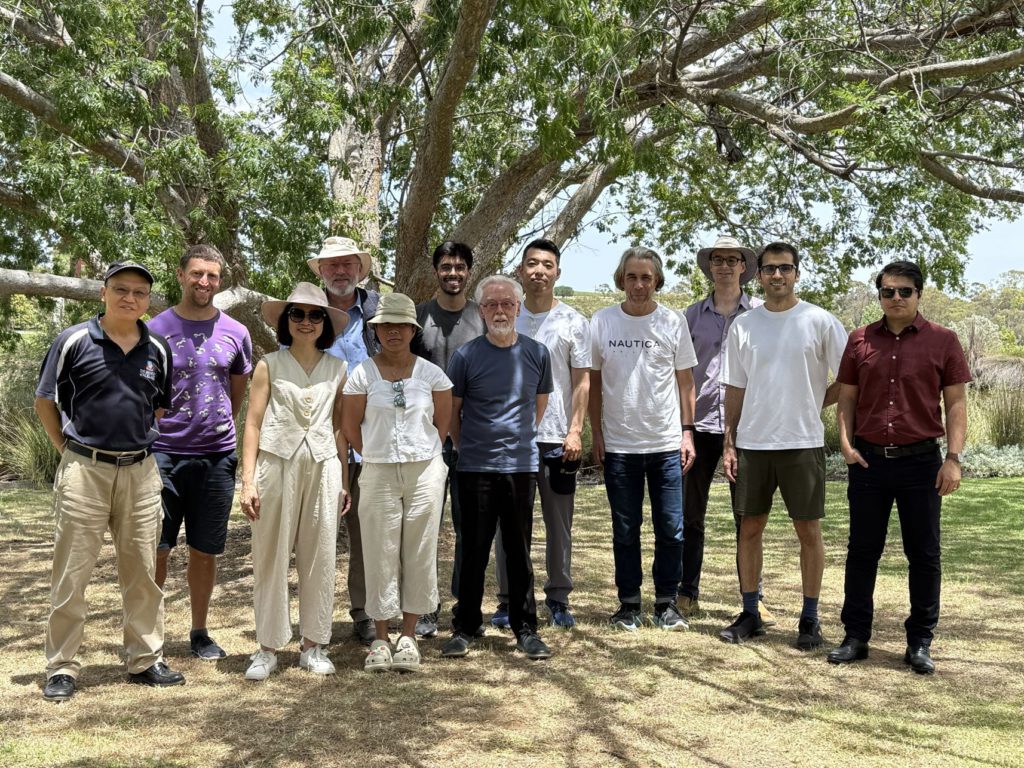
Australian researchers have completed the development of four cutting-edge mining technologies that promise to change how companies extract and process resources, with each innovation now ready for immediate deployment in industry.
The Australian Research Council Training Center for Integrated Operations for Complex Resources has moved beyond laboratory verification to provide practical solutions that address the real operational challenges facing modern mining operations. The research team is now looking for industry partners willing to trial these technologies in live mining environments.
Advanced sensor systems target real-time decision making
Dr. Sultan Abu Al-Khair has developed rapid body knowledge update systems that integrate sensor data with structural information to provide miners with real-time resource model updates. His technology addresses a critical gap in the industry where traditional methods leave significant delays between data collection and operational decision-making.
Pouya Nobahar has created AI-based mine-to-mill optimization systems that link resource properties directly to downstream processing and financial performance. His approach dramatically reduces computational time from the industry standard of two days for a million scenarios to just 10 minutes.
Ahmad Reza Khodayari focused on cave point cloud processes and fragmentation sensing systems that optimize particle size distribution. Its physics engine approach reduces simulation time from 2.5 months to one week with the potential to increase crusher energy efficiency by 20 to 25 percent.
Dr. Akhil Kumar has developed a protein-based gold biosensor technology that provides environmentally friendly, real-time detection of gold presence and concentration. His system provides a faster and more efficient alternative to expensive X-ray methods and time-consuming off-site laboratory analyses.
Industrial cooperation drives technology transfer
Professor Peter Dodd, Director of the Training Center and Professor of Mining Engineering at the University of Adelaide, confirmed that these projects have passed the conceptual stages and are ready for implementation on the ground.
“These are not early-stage concepts,” Professor Dodd said. “It has been developed to solve real operational challenges and is ready for deployment in partnership with industry.”
Professor Dodd stressed that successful technology transfer now depends on finding forward-thinking industrial partners willing to test these innovations in operational environments.
“The capacity is there, validation has been completed, and we are looking for forward-looking partners who are ready to trial and deploy these technologies in operational environments,” Professor Dodd said. “For the resources sector to remain successful, it must be prepared to evaluate and deploy new technologies. Companies that participate now will not only enhance their own operations, but will help shape the future competitiveness of our industry.”
Researchers target integrated solutions
The research team began exploring ways to integrate their individual innovations into integrated systems that maximize operational impact. Since the training center began operations in 2021, it has completed 16 doctoral projects and three postdoctoral research programs focusing on automated, integrated and improved mining systems.
“We are excited to trial our technology and further demonstrate its value to our industry partners,” Noubhar said. “Current platforms take two days to calculate a million scenarios. Using the AI-based mine-to-mill optimization system, this time has been reduced to 10 minutes.”
Dr. Kumar highlighted the environmental advantages of his biosensor technology along with its operational benefits.
“Our protein-based biosensor technology provides environmentally friendly, real-time detection of gold presence and concentration,” said Dr. Kumar. “Our system is a faster and more efficient alternative to expensive and time-consuming X-ray and off-site laboratory methods. Our core value proposition allows miners to save significant resources by avoiding processing non-gold ore.”
Khodayari stressed the significant financial benefits that his hash optimization technology can bring to mining operations.
“The simulation time to relate particle size to material flow has been significantly reduced from 2.5 months to one week by pioneering the use of physics engines for mining simulation,” Khodayari said. “Improving particle size is expected to increase the energy efficiency of crushers by 20 to 25 percent, providing significant financial benefits.”
The integration approach accelerates commercial deployment
Dr. Abu Al-Khair noted that although the research projects began independently, the team now sees opportunities to create integrated solutions that multiply their individual benefits.
Dr Abu Al-Khair said: “Our original doctoral research projects were developed independently of each other, but we are now exploring integrating the projects at the intersection to deliver a system that achieves maximum impact.” “Our technology focuses on instantly updating resource knowledge and models to capture the full value of smart sensors, addressing a significant gap in the mining industry.”
Professor Bill Skinner, who leads the mineral processing research topic, credited the training center’s integrated structure with accelerating the path from research to practical deployment.
“By aligning research directly with operational reality, we have helped significantly shorten the path from innovation to application,” Professor Skinner said.
Additional technologies are approaching commercial readiness
The training center expects that additional innovations from its research pipeline will reach the stage of readiness for commercialization in the coming months. The program has established partnerships with major mining companies and technology providers including BHP, Orica, Maptek and Rockwell Automation to ensure that research results meet real industry needs.
The Center’s collaborative approach connects doctoral students and postdoctoral researchers directly with technology innovators and industry practitioners. This structure enabled rapid validation of concepts and accelerated the transition from laboratory testing to field-ready applications.
Industry partners sought pilot programs
Mining companies, mining equipment technology and service organizations and technology partners can now partner with the Training Center for pilot programs and collaborative trials. The research team provides detailed technical briefings on each of the four technologies and welcomes discussions on customizing solutions for specific operational environments.
The training center will formally conclude its funded research program in August 2026, but multiple technologies will continue to move into industry trials and commercial deployment through ongoing partnerships after the formal term of the program ends. Companies interested in pilot programs or technical briefings can contact the Training Center at iocr@adelaide.edu.au.
The Australian Research Council Training Center for Integrated Operations for Complex Resources received funding in 2019 and commenced operations in 2021 to position Australia as a global leader in advanced data-driven mining. The Center operates within the School of Chemical Engineering at the University of Adelaide and includes collaboration with Curtin University and the former University of South Australia, which has now been merged within the University of Adelaide.
Research and industry partners include BHP, Bureau Veritas, Dassault Systèmes, Magotteaux, Manta Controls, MZ Minerals, Orica, PETRA, Rockwell Automation, RoqSense, Scantech International, RESA, Maptek, Veracio and MatrixGroup.
More information is available at www.Iocr.com.au
Source link



