

- The second-quarter earnings come at a sensitive time both geopolitically and for the technology sector.
- Artificial intelligence and chip stocks face scrutiny as Wall Street fluctuates
- Are AI forecasts still optimistic or are fears of a bubble justified?
Hyperscalers vs. enablers
Q2 earnings season is here, with Tesla and Alphabet kicking things off in the tech sector on July 22. And artificial intelligence (AI) stocks appear poised to dominate the season once again. But this time, the focus is as much, if not more, on AI enablers as it is on super-scaling tools. Specifically, semiconductors were the biggest gainer in the second quarter, with its shares rising to all-time highs.
The growing demand for AI data center infrastructure has proven to be a boon for chip makers as well as other manufacturers of data center equipment. These so-called AI enablers directly benefit from all the AI spending by super-fast companies like Microsoft, Alphabet, Amazon, Meta, and Oracle.
While there is a big question mark over whether all of the AI investments will pay off for Wall Street’s top brass, the earnings potential for the beneficiaries of this spending is a sure bet. Hence, investors have been turning towards chipmakers over the past few months, while losing enthusiasm for usual favorites like Magnificent Seven (M7).
Semiconductor boom
The Philadelphia Semiconductor Sector Index, which measures the 30 largest publicly traded companies in the U.S. that design and manufacture semiconductors, rose nearly 88% in the second quarter. By comparison, the broader technology index — the Nasdaq 100 — was up 27.5%, while the S&P 500 was up nearly 15%.
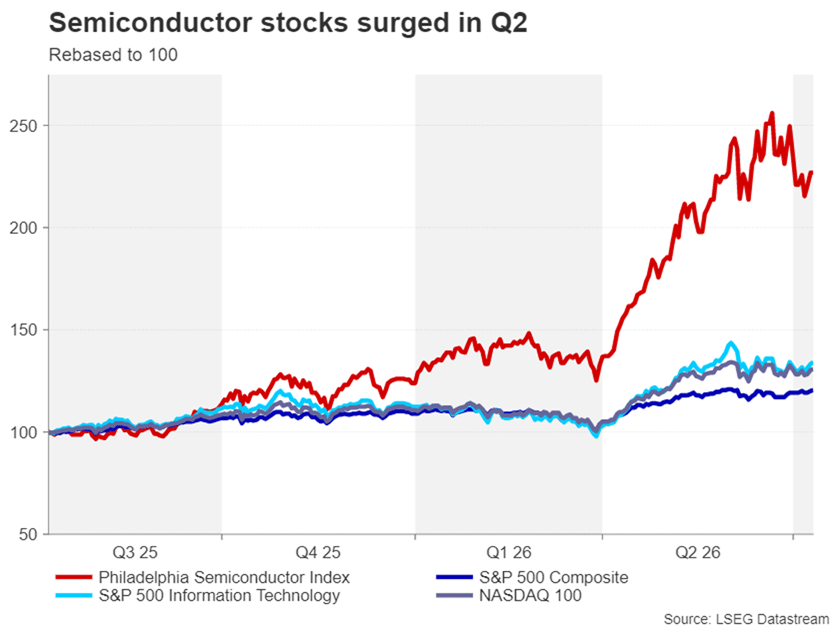
The rise of chips has created new trillion-dollar companies, most notably Micron Technology and SK Hynix. Interestingly, the performance of shares of AI and chip giant Nvidia has been more in line with that of broader indices than that of the semiconductor gauge, as the company fell into the AI craze much earlier than its smaller rivals, and its rise has begun to slow recently.
As Q2 earnings season approaches, excitement is building for major chip stocks following bumper earnings reported in the first quarter. The challenge is whether they will be able to maintain similar revenue growth while maintaining bullish expectations for the coming quarters.
Chip stocks lead the way
However, for traders, the risk is that triple-digit growth in the first quarter will be difficult to follow, so the scope for additional gains may be limited. Among the winners, South Korea’s Sandisk, Micron Technology and SK Hynix topped the leaderboard, while Meta, Oracle and Microsoft found themselves at the bottom of the table.
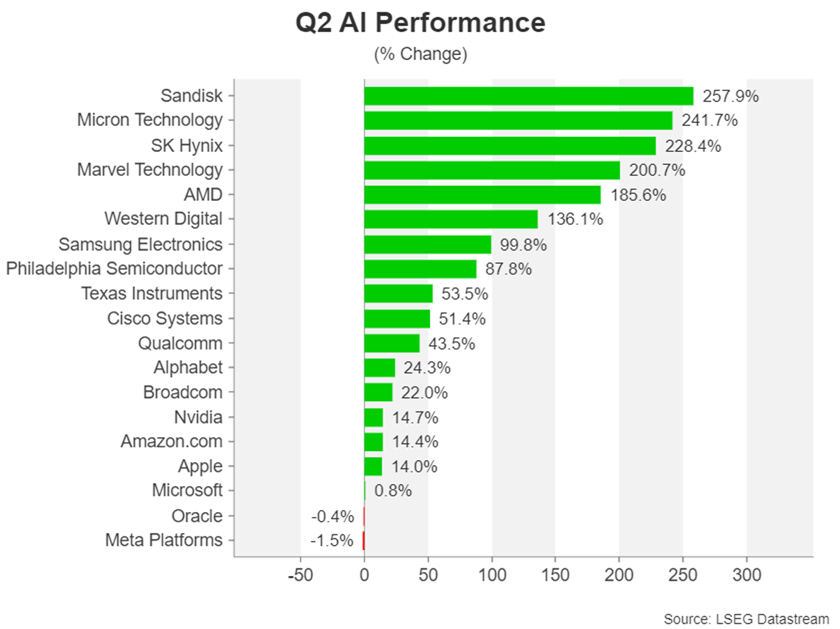
Although Oracle is not considered part of the big technology companies, concerns about its spending plans and balance sheet are overshadowing its healthy earnings growth, as well as the prospects of other companies with significant expansion. For Meta and Microsoft, there are growing doubts about their AI ambitions and earnings potential, which don’t stack up well when compared to M7 peers like Alphabet and Amazon.
Going forward, the key questions for investors are: Is the strong demand holding up? How much optimism is already priced into these stocks? Will the scarcity of memory and storage chips decrease?
Rosy forecast
The outlook is definitely on the optimistic side. According to FactSet, the S&P 500’s information technology (IT) sector earnings growth is estimated at 63.3% year-over-year for the second quarter, the second highest rate after the energy sector (122.9% year-over-year).
In the IT sector, semiconductors are doing much of the heavy lifting as its expected earnings growth of 131% far outpaces that of other subsectors.
Aside from the energy and IT sectors, materials are the only other sector expected to achieve faster earnings growth than the entire S&P 500, which is expected to reach 23.6%.
While the energy sector had a bumper quarter due to the jump in oil and gas prices due to the US-Iran war, the AI boom has begun to spread beyond IT, boosting the materials sector. Specifically, companies involved in mining and production of raw materials such as metals enjoy strong demand from huge spending on data center infrastructure.
Non-technology sectors may face difficulties
The outlook for other sectors is not as optimistic, with only utilities expected to achieve earnings growth of more than 10%. However, the S&P 500 is on track for its second straight quarter of 20% earnings growth, and its seventh quarter of double-digit growth.
This is an impressive run considering the trade war in 2025 and the conflict in the Middle East in just the last quarter. But will traders like it? Many valuations are already at extremely excessive levels, drawing comparisons to the dot-com bubble of the late 1990s.
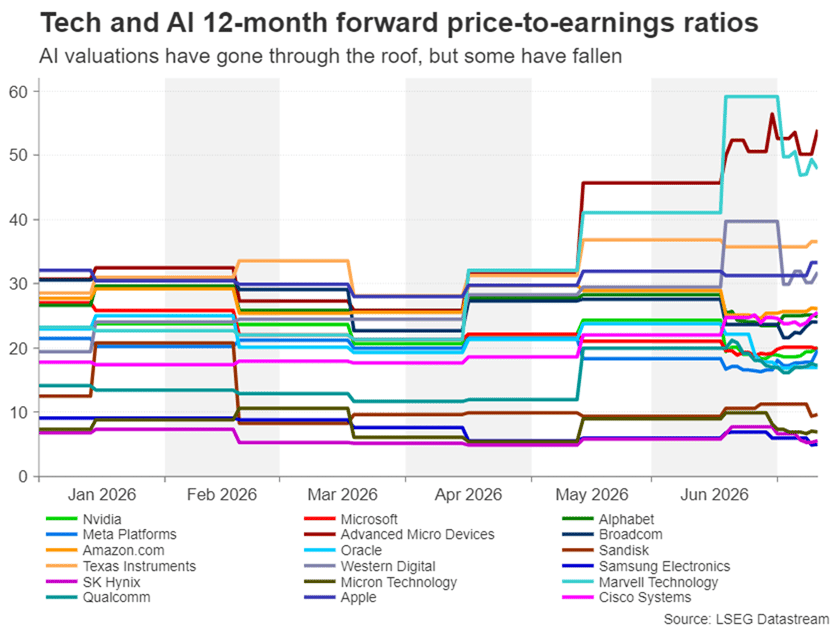
Elon Musk’s Tesla and UK chipmaker ARM Holdings have forward P/E ratios of 177 and 135, respectively, while Intel’s P/E ratio is 82.5, all well above the S&P 500 average of just over 22. However, some P/E ratios have fallen, such as Nvidia’s, and there are several chip stocks that are still below that. 20 P/E, even after the recent rise.
Room for growth?
This suggests that if actual earnings match expected results over the coming quarters and expectations remain positive, there is room for much larger gains for these stocks before they become significantly overvalued.
These companies include Micron Technology, Qualcomm, SanDisk, Broadcom, Texas Instruments, and Western Digital, all of which have benefited from the explosion in new data centers. The massive increase in demand has led to a shortage of memory and storage chips, pushing up gross margins for major producers. But other companies like Advanced Micro Devices and Marvell Technology look somewhat overvalued with P/Es in the 50s.
However, with renewed concerns about the sustainability of the AI boom sparking a sell-off in chip stocks, depressed valuations could represent a buying opportunity, even for some of the more expensive stocks. However, many traders may prefer to stay put until they get a glimpse of what the new earnings season holds for the AI industry and the changing dynamics within it.
Mixed evaluations
Investors are no doubt hoping to see continued double-digit earnings growth in the second quarter as well as upbeat guidance for the next few quarters. Any signs of slowing revenue growth are likely to unnerve markets. But it is important to highlight that the risks are different for hyperscalers and enablers.
The main concern for hyperscalers is that the record amount of capital spending being pumped into AI is not delivering a satisfactory return on investment, especially for those who completely deplete their cash flows or resort to issuing new debt to fund their AI ambitions.
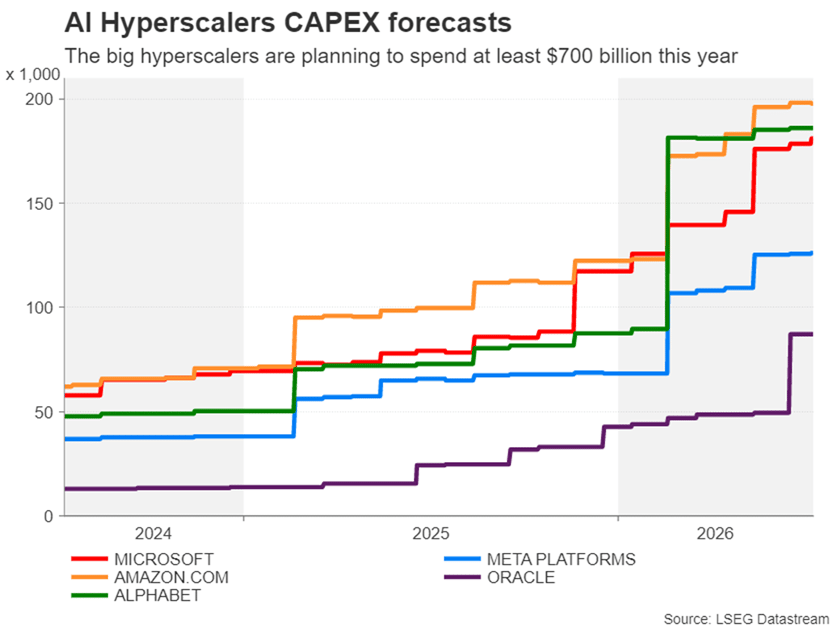
The scarcity of memory chips and other AI components is also a problem for hyperscalers, posing a double challenge, as it not only limits supply but also drives up costs. Companies like Apple and Microsoft have even had to raise prices on some of their products, as margins have come under pressure. But for the enablers, it’s the windfall that sent their shares soaring.
Risks to expectations
This does not mean that chip and AI equipment manufacturers are not vulnerable to shortages along the supply chain. In addition, chipmakers risk overinvesting as they seek to expand production, which could lead to a supply glut in the future.
Another risk facing chipmakers is if the White House decides to ease restrictions on Chinese memory chips — something Apple has been lobbying the Trump administration for, alleviating a supply crunch and putting pressure on margins.
Beyond AI-related developments, which are constantly evolving, there is the turbulent geopolitical landscape, amid ongoing US-Iran tensions that are increasing inflationary pressures by squeezing energy flows from the Gulf, and a more uncertain period for Fed policy, with the return of interest rate hikes on the horizon. The above has increased the risk of an economic slowdown in the United States and the world. The severe economic pain makes it likely that big AI spenders will tighten their financial constraints at some point, doing the most harm to AI enablers.
One might wonder, will Nvidia also be affected by the reduction in investment in AI? After all, the company has an order backlog worth $1 trillion. But this has certainly already been priced into its share price, so the answer is probably yes.
The AI industry: It’s complex
However, it is important to keep in mind that not all chip makers are the same. Each serves a specific purpose within the processor architecture and semiconductor supply chain and will therefore be affected differently by AI titles. Add to the mix hyperscalers from major tech companies and their various fundamentals and the picture becomes even more complex.
One positive consequence of this is that it allows investors to rotate within the broader technology sector as demand and industry trends change. This pattern peaked in the second quarter, and while it makes it more difficult to predict which direction AI stocks will head, it’s a reminder that much of the AI industry is still in its infancy.
The second quarter earnings season will likely go little way to clarifying all of this, but will nonetheless be crucial in determining short- to medium-term momentum in AI trading. One thing that is becoming more certain is that technology and AI stocks are more susceptible to large daily fluctuations, which calls for more caution when trading them.



